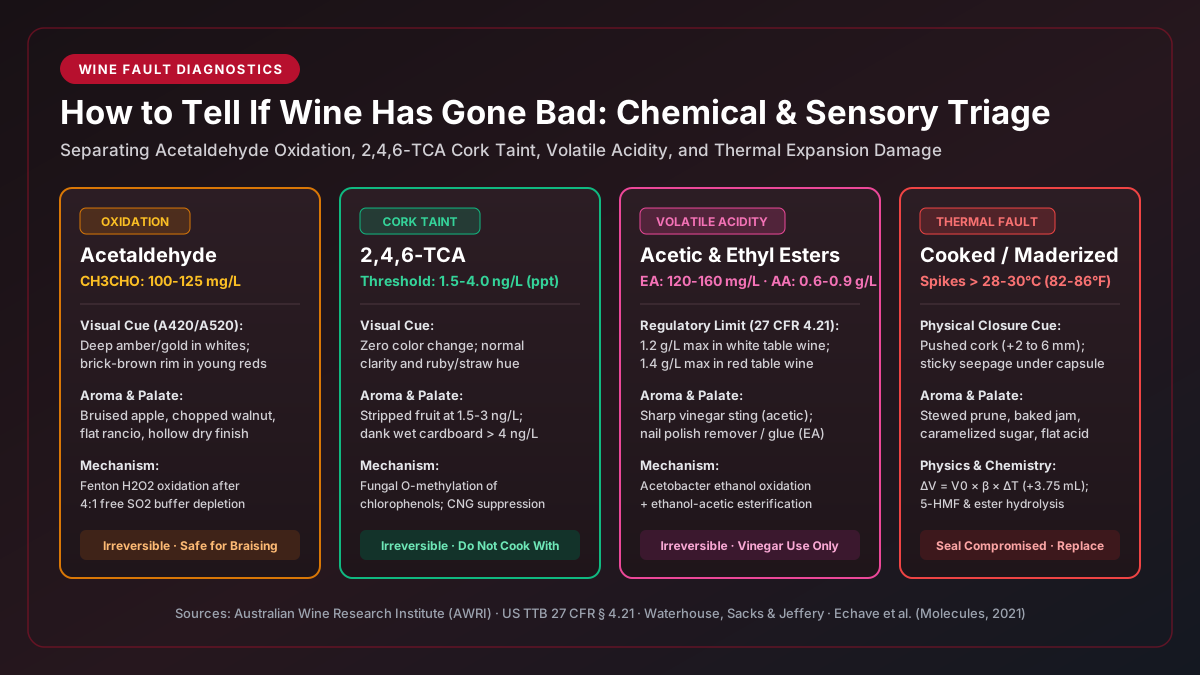
A wine has gone bad when closure failure, oxygen ingress, microbial metabolism, haloanisole contamination, or heat damage above 28 to 30 °C pushes off-aroma compounds past their sensory detection thresholds or browns the liquid core. Misdiagnosing a fault risks wasting sound aged bottles that merely contain harmless potassium bitartrate crystals or ruining a pan sauce by cooking with a 2,4,6-trichloroanisole (TCA) cork-tainted wine that concentrates dank cardboard odors under heat.
Because commercial table wine carries a low pH (3.0 to 3.8), 11% to 15% ABV ethanol, polyphenolic tannins, and sulfur dioxide (SO2), spoiled wine does not support human foodborne pathogens. Determining whether an unopened bottle held in storage or a bottle resealed after opening has deteriorated requires separating physical closure failures, spectrophotometric color shifts, and volatile chemical markers across seven distinct fault families.
| Fault Category | Primary Causal Compound | Sensory Recognition Threshold | Visual & Closure Indicator | Characteristic Odor & Palate Profile | Reversibility & Culinary Action |
|---|---|---|---|---|---|
| Oxidation | Acetaldehyde (CH3CHO), sotolon, phenylacetaldehyde |
100-125 mg/L in table wine (20-40 mg/L sound baseline) |
Deep amber/gold in white wine; brick-red or tawny-brown rim in red wine | Bruised green apple, chopped walnut, bitter almond, flat Sherry rancio; hollow dry palate | Irreversible; mild cases usable in marinades or vinegar |
| Volatile Acidity (VA) | Acetic acid (CH3COOH) & ethyl acetate (CH3COOCH2CH3) |
600-900 mg/L acetic acid; 120-160 mg/L ethyl acetate |
Often paired with oxidative browning or low fill level (ullage) | Sharp vinegar sting on finish (acetic acid); pungent nail polish remover or model glue (ethyl acetate) | Irreversible; discard if acetone-like, or divert to vinegar |
| Cork Taint (Haloanisoles) | 2,4,6-Trichloroanisole (2,4,6-TCA) & 2,4,6-TBA |
1.5-4.0 ng/L (parts per trillion, ppt) |
Zero color change; clarity and ruby or straw hue remain normal | Muted, fruit-stripped palate at 1.5-3.0 ng/L; wet cardboard, damp newspaper, moldy cellar above 4.0 ng/L |
Irreversible; never use for cooking (heat concentrates TCA) |
| Thermal / Heat Damage | 5-Hydroxymethylfurfural (5-HMF), furfural, hydrolyzed esters |
Triggered by sustained > 25 °C or spikes > 28-30 °C |
Cork pushed 2-6 mm above lip; sticky wine seepage tracks under capsule |
Stewed prunes, baked jam, caramelized brown sugar, roasted marshmallow; flat, soupy acidity | Irreversible seal breach; return unopened retail bottles |
| Reductive Sulfur (VSCs) | Hydrogen sulfide (H2S), methanethiol (CH3SH), ethanethiol |
1.0-1.6 µg/L (H2S); 1.1-3.1 µg/L (mercaptans) |
Normal color; most frequent under low-OTR tin-lined screw caps | Rotten eggs, struck match (H2S); burnt rubber, skunk, stagnant garlic, or boiled cabbage (mercaptans) |
Mild H2S often blows off after 15-30 min decanting; mercaptans persist |
| Brettanomyces Phenols | 4-Ethylphenol (4-EP) & 4-ethylguaiacol (4-EG) |
368-605 µg/L (4-EP); 33-110 µg/L (4-EG) |
Normal appearance; primarily affects barrel-aged red wines (pH > 3.7) |
Adhesive Band-Aid, antiseptic hospital gauze, horse stable, wet leather (4-EP); smoky clove or bacon (4-EG) |
Irreversible; do not reduce in cooking sauces |
| Bottle Refermentation | Dissolved CO2 plus lactic/yeast metabolites (diacetyl) |
> 1.0-1.5 g/L dissolved CO2 in still table wine |
Popped cork, milky opalescent haze, pinpoint CO2 bubbles on glass wall |
Prickly carbonation fizz on the tongue in a still wine; sour buttermilk or sauerkraut notes | Irreversible microbial instability; discard bottle |
The 3-Step Bottle, Visual, and Olfactory Diagnostic Protocol
Evaluating a suspect bottle follows a strict physical-to-chemical sequence: inspect the closure and neck seal before pulling the cork, assess color and clarity at a 45-degree tilt against a white surface, and separate fruit-stripping haloanisoles from overt oxidative or microbial off-odors in the glass headspace.
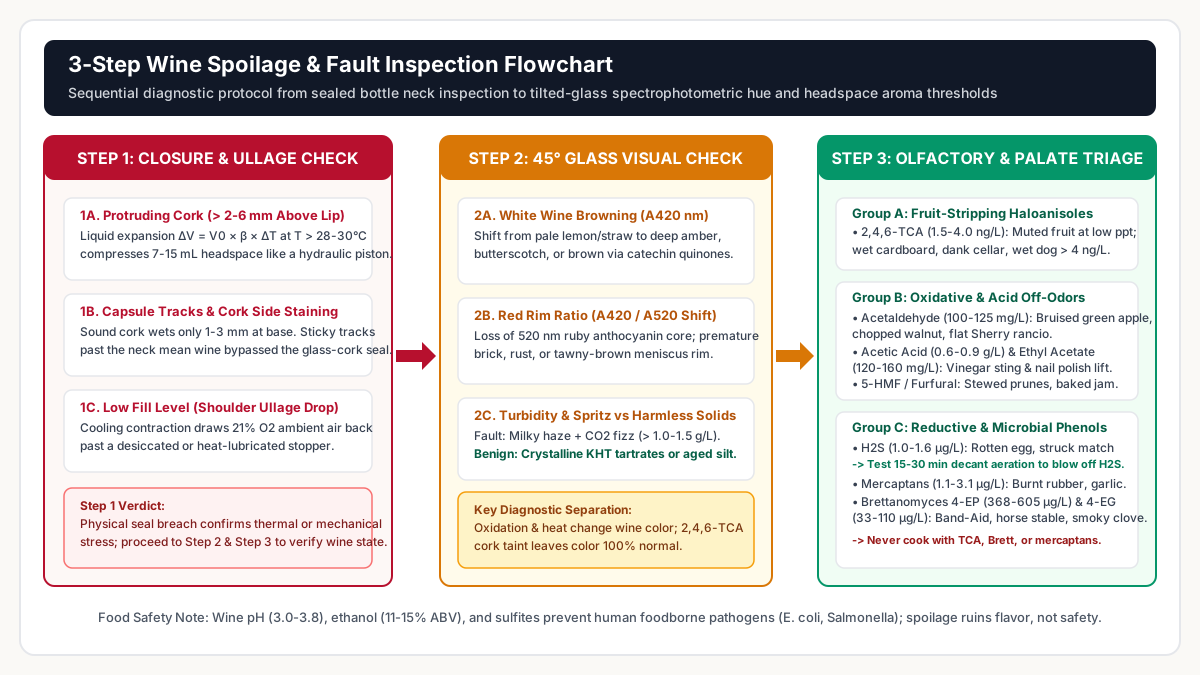
Step 1: Inspect the Capsule, Cork Seating, and Ullage Before Opening
Physical inspection of a sealed bottle reveals how the package responded to storage temperature and humidity before you taste a drop:
- Protruding or raised stopper: Remove or cut below the foil capsule and check the top of the cork relative to the glass lip (finish). A cork pushed
2 to 6 mmabove the rim signals internal hydraulic pressure from heat expansion above28 to 30 °C(82 to 86 °F) or carbon dioxide buildup from unintended refermentation. - Longitudinal wine staining and seepage: On a sound cork-sealed bottle, liquid wine wets only the bottom
1 to 3 mmof the cork face. Dark, sticky dried crust on the top of the cork or wine tracks running all the way up the side of the bark indicate that wine was forced past the glass-cork interface. - Excessive ullage (low fill level): In a standard
750 mLbottle, the headspace gap between the bottom of the cork and the wine meniscus at bottling is typically7 to 15 mL(about10 to 20 mmof linear height in the cylindrical neck). If the fill level has dropped into the lower neck or shoulder in a wine under 5 years old, evaporation and chronic seal failure have allowed ambient air (21% O2) into the bottle.
Step 2: Evaluate Color Browning (A420 / A520) and Clarity at a 45-Degree Tilt
Pour 60 to 90 mL into a clean, clear glass and tilt it at a 45-degree angle over a sheet of white paper. Look at two zones: the central core and the thin outer meniscus (rim).
In enological analysis (Waterhouse, Sacks & Jeffery; Echave et al., 2021), visual oxidation is quantified by light absorbance at 420 nm (yellow-brown pigments) relative to 520 nm (red monomeric anthocyanins):
White Wine Browning Index = A420 (absorbance at 420 nm in a 10 mm optical path)
Red Wine Color Hue Ratio = A420 ÷ A520- White wines: Sound young white wines absorb minimally at
420 nm(A420typically0.08 to 0.18), appearing pale straw, lemon-green, or light gold. When dissolved oxygen triggers ortho-diphenol oxidation, catechin and epicatechin polymerize into yellow-brown xanthylium cations and quinone polymers, drivingA420above0.35 to 0.60and turning the wine deep amber, butterscotch, or dull brown. - Red wines (worked numerical example): A young, sound Pinot Noir or Sangiovese typically exhibits
A420 = 1.40andA520 = 2.50, yielding a Hue Ratio of1.40 ÷ 2.50 = 0.56and a vibrant ruby-purple rim. If a failed closure or an uncorked week on a warm counter oxidizes the monomeric malvidin-3-glucoside anthocyanins and forms brown tannin polymers, absorbance shifts toA420 = 2.30andA520 = 1.60, pushing the Hue Ratio to2.30 ÷ 1.60 = 1.44. Visually, the ruby core collapses into a dull brick-red, rust, or mahogany-brown meniscus. - Clarity and gas nucleation: Check whether the liquid is bright or milky. A cloudy, opalescent haze combined with tiny pinpoint
CO2bubbles clinging to the glass bowl in a still wine indicates microbial refermentation. By contrast, heavy crystalline granules that sink immediately to the bottom of the glass are benign tartrates, covered in our guide to what wine sediment is made of.
Step 3: Swirl and Separate Olfactory Taints from Overt Off-Odors
Swirl the glass for 5 to 10 seconds to volatilize aroma compounds into the headspace and take a short ortho-nasal sniff. Wine faults split into two sensory categories:
- Fruit-stripping taints (
2,4,6-TCA): Haloanisoles suppress olfactory receptor signaling directly. At low concentrations (1.5 to 3.0 ng/L), the wine may not smell overtly moldy; instead, it smells completely blank and muted, as if all varietal fruit has been stripped away leaving only sour acid and bitter tannin. Above4.0 ng/L, the dank wet cardboard and moldy newspaper odor becomes unmistakable. - Overt additive off-odors: Oxidation, volatile acidity, reduction, and Brettanomyces add distinct chemical aromas on top of the wine: bruised green apple (
acetaldehyde), nail polish remover (ethyl acetate), sharp vinegar (acetic acid), rotten eggs (H2S), or adhesive Band-Aid (4-ethylphenol).
Oxidized Wine Smell vs. Corked Wine vs. Volatile Acidity
Consumers frequently use “corked” as a catch-all term for any spoiled bottle, but oxidation, cork taint, and volatile acidity originate from completely different chemical pathways and operate at concentration thresholds separated by eight orders of magnitude.
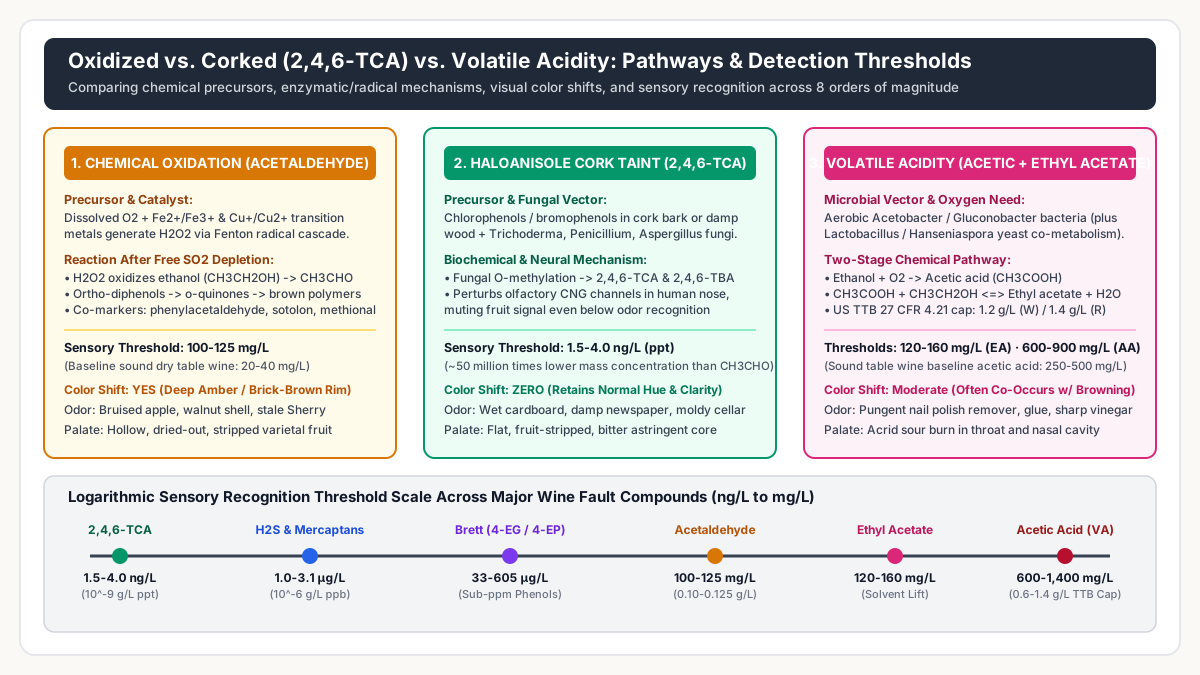
1. Chemical Oxidation: Fenton Radicals and Acetaldehyde (100 to 125 mg/L)
Oxygen gas (O2) in its ground triplet state does not react directly with ethanol or tartaric acid at room temperature. Instead, as documented in Understanding Wine Chemistry (Waterhouse, Sacks & Jeffery), oxygen reacts first with reduced transition metal ions present in wine (Fe2+ and Cu+), oxidizing them to Fe3+ and Cu2+ while reducing oxygen into hydroperoxyl radicals (HO2•). Those radicals oxidize ortho-diphenols (such as caffeic acid, catechin, and epicatechin) into reactive ortho-quinones and generate hydrogen peroxide (H2O2).
As long as the wine retains sufficient free bisulfite (HSO3-), the bisulfite scavenges H2O2 and reduces ortho-quinones back to phenols. Once free SO2 is exhausted, H2O2 reacts with Fe2+ (the Fenton reaction) to generate hydroxyl radicals (•OH) that oxidize ethanol (CH3CH2OH) directly into acetaldehyde (CH3CHO).
- Concentration threshold: Sound dry table wines contain
20 to 40 mg/Lof bound and free acetaldehyde. Once free acetaldehyde crosses100 to 125 mg/L, it dominates the headspace with aromas of bruised green apple, chopped walnut shell, wet hay, and flat Sherry-like rancio. - Co-occurring oxidative markers: Alongside acetaldehyde, strecker degradation of amino acids forms methional (boiled potato or cooked cabbage at
~50 µg/L) and phenylacetaldehyde (wilted rose and honey), while aldol condensation in oxidized white wines generates sotolon (curry leaf, fenugreek, and stale maple syrup at15 to 25 µg/L).
2. Haloanisole Cork Taint: 2,4,6-TCA (1.5 to 4.0 ng/L)
Unlike oxidation, cork taint has nothing to do with oxygen exposure after opening. It is caused by 2,4,6-trichloroanisole (2,4,6-TCA) and related haloanisoles such as 2,4,6-tribromoanisole (2,4,6-TBA). Filamentous fungi (Trichoderma, Penicillium, Aspergillus, and Fusarium species) inhabiting natural cork bark lenticels or damp cellar timber detoxify environmental chlorophenols and bromophenols via enzymatic O-methylation into non-polar haloanisoles.
- Parts-per-trillion potency: According to Australian Wine Research Institute (AWRI) sensory panels, the human recognition threshold for
2,4,6-TCAin table wine is1.5 to 4.0 ng/L(parts per trillion, ppt), roughly 50 million times lower by mass than the100 mg/Lthreshold of acetaldehyde. A single drop (0.05 mL) of pure TCA could taint more than 20 million standard750 mLbottles. - How to separate cork taint from oxidation instantly: Look at the wine color and check when the bottle was opened. A corked bottle smells musty or fruit-stripped the moment the cork is pulled, and its color remains 100% normal. An oxidized bottle changes color toward amber or brown and worsens progressively over hours or days of air exposure. Furthermore, as detailed in our analysis of whether screw-cap wine can be corked,
2,4,6-TCAor2,4,6-TBAcan also enter screw-cap bottles via contaminated oak barrels, filter pads, or cellar wood before bottling.
3. Volatile Acidity (VA): Acetic Acid and Ethyl Acetate (27 CFR § 4.21)
Volatile acidity refers to steam-distillable short-chain fatty acids in wine, measured analytically as acetic acid (CH3COOH) alongside its ethyl ester, ethyl acetate (CH3COOCH2CH3). When aerobic acetic acid bacteria (Acetobacter aceti, Acetobacter pasteurianus, and Gluconobacter oxydans) gain access to dissolved oxygen through a failed stopper or in an open bottle, they oxidize ethanol into acetaldehyde and then into acetic acid. Acetic acid subsequently reacts with ethanol (CH3COOH + CH3CH2OH <=> CH3COOCH2CH3 + H2O) to form ethyl acetate.
| Parameter or Legal Standard | White & Rosé Table Wine | Red Table Wine | High-Brix Unameliorated Wine (>= 28° Brix) |
Sensory / Regulatory Consequence |
|---|---|---|---|---|
| Sound Baseline Acetic Acid | 0.20-0.40 g/L (200-400 mg/L) |
0.30-0.50 g/L (300-500 mg/L) |
0.40-0.80 g/L (400-800 mg/L) |
Normal fermentation byproduct; sub-threshold background |
| Sensory Recognition (Acetic Acid) | 0.60-0.75 g/L (600-750 mg/L) |
0.70-0.90 g/L (700-900 mg/L) |
0.90-1.20 g/L (masked by residual sugar) |
Sharp vinegar aroma and sour stinging burn in the throat |
| Sensory Recognition (Ethyl Acetate) | 120-150 mg/L (0.12-0.15 g/L) |
130-160 mg/L (0.13-0.16 g/L) |
150-200 mg/L (0.15-0.20 g/L) |
Pungent nail polish remover, acetone, or model airplane glue |
US TTB Legal Limit (27 CFR § 4.21) |
0.12 g / 100 mL (1.20 g/L) |
0.14 g / 100 mL (1.40 g/L) |
0.15 g / 100 mL (W) · 0.17 g / 100 mL (R) |
Maximum volatile acidity exclusive of SO2 for commercial sale |
While acetic acid itself smells like salad vinegar and stings the back of the palate, ethyl acetate is far more volatile and strikes the upper nasal cavity with a sharp solvent or nail polish remover aroma even before acetic acid reaches the federal 1.20 to 1.40 g/L ceiling under US TTB 27 CFR § 4.21.
Heat-Damaged Wine Signs and Liquid Thermal Expansion Physics
When an unopened bottle sits in a hot delivery van, shipping container, kitchen cabinet above an oven, or sunlit room above 28 to 30 °C (82 to 86 °F), it suffers both mechanical seal failure and accelerated thermal chemistry (“cooked” or maderized wine).
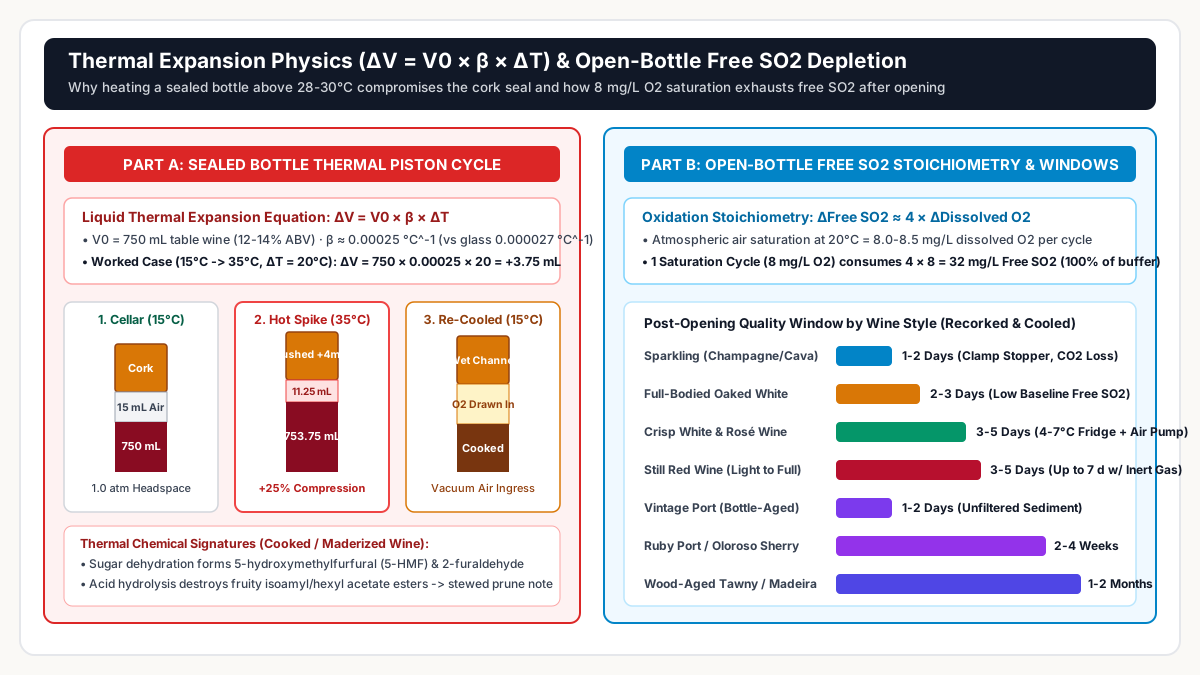
Why Heat Pushes Corks and Draws Air In: Worked Physics Calculation
Wine expands roughly ten times faster than the soda-lime glass bottle holding it because ethanol has a high volumetric thermal expansion coefficient (β_ethanol ≈ 0.00109 °C^-1 vs β_water ≈ 0.000207 °C^-1 at 20 °C). For a standard 12% to 14% ABV table wine, the composite volumetric expansion coefficient is approximately β ≈ 0.00025 °C^-1 (2.5 × 10^-4 °C^-1), whereas soda-lime glass expands at only β_glass ≈ 0.000027 °C^-1.
The liquid volume expansion ΔV for a bottle of initial volume V_0 subjected to a temperature increase ΔT follows the volumetric thermal expansion equation:
ΔV = V_0 × β × ΔT
New Headspace Volume (V_headspace_final) = V_headspace_initial - ΔV
Worked numerical example (15 °C cellar to 35 °C hot vehicle trunk, ΔT = 20 °C):
- Liquid expansion: For a
V_0 = 750 mLbottle heated from15 °C(59 °F) to35 °C(95 °F),ΔT = 20 °C:ΔV = 750 mL × 0.00025 °C^-1 × 20 °C = +3.75 mL(reaching+4.69 mLat40 °C). - Headspace compression: A standard natural-cork bottle has an initial headspace (ullage) of
V_headspace_initial = 15.0 mLbeneath a45 mmcork. Expanding the wine by3.75 mLshrinks the remaining gas space to15.0 - 3.75 = 11.25 mL, a 25% volume compression (and up to 50% compression if the initial ullage was only7.5 mL). - Piston effect and vacuum air ingress: Compressing the trapped headspace gas combines with higher water and ethanol vapor pressure at
35 °Cto drive internal gauge pressure upward. The expanding liquid acts as a hydraulic piston, pushing the cork2 to 6 mmout of the neck or forcing liquid wine along microscopic channels between the cork and glass. When the bottle later cools back to15 °C, the liquid contracts by3.75 mL, creating a partial vacuum inside the neck that sucks ambient air (21% O2) past the compromised, wine-lubricated cork seal.
Chemical Markers of Cooked Wine: 5-HMF, Furfural, and Ester Hydrolysis
Even if a screw cap or tight stopper prevents visible leakage, high temperature alters wine flavor through two irreversible reactions documented by the AWRI (TN09):
- Acid-catalyzed ester hydrolysis: Fresh, fruity fermentation esters in young white and red wines (such as isoamyl acetate, which gives banana/pear lift, and ethyl hexanoate, which gives green apple/berry aroma) hydrolyze rapidly at
> 25 to 30 °Cback into acetic/hexanoic acid and alcohol, flattening the wine’s primary fruit. - Sugar dehydration into furfurals: Heat catalyzes the dehydration of residual hexose sugars (fructose and glucose) into 5-hydroxymethylfurfural (
5-HMF) and pentose sugars (arabinose and xylose) into 2-furaldehyde (furfural) alongside Maillard amino-carbonyl products. These compounds give heat-damaged wine its signature cooked aroma of stewed prunes, baked fig jam, burnt marshmallow, and caramelized brown sugar.
Reductive Sulfur Faults, Brettanomyces, and Bottle Refermentation
Not every off-odor comes from oxygen or heat. Three major fault categories develop under low-oxygen (reductive) conditions or from microbial activity inside the bottle.
1. Volatile Sulfur Compounds (VSCs): H2S vs. Mercaptans
When Saccharomyces cerevisiae yeast ferments grape must with insufficient yeast assimilable nitrogen (YAN), it generates hydrogen sulfide (H2S) via the sulfate reduction sequence. During bottle storage under nearly airtight closures (particularly tin-lined screw caps with very low oxygen transmission rates, as compared in our guide to Saranex vs. tin screw cap liners), thioacetates can also slowly hydrolyze back into free volatile thiols:
- Hydrogen sulfide (
H2S, threshold1.0 to 1.6 µg/L): Smells like rotten eggs, sewer gas, or a freshly struck flint match. BecauseH2Shas a low boiling point (-60 °C) and high volatility, pouring the wine hard into a wide decanter and swirling for15 to 30 minutesoften blows off mildH2Sor oxidizes it enough to restore drinkability. - Methanethiol (
1.8 to 3.1 µg/L) and ethanethiol (1.1 µg/L): Mercaptans smell like burnt rubber, skunk spray, stagnant garlic, or boiled cabbage. Unlike simpleH2S, mercaptans and dimethyl sulfide (DMS, threshold25 to 60 µg/L, smelling of canned corn or cooked asparagus) do not reliably blow off with decanting.
2. Brettanomyces Volatile Phenols (4-EP and 4-EG)
The spoilage yeast Dekkera / Brettanomyces bruxellensis thrives in red wines with higher pH (> 3.7), low molecular SO2, and traces of residual sugar (> 0.5 g/L), especially in used oak barrels. Brettanomyces enzymes decarboxylate grape hydroxycinnamic acids (p-coumaric acid and ferulic acid) into vinylphenols and reduce them into 4-ethylphenol (4-EP) and 4-ethylguaiacol (4-EG):
- Sensory threshold: AWRI measurements place the recognition threshold for
4-EPbetween368 and 605 µg/Lin red wine (368 µg/Lin neutral reds,425 µg/Lin herbaceous Cabernet Sauvignon, and569 µg/Lin oaked styles), while4-EGis detected at33 to 110 µg/L(typically present at an8:1 to 10:1ratio of4-EPto4-EG). - Sensory profile: Below
300 µg/L, trace4-EGand4-EPcan register as spicy clove, leather, or cured bacon. Once4-EPcrosses400 to 600 µg/L, it blankets the fruit with adhesive Band-Aid, antiseptic hospital gauze, wet horse stable, and barnyard manure, paired with a metallic, drying finish.
3. Unintended Refermentation in the Bottle (CO2 > 1.0 to 1.5 g/L)
If a wine containing unfermented residual sugar (> 2.0 g/L) or L-malic acid is bottled without a sterile 0.45 µm membrane filtration or sufficient molecular SO2, surviving yeast (Saccharomyces or SO2-tolerant Zygosaccharomyces bailii) or lactic acid bacteria (Pediococcus, Lactobacillus, Oenococcus oeni) can resume fermentation inside the sealed bottle.
Still table wine normally holds 0.3 to 0.8 g/L of dissolved CO2. Once microbial refermentation pushes dissolved CO2 past 1.0 to 1.5 g/L, a prickly fizz (petillance) tingles on the tongue; above 2.0 to 2.5 g/L, visible bubbles cling to the glass and internal gas pressure can pop the cork upon opening. Refermentation by lactic bacteria also leaves a turbid haze, viscous ropiness, buttery diacetyl, or a mousy aftertaste (acetyltetrahydropyridines). This differs completely from the deliberate secondary fermentation used in Champagne, Prosecco, and Cava labels and closures and the 24 g/L tirage and autoclave engineering covered in our Champagne vs Prosecco vs Cava production methods guide.
Open-Bottle Free SO2 Depletion Kinetics and Storage Windows by Style
Once you pull the cork and pour a glass, atmospheric air (21% O2) rushes into the bottle headspace and dissolves into the wine during pouring. Understanding how fast an open bottle goes bad comes down to the stoichiometric reaction between dissolved oxygen and free sulfur dioxide (SO2).
Stoichiometric Depletion Calculation: 4 mg/L Free SO2 per 1 mg/L O2
In wine oxidation chemistry (Waterhouse, Sacks & Jeffery; AWRI), although the direct molar reaction of 1 mole of O2 (32 g/mol) oxidizing 2 moles of bisulfite (SO2, 64 g/mol) to sulfate corresponds to a 64 ÷ 32 = 2:1 mass ratio, concurrent nucleophilic addition of bisulfite to oxidized ortho-quinones and aldehydes results in an observed empirical consumption of approximately 4 mg/L of free SO2 per 1 mg/L of dissolved O2.
Free SO2 Consumed (mg/L) ≈ 4.0 × Dissolved O2 Uptake (mg/L)
Remaining Free SO2 (mg/L) = Initial Free SO2 - (4.0 × Dissolved O2 Uptake)
Worked open-bottle calculation:
- Initial buffer: A crisp commercial white table wine (
pH 3.3) is bottled with28 mg/Lof freeSO2(maintaining~0.8 mg/Lantimicrobial molecularSO2). - Oxygen saturation upon opening: At room temperature (
20 °C), pouring two glasses and leaving350 mLof air headspace saturates the wine with approximately8.0 mg/Lof dissolvedO2. - Buffer exhaustion: That single
8.0 mg/Loxygen saturation cycle consumes up to4.0 × 8.0 = 32.0 mg/Lof freeSO2. Within24 to 72 hoursat room temperature, the entire28 mg/LfreeSO2shield drops below5 mg/L, allowing Fenton radicals to oxidize ethanol into acetaldehyde (> 100 mg/L) and brown the wine. Storing the recorked bottle in a4 to 7 °Crefrigerator slows the Fenton reaction rate constant by a factor of2.5 to 4.0, extending drinkability to3 to 5 days.
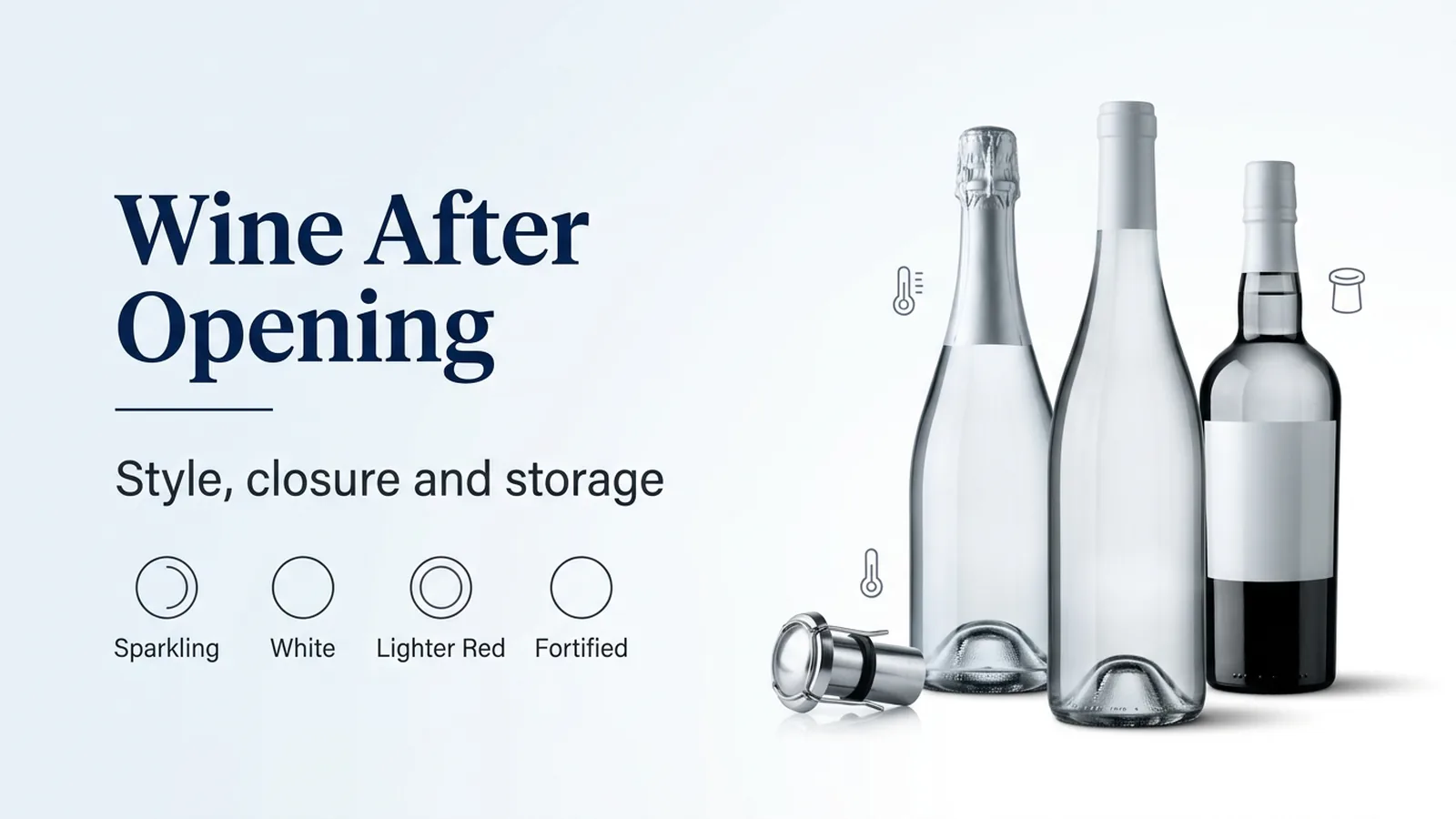
| Wine Style | Post-Opening Quality Window | Required Storage Condition | Primary Chemical Failure Mode |
|---|---|---|---|
| Sparkling Wine (Champagne, Prosecco, Cava) | 1 to 2 days | Clamp-style airtight sparkling stopper; refrigerate at 4-7 °C (39-45 °F) |
Loss of dissolved CO2 equilibrium (Henry’s Law) followed by oxidative flattening |
| Full-Bodied Oaked White (Oaked Chardonnay, Viognier) | 2 to 3 days | Tightly recorked or inert-gas purged; refrigerate at 4-7 °C |
Lower baseline free SO2 (15-25 mg/L) and prior barrel oxidation speed acetaldehyde rise |
| Crisp White & Rosé (Sauvignon Blanc, Riesling, Pinot Grigio) | 3 to 5 days | Recorked with vacuum pump or argon gas; refrigerate at 4-7 °C |
Free SO2 depletion (4:1 ratio), loss of varietal thiols/esters, and bruised-apple emergence |
| Light- to Full-Bodied Red (Pinot Noir to Cabernet Sauvignon) | 3 to 5 days (5-7 d with inert gas) |
Recorked and stored at 12-15 °C (54-59 °F) or refrigerated |
Phenolic tannins (1,500-3,000 mg/L) buffer Day 1-2 air, then acetaldehyde and ethyl acetate dominate |
| Bottle-Aged Vintage Port | 1 to 2 days | Recorked in cool cellar (12-15 °C); decanted off heavy sediment |
Unfiltered anthocyanin-tannin matrix oxidizes rapidly once exposed to air |
| Ruby Port & Oloroso Sherry | 2 to 4 weeks | Recorked and refrigerated or held at cool cellar temperature | 17-20% ABV fortification inhibits Acetobacter; slow ester volatilization over weeks |
| Wood-Aged Tawny Port & Madeira | 1 to 2 months | Recorked and stored cool and dark | Extensive prior oxidative cask maturation makes them highly stable against air |
For a deeper breakdown of container headspace geometry and producer-specific fortified wine protocols, see our companion guide on how long wine lasts after opening by style.
Harmless Lookalikes That Do Not Mean Wine Has Gone Bad
Before discarding a bottle based on particles in the glass or a brief initial odor upon pulling the cork, distinguish true chemical spoilage from three benign winemaking phenomena.
| Visual or Sensory Observation | Physical or Chemical Composition | Why It Forms | How to Distinguish It from a True Wine Fault |
|---|---|---|---|
| Clear or Purple Crystals on Cork / Glass Bottom (“Wine Diamonds”) | Potassium bitartrate (KHC4H4O6, cream of tartar) |
Supersaturated tartaric acid binds potassium ions and precipitates when chilled below cold-stabilization temperature | Crystals are hard, gritty like coarse sugar, odorless, and tasteless; wine remains bright with clean fruit aroma |
| Dark Silt or Flaky Crust in Aged Red Wine | Polymerized anthocyanin-tannin colloids | Over 5 to 10+ years in bottle, grape tannins and red pigments link into heavy insoluble chains that settle out |
Settles cleanly to the bottom when stood upright for 24 hours; wine smells complex and savory rather than vinegary or musty |
| Matte Opalescence in Unfined / Unfiltered Wine | Suspended grape proteins, mannoproteins, or fine yeast lees | Winemaker intentionally skipped bentonite/isinglass fining or tight pad filtration to preserve texture | Label explicitly states “Unfined” or “Unfiltered”; no prickly CO2 fizz, no popped cork, and no sour buttermilk or vinegar smell |
Our technical explainers on why cold stabilization cannot prevent every tartrate crystal, what wine sediment is made of, and unfined vs. unfiltered wine clarity detail how winemakers manage these non-spoilage solids before bottling. Similarly, controlled tertiary maturation in the cellar is covered in how wine aging works.
Microbiological Safety and Culinary Reuse Rules
Why Spoiled Table Wine Does Not Cause Foodborne Illness
Unlike meat, dairy, or low-acid canned vegetables, spoiled table wine cannot harbor human foodborne bacterial pathogens such as Salmonella, Escherichia coli O157:H7, Listeria monocytogenes, or Clostridium botulinum. Four overlapping chemical barriers prevent pathogen survival in wine:
- High titratable acidity and low pH (
3.0 to 3.8), well below thepH 4.6threshold required for Clostridium botulinum growth. - Ethanol concentration (
11% to 15% ABVin table wine;17% to 20% ABVin fortified wine), which disrupts bacterial cell membranes. - Free and bound sulfur dioxide (
SO2) alongside antimicrobial phenolic acids and condensed grape tannins. - Low dissolved oxygen and nutrient depletion following primary yeast fermentation.
Drinking a glass of oxidized, cork-tainted, or heat-damaged wine will not cause food poisoning, though microbially spoiled red wines with elevated biogenic amines (such as histamine and tyramine from Pediococcus or Lactobacillus metabolism) or high acetaldehyde can leave an unpleasant sour taste and trigger mild flushing in sensitive individuals.
When You Can Cook With Bad Wine (and When to Pour It Out)
Whether an off-tasting bottle can be salvaged in the kitchen depends on the volatility and thermal stability of the fault compound:
- NEVER cook with
2,4,6-TCAcorked wine, Brettanomyces (4-EP), or mercaptan-reduced wine:2,4,6-TCAhas a high boiling point (240 °C) and low steam volatility relative to ethanol (78.4 °C) and water (100 °C). Simmering a corked wine in a risotto, pan reduction, or beef bourguignon boils off the alcohol and concentrates the dank wet-cardboard taint across the entire dish. The same applies to Band-Aid4-ethylphenol(boiling point 218 °C) and burnt-rubber mercaptans. - Safe for slow braises, marinades, or homemade wine vinegar: A bottle that is mildly oxidized (
100 to 150 mg/Lacetaldehyde, showing slight browning and muted fruit after 4 to 6 days in the fridge) or slightly elevated in acetic acid (0.6 to 0.9 g/L) works cleanly in slow-cooked tomato ragùs, pot roasts, acidic meat marinades, or a homemade Acetobacter vinegar mother. Only discard an oxidized bottle from kitchen use if ethyl acetate (> 150 mg/L) gives it an aggressive nail polish remover odor.