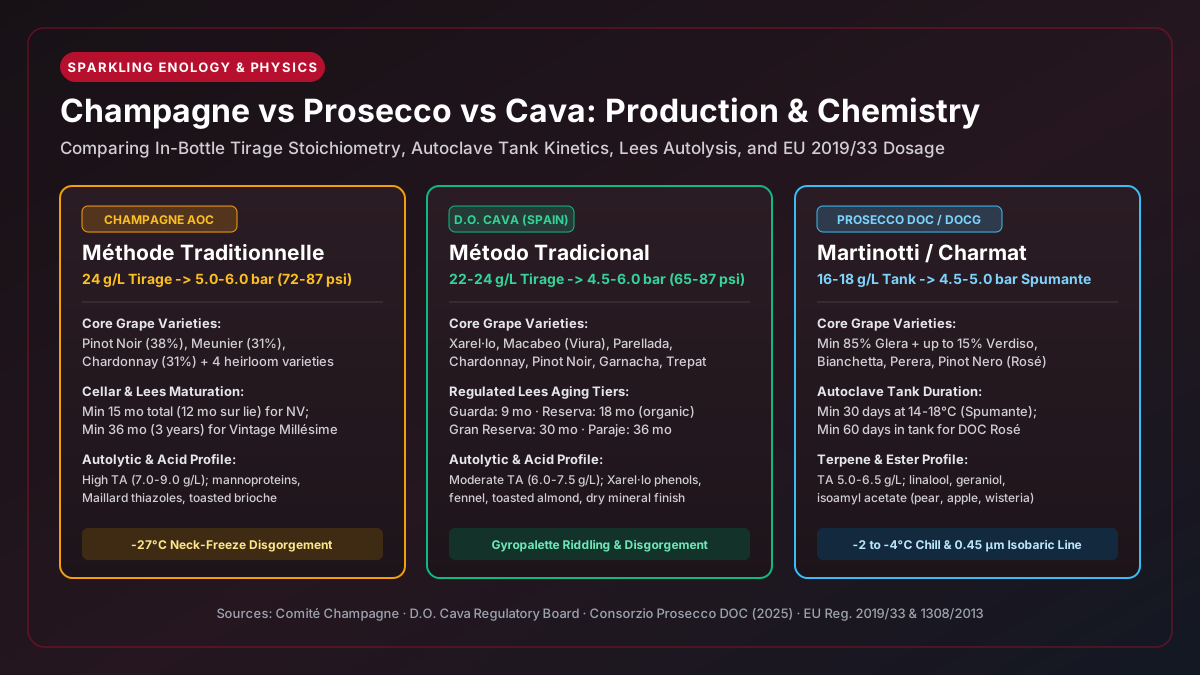
Champagne AOC and Cava DO use a second alcoholic fermentation inside the individual glass bottle followed by 9 to 36+ months of enzymatic yeast lees autolysis, whereas Prosecco DOC Spumante uses bulk pressurized stainless-steel autoclaves for 30 to 90 days to preserve primary grape monoterpenes. Confusing these two vessel systems or misreading European Union sugar tiers wastes money on long-aged autolytic bottles whose microgram-level brioche volatiles are obliterated in citrus blends, or leads to choosing the wrong sweetness tier when a bone-dry Brut (0 to 12 g/L) is required instead of an Extra Dry (12 to 17 g/L).
While our foundational overview of Champagne vs Prosecco vs Cava labels and closures covers appellation geography, semi-generic US label rules, and stopper regulations, this technical guide examines the physical chemistry inside the fermentation vessel: Gay-Lussac tirage stoichiometry, intracellular yeast autolysis kinetics, mannoprotein bubble stabilization, and sugar-to-acid calculations in mixed drinks.
| Parameter | Champagne AOC (France) | D.O. Cava (Spain) | Prosecco DOC & Conegliano Valdobbiadene DOCG (Italy) |
|---|---|---|---|
| Governing Body & Core Zone | Comité Champagne (CIVC) & INAO; ~34,200 ha in north-eastern France (Reims, Marne, Côte des Blancs, Aube) | Consejo Regulador D.O. Cava; >95% in Comtats de Barcelona (Sant Sadurní d’Anoia, Penedès) + 3 zones | Consorzio Prosecco DOC (9 provinces in Veneto & Friuli) & Conegliano Valdobbiadene / Asolo DOCG |
| Authorized Grape Varieties | Pinot Noir (~38%), Meunier (~31%), Chardonnay (~31%); plus Arbane, Petit Meslier, Pinot Blanc, Pinot Gris (~0.3%) | Macabeo (Viura), Xarel·lo, Parellada, Chardonnay, Pinot Noir, Subirat Parent; Garnacha, Monastrell, Trepat (Rosado) | Minimum 85% Glera; up to 15% Verdiso, Bianchetta, Perera, Glera Lunga, Chardonnay, Pinots (10-15% Pinot Nero for Rosé) |
| Secondary Fermentation Method | Méthode Traditionnelle: strictly inside the retail bottle (<375 mL or >3 L transfer restricted) |
Método Tradicional: strictly inside the retail bottle (identical mechanical sequence to Champagne) | Metodo Martinotti / Charmat: pressurized stainless-steel autoclave (>95% of production; bottle Sui Lieviti permitted in specific tiers) |
| Tirage / Autoclave Sugar Charge | 22 to 24 g/L sucrose (liqueur de tirage) added to dry 10.5-11.0% ABV base wine |
22 to 24 g/L sucrose (licor de tiraje) added to dry 10.0-11.0% ABV base wine |
15 to 18 g/L fermentable sugar consumed in tank at 14 to 18 °C before -2 to -4 °C thermal arrest |
| Minimum Lees / Tank Duration | 15 months total in cellar (12 mo on lees) for Non-Vintage; 36 months for Vintage Millésime | 9 mo (Cava de Guarda); 18 mo (Reserva, organic); 30 mo (Gran Reserva); 36 mo (Paraje Calificado) | 30 days minimum in autoclave for Prosecco DOC Spumante; 60 days minimum for Prosecco DOC Spumante Rosé |
| Yeast Removal & Clarification | Pupitre or gyropalette riddling + -25 to -27 °C neck-freeze disgorgement (dégorgement) |
Pupitre or gyropalette riddling + -25 to -27 °C neck-freeze disgorgement (degüelle) |
Chilled to -2 to -4 °C for tartrate stabilization + 0.45 µm isobaric counter-pressure filtration |
Internal Bottle Pressure (20 °C) |
5.0 to 6.0 bar (500 to 600 kPa; 72 to 87 psi); ~11.5-12.0 g/L dissolved CO2 |
4.5 to 6.0 bar (450 to 600 kPa; 65 to 87 psi); EU Quality Sparkling minimum 3.5 bar |
Spumante: 4.5 to 5.0 bar (65 to 72 psi; min 3.0-3.5 bar); Frizzante: 1.0 to 2.5 bar (14.5 to 36 psi) |
Titratable Acidity (TA) & pH |
7.0 to 9.0 g/L (as tartaric acid); pH 2.95 to 3.15 |
6.0 to 7.5 g/L (as tartaric acid); pH 3.05 to 3.25 |
5.0 to 6.5 g/L (as tartaric acid); pH 3.15 to 3.35 |
| Dominant Chemical Aromatics | Autolytic Maillard thiazoles, pyrazines, furans, sotolon, and mannoproteins (brioche, toast, hazelnut) | Early-to-deep autolytic esters, Xarel·lo polyphenols, fennel, dried herb, toasted almond, citrus peel | Primary Glera monoterpenes (linalool, geraniol, alpha-terpineol) and acetate esters (green pear, apple, wisteria) |
Traditional Method vs. Charmat Tank Engineering and Stoichiometry
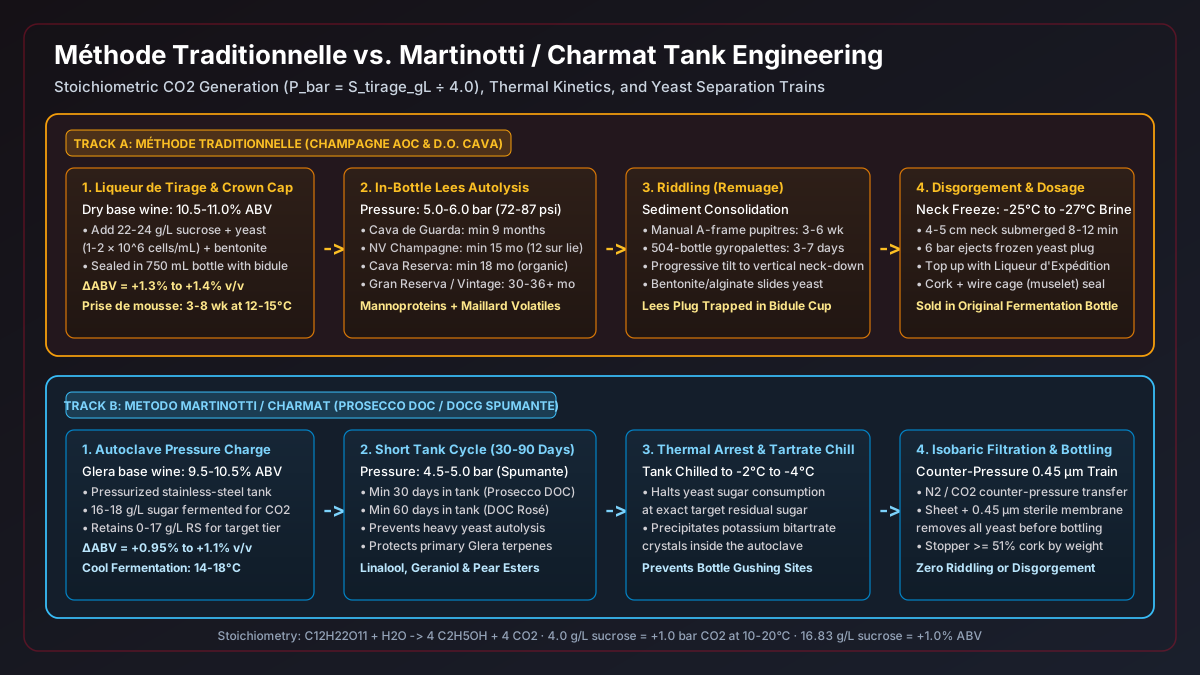
Every sparkling wine prohibited from artificial carbonation acquires its effervescence by trapping carbon dioxide (CO2) generated when Saccharomyces cerevisiae yeast ferments sugar inside a pressure-sealed vessel. Whether that vessel is an individual 750 mL thick-walled glass bottle (Méthode Traditionnelle / Método Tradicional) or a 10,000 to 50,000 L jacketed stainless-steel pressure tank (Metodo Martinotti / Charmat) dictates the wine’s pressure ceiling, yeast contact surface area, clarification mechanics, and oxygen exposure.
Gay-Lussac Secondary Fermentation Stoichiometry and Pressure Formulas
During prise de mousse (the capture of the foam), yeast invertase first hydrolyzes sucrose (C12H22O11, molar mass 342.30 g/mol) into glucose and fructose (2 C6H12O6), which glycolytic enzymes convert into ethanol (C2H5OH, molar mass 46.07 g/mol) and carbon dioxide (CO2, molar mass 44.01 g/mol):
C12H22O11 + H2O -> 2 C6H12O6 -> 4 C2H5OH + 4 CO2
Theoretical Mass Yield (1.00 g sucrose): 0.538 g Ethanol + 0.514 g CO2
Empirical Enological Conversion (allowing ~4-5% yeast biomass & byproducts):
  P_CO2_bar  = S_tirage_gL ÷ 4.0      (at 10-20 °C in 10.5-12.5% ABV wine)
  ΔABV_pct   = S_tirage_gL ÷ 16.83    (g/L sucrose per +1.0% v/v ethanol)
  C_CO2_gL   = S_tirage_gL × 0.49     (g/L dissolved CO2 retained in bottle)
Worked numerical example: Champagne & Cava Tirage (S_tirage_gL = 24.0 g/L) vs. Prosecco Spumante Tank Charge (S_tirage_gL = 17.0 g/L):
- Champagne AOC and D.O. Cava (
24.0 g/Lsucrose tirage):- A dry still base assemblage (
10.8% ABV,< 1.5 g/Lresidual sugar) is dosed with24.0 g/Lof cane or beet sucrose,1.5 × 10^6 cells/mLof acclimatized Saccharomyces cerevisiae bayanus yeast, diammonium phosphate nitrogen nutrient, and bentonite-alginate riddling adjuvant. - Overpressure generated:
P_CO2_bar = 24.0 ÷ 4.0 = 6.0 bar(600 kPaor87.0 psigauge pressure at20 °C). - Alcohol increase:
ΔABV_pct = 24.0 ÷ 16.83 = +1.43% ABV, raising the finished wine from10.8%to12.23% ABV. - Dissolved gas:
C_CO2_gL = 24.0 × 0.49 = 11.76 g/Lof dissolvedCO2(equivalent to~5.9 Lof expanded gas at atmospheric pressure trapped inside a single750 mLbottle).
- A dry still base assemblage (
- Prosecco DOC Spumante (
17.0 g/Lsugar fermented in autoclave):- A Glera base wine (
10.0% ABV) is charged into a stainless-steel autoclave with must or sucrose so that the yeast consumes17.0 g/Lof sugar at14 to 18 °Cover15 to 20 daysbefore cooling halts fermentation with15.0 g/Lof unfermented sugar remaining (for an Extra Dry tier). - Overpressure generated:
P_CO2_bar = 17.0 ÷ 4.0 = 4.25 to 4.5 bar(62 to 65 psi). - Alcohol increase:
ΔABV_pct = 17.0 ÷ 16.83 = +1.01% ABV, bringing the finished Prosecco to11.0% ABV.
- A Glera base wine (
Riddling and -27 °C Neck-Freeze Disgorgement vs. Isobaric Filtration
Once secondary fermentation finishes, the spent yeast cells (lees) must be separated from the sparkling wine without venting the dissolved CO2. This separation step represents the primary cost and labor divergence between the two methods:
- Traditional Method (Riddling + Disgorgement): Bottles age horizontally (
sur lattes) in cool cellars (10 to 12 °C), maximizing the surface area of the yeast sediment strip along the lower belly of the glass. To clarify the wine, bottles are transferred either to wooden A-frame racks (pupitres, twisted manually by 1/8th to 1/4th of a turn over3 to 6 weeks) or to automated504-bottlehydraulic cages (gyropalettes, programmed to oscillate and tilt 24 hours a day for3 to 7 days). Bentonite clay and sodium alginate flocculants added at tirage cause the sticky yeast cells to agglomerate and slide down the glass into thebidule(a cylindrical polyethylene cup inserted beneath the crown cap). On the disgorgement line, the inverted bottle necks are submerged4 to 5 cmdeep in a-25 to -27 °C(-13 to -17 °F) propylene glycol or calcium chloride brine bath for8 to 12 minutes, freezing a solid plug of wine and trapped yeast lees in the neck. When the bottle flips upright and a mechanical claw pries off the crown cap, the internal6.0 barpressure shoots the frozen lees plug out of the neck. The bottle immediately receives a calibrated dose ofliqueur d'expédition(wine plus sucrose solution) and is sealed with a compressed natural/agglomerated cork and wire cage (muselet). For details on what makes up the expelled plug, see our guide to what wine sediment is made of. - Martinotti / Charmat Method (Thermal Arrest + Isobaric Filtration): No bottle rotation or neck freezing takes place. When the autoclave hits the target pressure (
4.5 to 5.0 bar) and target residual sugar, refrigerated glycol jackets drop the entire tank temperature to-2 to -4 °C(28 to 25 °F) for7 to 14 days. This cold soak simultaneously shocks the yeast into dormancy and precipitates supersaturated potassium bitartrate crystals (KHC4H4O6) out of solution inside the tank; without this step, microscopic tartrate crystals left in the bottle act as jagged nucleation sites that cause uncontrollable gushing upon opening, a phenomenon detailed in cold stabilization in wine and its limits. The chilled wine is then pushed under counter-pressure (N2orCO2gas held above5.0 bar) through lenticular depth filters and a sterile0.45 µmmembrane filter directly into an isobaric counter-pressure filler. Our breakdown of unfined vs. unfiltered wine processes explains how0.45 µmmembrane filtration removes 100% of remaining yeast cells so a sweet15 g/LExtra Dry Prosecco cannot referment in the bottle on retail shelves.
Takeaway: The traditional method locks each bottle into an individual closed reactor that requires -27 °C neck-freeze disgorgement, while the Martinotti tank method clarifies thousands of liters in a single isobaric 0.45 µm filtration pass.
Yeast Lees Autolysis vs. Primary Terpene Preservation
A persistent misconception holds that the Charmat tank method is merely an industrial shortcut to imitate Champagne at lower cost. In enological biochemistry, the two methods target opposite classes of aroma compounds: Champagne and aged Cava rely on tertiary enzymatic yeast autolysis, whereas Prosecco relies on primary varietal monoterpene and fermentation ester preservation.
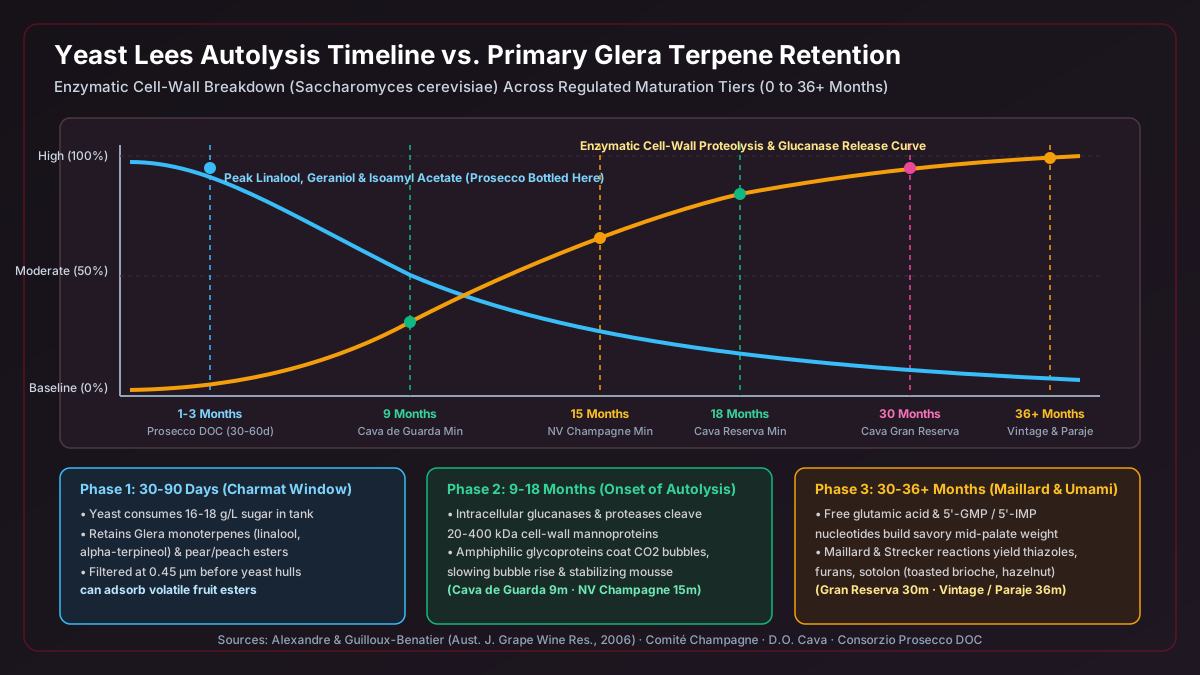
Enzymatic Lees Autolysis Kinetics in Champagne and Cava (9 to 36+ Months)
During the 3 to 8 weeks of secondary fermentation inside a Champagne or Cava bottle, yeast cells multiply to ~2 to 4 × 10^7 cells/mL, exhaust every gram of fermentable sugar, and die from nutrient starvation, high ethanol (12.0 to 12.5% ABV), and toxic dissolved CO2 pressure. However, as established in the classic review by Alexandre and Guilloux-Benatier (Australian Journal of Grape and Wine Research, 2006), dead yeast cells do not break down immediately. At cellar temperatures (10 to 12 °C) and low wine pH (2.95 to 3.20), intracellular vacuolar enzymes remain quiescent for the first 3 to 6 months.
True autolysis (self-digestion of the yeast cell) only accelerates between 9 and 15 months and continues evolving through 30 to 36+ months:
- Glucanase and Mannoprotein Shearing (
9 to 18 Months): Endogenousbeta-(1,3)- andbeta-(1,6)-glucanases cleave the rigid inner glucan mesh of the Saccharomyces cerevisiae cell wall, releasing high-molecular-weight mannoproteins (20 to 400 kDaglycoproteins composed of85 to 90%D-mannose carbohydrate and10 to 15%peptide). Because mannoproteins possess both hydrophilic carbohydrate chains and hydrophobic peptide domains, they migrate to the gas-liquid interface of risingCO2bubbles. This glycoprotein coat increases surface viscoelasticity, slows gas diffusion across the bubble wall, prevents small bubbles from coalescing into large bubbles, and stabilizes a dense, persistent collar (mousse) at the top of the glass while imparting a round, creamy mid-palate texture. - Proteolysis, Free Amino Acids, and Nucleotides (
12 to 24 Months): Acid proteases (primarily protease A) hydrolyze cytoplasmic peptides into free amino acids, notably glutamic acid, alanine, threonine, and serine, while intracellular ribonucleases release purine5'-ribonucleotides (5'-GMPand5'-IMP). These compounds lower the sensory sharpness of malic and tartaric acid and create savory umami length on the finish. - Maillard, Strecker, and Lipid Volatiles (
18 to 36+ Months): Released sulfur-containing amino acids (cysteine and methionine) and sugars undergo slow non-enzymatic Maillard and Strecker reactions in the reductive bottle environment, while unsaturated yeast membrane lipids oxidize slightly. These pathways generate 2-acetylthiazole, alkylpyrazines, furfural, 5-methylfurfural, sotolon, and gamma-lactones, which produce the unmistakable aromas of warm brioche, toasted bread crust, roasted hazelnut, shortbread biscuit, and baked apple. For how reductive bottle maturation contrasts with barrel aging, see how wine aging works in tank, barrel, and bottle. Additionally, how bottle size (375 mLhalf-bottle vs.750 mLstandard vs.1.5 Lmagnum) shifts the oxygen-to-lees ratio during autolysis is detailed in our wine bottle sizes chart.
Why D.O. Cava’s Four Aging Tiers Bridge the Gap Between Prosecco and Champagne
Understanding the autolysis timeline explains why two bottles of Spanish Cava can taste radically different depending on their regulatory tier under the Consejo Regulador D.O. Cava rules:
- Cava de Guarda (
Minimum 9 monthson lees, green quality seal): Disgorged right at the onset of enzymatic cell-wall breakdown (9 to 11 months). It captures early mannoprotein bubble refinement and subtle pastry/almond hints while keeping the primary citrus, green apple, and wild fennel fruit of Macabeo, Xarel·lo, and Parellada front and center. - Cava de Guarda Superior Reserva (
Minimum 18 monthson lees): Raised from 15 to 18 months under updated D.O. Cava standards (requiring 100% certified organic vineyards, vintage dating, and a10,000 kg/hayield cap). At18 months, it surpasses the15-monthlegal minimum of Non-Vintage Champagne, displaying pronounced brioche, toasted nut, and creamy mannoprotein weight. - Cava Gran Reserva (
Minimum 30 monthson lees) and Cava de Paraje Calificado (Minimum 36 monthson lees): Restricted by law to bone-dry sugar categories (Brut Nature,Extra Brut, andBrut). Xarel·lo provides high resveratrol and polyphenolic anti-oxidative structure that supports30 to 60+ monthsof deep autolytic maturation without premature browning.
Why Prosecco Uses Short Tank Cycles (30 to 90 Days) to Protect Glera Terpenes
If a winemaker subjected Glera base wine to 24 months of yeast lees autolysis inside a bottle, the wine would lose the exact floral and orchard-fruit character that defines Prosecco. Unlike neutral Chardonnay or Pinot Meunier, Glera is a semi-aromatic grape rich in monoterpenes (linalool, geraniol, nerol, citronellol, and alpha-terpineol) alongside norisoprenoids (beta-damascenone). During cool 14 to 18 °C autoclave fermentation, yeast also synthesizes fruity acetate and ethyl esters (isoamyl acetate, hexyl acetate, ethyl hexanoate, and ethyl octanoate), which give Prosecco its signature aromas of fresh Williams pear, Golden Delicious apple, white peach, and wisteria blossom.
Over extended multi-year storage on dead yeast lees, two degradation reactions ruin those primary aromatics:
- Ester hydrolysis and terpene rearrangement: At wine pH (
3.15 to 3.35), fruity acetate esters slowly hydrolyze back into acids and alcohols, while acid-catalyzed hydration converts floral linalool and geraniol into less fragrant alpha-terpineol and terpene diols. - Sorption by yeast cell walls: The hydrophobic lipid and mannoprotein fractions of decaying yeast hulls act like an adsorbent sponge, binding and stripping volatile fruity esters out of the liquid phase.
By completing the second fermentation in a temperature-controlled stainless-steel autoclave within 30 to 60 days (60 days minimum for Prosecco DOC Spumante Rosé under Article 5 of the 2025 Prosecco DOC specification) and immediately filtering out the yeast at -2 to -4 °C, the Martinotti method locks in peak primary monoterpenes and acetate esters.
Takeaway: Extended lees aging (15 to 36+ months) builds Champagne and Cava Reserva’s toasted brioche and mannoprotein creaminess, while rapid autoclave filtration (30 to 90 days) protects Prosecco’s volatile Glera terpenes and pear esters from hydrolysis and yeast-hull adsorption.
EU Regulation 2019/33 Dosage Chemistry: Why Extra Dry Tastes Sweeter Than Brut
Across Champagne AOC, D.O. Cava, and Prosecco DOC/DOCG Spumante, the sweetness words printed on the front or back label are strictly governed by Commission Delegated Regulation (EU) 2019/33, Annex III, Part A (with an analytical measurement tolerance of ± 3 g/L). Because the scale was codified in the 19th century when mainstream Champagne was dosed at 50 to 150 g/L for dessert service, the modern tiers read backwards to casual buyers: Extra Dry (12 to 17 g/L) contains up to 40% more residual sugar than the top of the Brut band (0 to 12 g/L).
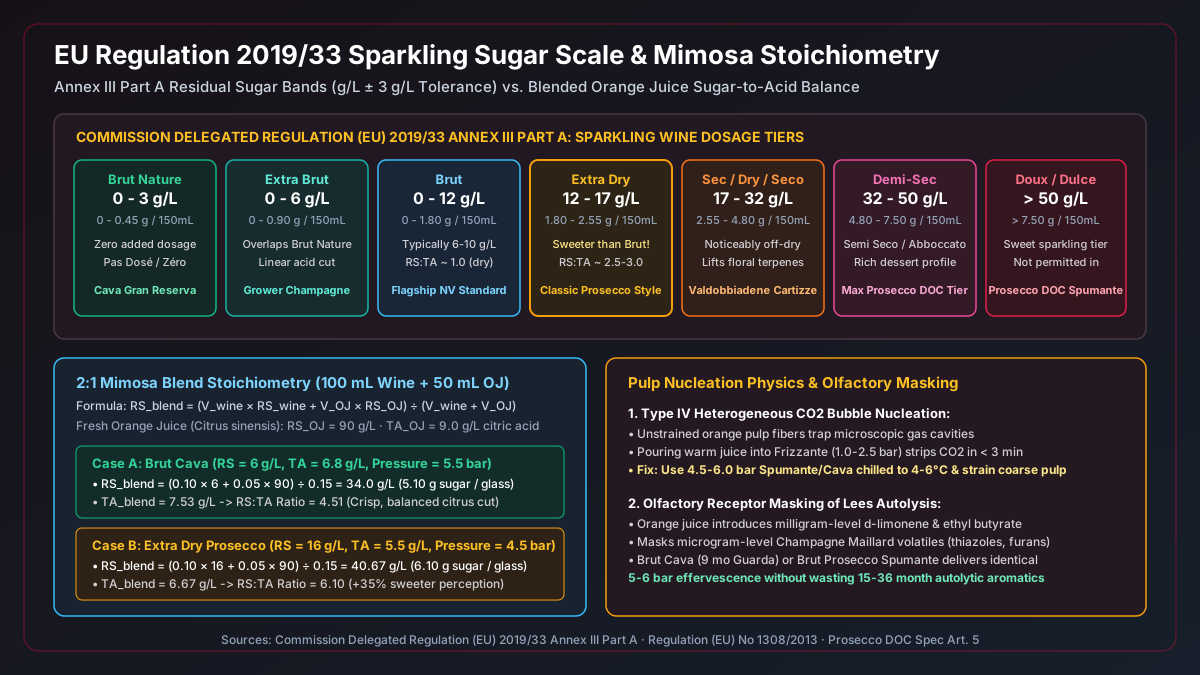
| EU Sugar Tier (EN / FR / IT / ES) | Legal Residual Sugar (g/L) |
Sugar per 150 mL Flute (g) |
Typical RS : TA Ratio |
Regulatory & Stylistic Application Across the 3 Wines |
|---|---|---|---|---|
| Brut Nature (Pas Dosé / Dosage Zéro) | 0 to 3 g/L (no added sugar after 2nd fermentation) |
0 to 0.45 g |
0.1 to 0.4 |
Flagship tier for Cava Gran Reserva & Paraje Calificado, grower Champagne, and zero-dosage Valdobbiadene Rive |
| Extra Brut | 0 to 6 g/L |
0 to 0.90 g |
0.3 to 0.8 |
Crisp, high-linearity Champagne, Cava Reserva, and dry Conegliano Valdobbiadene DOCG |
| Brut | 0 to 12 g/L (typically dosed at 6 to 10 g/L) |
0 to 1.80 g (0.9-1.5 g typical) |
0.8 to 1.6 |
Core dry standard for Non-Vintage Champagne (~85% of exports), Cava de Guarda, and modern Prosecco DOC Brut |
| Extra Dry (Extra Sec / Extra Seco) | 12 to 17 g/L |
1.80 to 2.55 g |
2.0 to 3.1 |
Classic commercial Prosecco DOC / DOCG style (14-16 g/L lifts floral Glera terpenes); noticeably off-dry |
| Dry (Sec / Secco / Seco) | 17 to 32 g/L |
2.55 to 4.80 g |
3.0 to 5.5 |
Clearly sweet on the palate; traditional tier for Valdobbiadene Superiore di Cartizze DOCG (~20-25 g/L) |
| Demi-Sec (Abboccato / Semi Seco) | 32 to 50 g/L |
4.80 to 7.50 g |
5.5 to 8.5 |
Dessert-weight sparkling wine; highest sweetness tier permitted for Prosecco DOC Spumante (Art. 5) |
| Doux (Dolce / Dulce) | > 50 g/L |
> 7.50 g |
> 8.5 |
Historical sweet Champagne/Cava tier; prohibited for Prosecco DOC Spumante (and Rosé is capped at Extra Dry) |
The Sugar-to-Acid Ratio (RS : TA) Psychophysics Equation
Why does a Brut Champagne dosed at 9.0 g/L of residual sugar taste bone-dry and chalky, while an Extra Dry Prosecco at 15.0 g/L tastes plush and sweet? In sensory psychophysics, perceived sweetness is governed not by residual sugar (RS) in isolation, but by the dimensionless Residual Sugar to Titratable Acidity Ratio (RS : TA) alongside volatile aroma-sweetness cross-modal interactions:
Sugar-to-Acid Ratio (RS:TA) = Residual_Sugar_gL ÷ Titratable_Acidity_gL
Perceived Dryness Thresholds (Sparkling Wine at 6-8 °C):
  RS:TA <= 1.25  ->  Perceived as Bone-Dry to Crisp Dry (Acid dominates finish)
  RS:TA 1.3-2.2  ->  Perceived as Balanced / Softly Dry
  RS:TA >= 2.30  ->  Perceived as Off-Dry to Noticeably Sweet
Worked comparison:
- Non-Vintage Brut Champagne: Dosed at
RS = 8.5 g/Lwith cool-climate northern French acidity ofTA = 8.0 g/L(as tartaric acid,pH 3.05). Its ratio isRS:TA = 8.5 ÷ 8.0 = 1.06. The high concentration of tartaric and malic protons masks the8.5 g/Lsugar completely, leaving a linear, mouth-watering finish. - Brut Cava de Guarda: Dosed at
RS = 7.5 g/Lwith Mediterranean Penedès acidity ofTA = 6.5 g/L(pH 3.15). Its ratio isRS:TA = 7.5 ÷ 6.5 = 1.15, tasting dry and balanced with softer malic bite than Champagne. - Extra Dry Prosecco DOC: Arrested in the autoclave at
RS = 15.5 g/Lwith Veneto plains acidity ofTA = 5.6 g/L(pH 3.25). Its ratio jumps toRS:TA = 15.5 ÷ 5.6 = 2.77. Furthermore, Glera’s sweet-smelling floral monoterpenes (linalool) and pear esters trigger associative sweetness in the olfactory bulb, amplifying the2.77sugar-to-acid ratio on the palate.
Takeaway: Always verify both the EU sugar tier (Brut vs. Extra Dry) and the underlying RS:TA ratio: an Extra Dry Prosecco (RS:TA ≈ 2.5 to 3.0) carries nearly triple the effective sweetness balance of a Brut Champagne or Brut Cava (RS:TA ≈ 1.0 to 1.2).
Champagne or Prosecco (or Cava) for Mimosas: Cocktail Stoichiometry and Nucleation Physics
When evaluating Champagne or Prosecco for Mimosas (or Buck’s Fizz, Bellinis, and Aperol Spritzes), enological chemistry reduces the decision to three measurable variables: blended sugar-to-acid stoichiometry, heterogeneous CO2 bubble nucleation on suspended fruit pulp, and olfactory receptor masking of autolytic volatiles.
1. Blended Residual Sugar and Acidity Stoichiometry (RS_blend and TA_blend)
Freshly squeezed orange juice (Citrus sinensis) contains an average of RS_OJ = 90.0 g/L of natural sugars (sucrose, fructose, and glucose) and TA_OJ = 9.0 g/L of titratable acidity (predominantly citric acid, pH 3.5), alongside suspended cellulose pulp fibers and peel oils. When mixing a volume V_wine of sparkling wine with a volume V_OJ of orange juice, the conservation-of-mass mixing equations are:
RS_blend (g/L) = (V_wine × RS_wine + V_OJ × RS_OJ) ÷ (V_wine + V_OJ)
TA_blend (g/L) = (V_wine × TA_wine + V_OJ × TA_OJ) ÷ (V_wine + V_OJ)
Blend_RS_to_TA = RS_blend ÷ TA_blend
Worked numerical example: Standard 2:1 Mimosa (V_wine = 100 mL + V_OJ = 50 mL, total 150 mL flute):
- Case A: Mixing with Brut Cava (
RS_wine = 6.0 g/L,TA_wine = 6.8 g/L,5.5 bar):RS_blend = (0.10 L × 6.0 g/L + 0.05 L × 90.0 g/L) ÷ 0.15 L = (0.60 + 4.50) ÷ 0.15 = 34.00 g/L(5.10 gtotal sugar in the glass).TA_blend = (0.10 L × 6.8 g/L + 0.05 L × 9.0 g/L) ÷ 0.15 L = (0.68 + 0.45) ÷ 0.15 = 7.53 g/L.Blend_RS_to_TA:34.00 ÷ 7.53 = 4.51.
- Case B: Mixing with Extra Dry Prosecco (
RS_wine = 16.0 g/L,TA_wine = 5.5 g/L,4.5 bar):RS_blend = (0.10 L × 16.0 g/L + 0.05 L × 90.0 g/L) ÷ 0.15 L = (1.60 + 4.50) ÷ 0.15 = 40.67 g/L(6.10 gtotal sugar in the glass).TA_blend = (0.10 L × 5.5 g/L + 0.05 L × 9.0 g/L) ÷ 0.15 L = (0.55 + 0.45) ÷ 0.15 = 6.67 g/L.Blend_RS_to_TA:40.67 ÷ 6.67 = 6.10(+35.3% higher sugar-to-acid ratio than the Brut Cava blend).- If poured at a heavy
1:1brunch ratio (75 mLwine +75 mLorange juice), the Extra Dry Prosecco blend climbs toRS_blend = 53.0 g/L(Douxdessert territory) with anRS:TAratio of7.31, producing a cloying, syrupy finish.
2. Pulp Nucleation Physics (Spumante vs. Frizzante Depressurization)
In a clean crystal flute, CO2 bubble formation occurs via Type IV non-classical heterogeneous nucleation: dissolved CO2 diffuses into microscopic cylindrical gas pockets trapped inside hollow cellulose fibers left on the glass wall by drying towels. When unfiltered orange juice or peach purée is poured into sparkling wine, millions of suspended plant cellulose fibers and hesperidin crystals enter the liquid column simultaneously.
Each pulp fiber acts as a jagged hydrophobic nucleation site, triggering instantaneous mass exsolution of dissolved CO2 (excessive foaming upon pouring followed by rapid flattening in the glass):
- Why Prosecco Frizzante (
1.0 to 2.5 bar) fails in Mimosas: A semi-sparkling Frizzante starts with only3.5 to 5.5 g/Lof dissolvedCO2. Diluting it2:1or1:1with uncarbonated orange juice and exposing it to pulp fiber nucleation drops dissolvedCO2below the~2.2 g/Lsensory effervescence threshold within2 to 3 minutes. - Engineering control: Always select a fully sparkling
4.5 to 6.0 barwine (Cava,Prosecco DOC Spumante Brut, orCrémant), chill both the bottle and the orange juice to4 to 6 °C(39 to 43 °F) to maximizeCO2solubility under Henry’s Law, pass the juice through a fine-mesh strainer to remove coarse cellulose fibers, and pour the chilled sparkling wine first before gently layering the cold juice down the side of the flute.
3. Olfactory Masking of Autolytic Volatiles
From an analytical aroma standpoint, fresh orange juice introduces 10 to 50 mg/L of d-limonene, 0.5 to 2.0 mg/L of ethyl butyrate, and octanal / decanal citrus aldehydes. Those high-concentration fruit volatiles saturate human olfactory receptors and completely mask the delicate microgram-per-liter (µg/L) concentrations of 2-acetylthiazole, sotolon, and tetramethylpyrazine generated during 15 to 36 months of Champagne lees autolysis.
| Mixed Drink / Service Scenario | Optimal Sparkling Base & Sugar Tier | Chemical & Physical Rationale | What to Avoid (Failure Mode) |
|---|---|---|---|
| Classic 2:1 or 1:1 Mimosa / Buck’s Fizz (with orange juice) | Brut Cava de Guarda or Brut Nature Cava (0 to 9 g/L RS, 5.0 to 6.0 bar) |
High 5-6 bar CO2 survives pulp nucleation; low wine sugar keeps blend RS:TA near 4.5; clean citrus/mineral profile avoids brioche clash |
Vintage / NV Champagne (15-36 mo autolytic thiazoles masked by d-limonene) or Prosecco Frizzante (<2.5 bar goes flat in 3 min) |
Bellini (2:1 white peach purée) or Rossini (strawberry purée) |
Prosecco DOC Spumante Brut (6 to 11 g/L RS, 4.5 to 5.0 bar) |
Glera’s primary linalool, geraniol, and isoamyl acetate esters amplify stone-fruit lactones and esters without smoky/yeasty interference | Heavily autolytic Gran Reserva Cava or Champagne (savory yeast umami and toasted bread clash with delicate white peach purée) |
Aperol Spritz (3:2:1 Sparkling : Aperol : Soda Water) |
Prosecco DOC Spumante Brut (6 to 11 g/L RS) or Brut Cava |
Aperol liqueur carries ~240 g/L sugar alongside bitter gentian/rhubarb/quinine; Brut wine (<12 g/L) balances the bitter-sweet aperture |
Extra Dry or Dry Prosecco (12 to 32 g/L RS compounds with Aperol’s 240 g/L sugar, muting the bitter botanical finish) |
French 75 (Gin + Lemon Juice + Simple Syrup + Sparkling) |
Brut Cava or Brut Crémant / NV Brut Champagne (5.5 to 6.0 bar, TA >= 7.0 g/L) |
Clear strained lemon juice has low pulp nucleation and high citric acid, allowing subtle autolytic biscuit notes and 6 bar fizz to shine |
Extra Dry Prosecco (excess sugar + floral Muscat-like terpenes fight juniper and coriander botanicals in dry gin) |
Takeaway: For Mimosas, pair strained, 4 °C orange juice 2:1 with a 5.0 to 6.0 bar Brut or Brut Nature Cava (or Prosecco DOC Spumante Brut) to keep the blended RS:TA ratio near 4.5 without wasting 15 to 36 months of Champagne lees autolysis on d-limonene masking.
Post-Opening Depressurization and Oxidation Fault Boundaries
Once any sparkling bottle is uncorked, the headspace pressure drops instantaneously from 4.5 to 6.0 bar to atmospheric 1.0 bar (0 bar gauge), creating a steep thermodynamic driving force for dissolved CO2 (10 to 12 g/L) to escape into the room under Henry’s Law (C = k_H × P_gas).
- Open-bottle retention window (
1 to 2 days): Even when resealed immediately with a hinged clamp-style sparkling wine stopper and refrigerated at4 to 7 °C(39 to 45 °F), a half-full750 mLbottle loses25% to 40%of its dissolvedCO2into the expanded375 mLheadspace overnight. Ordinary push-in decorative stoppers or vacuum pumps (which pull dissolvedCO2out of solution) fail to hold3.5+ barof equilibrium pressure; see how long wine lasts after opening by style for full depressurization curves. - Unopened shelf life (
1 to 3 yearsvs.5 to 15+ years): Because Prosecco DOC relies on fragile acetate esters (isoamyl acetateandethyl hexanoate) that hydrolyze over time, unopened bottles are at peak aromatic intensity within12 to 24 monthsof bottling. Non-Vintage Champagne and Cava Reserva hold for2 to 4 yearsafter disgorgement, while Vintage Champagne and Cava Gran Reserva/Paraje Calificado with high phenolic buffering (Xarel·loandPinot Noir) evolve for5 to 15+ yearsin a dark12 °Ccellar, as covered in how long unopened wine lasts. - Distinguishing intentional autolysis from oxidation faults: In aged Champagne and Cava Gran Reserva, golden color and nutty/toasted brioche notes (
thiazoles,sotolon) are accompanied by brisk4.5 to 6.0 bareffervescence and bright acidity. If a young Prosecco or Cava pours deep amber-brown (A420 > 0.35), smells of bruised green apple (acetaldehyde > 100 to 125 mg/L) or nail polish remover (ethyl acetate), and shows zero bubble stream upon opening, the closure has failed; use the diagnostic thresholds in how to tell if wine has gone bad to confirm spoilage. For verifying vintage percentages (85%on Prosecco Millesimato and Cava Reserva vs.100%on Vintage Champagne), consult the 75-85-95 wine label rule and browse our wine explained category and labels and filling guides.
Takeaway: Seal opened Champagne, Prosecco, or Cava with a hinged locking clamp stopper at 4 to 7 °C and finish within 1 to 2 days before Henry’s Law headspace equilibration flattens the wine.