Treating a cold-stability result as a guarantee against every deposit can lead to the wrong explanation when sediment appears. Cold stabilization in wine mainly targets potassium bitartrate crystals before bottling. It does not establish calcium tartrate, protein or microbial stability.
This guide explains the chilling, separation and checking sequence, then sets out what a cold-stability result can tell you. It is an explanation of cellar decisions, rather than a home-freezing recipe or a diagnosis of particles in a particular bottle.
What does cold stabilization do to wine?
Traditional cold stabilization encourages potassium bitartrate to crystallize in the cellar so that the crystals can be separated before packaging. Potassium bitartrate, also called potassium hydrogen tartrate or KHT, is a salt associated with tartaric acid naturally present in grapes and wine.
Cooling reduces KHT solubility. Wine that holds more of it in solution than it can retain under the new conditions can form a crystalline deposit. Alcohol, pH and other components also influence the outcome; temperature is one part of the chemistry. These principles are explained in Virginia Tech’s potassium bitartrate stabilization chapter.
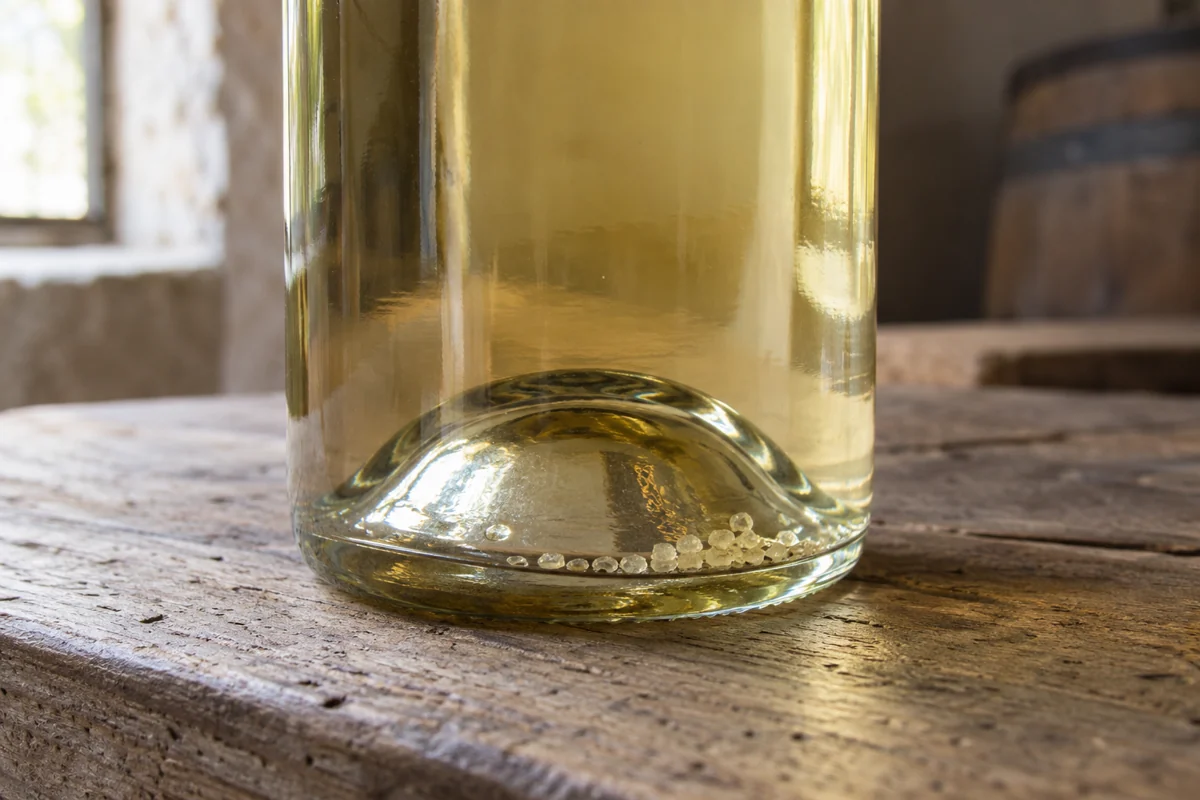
Removing particles already present and reducing the tendency to form new crystals are different tasks. A wine can look clear while still containing dissolved material that may precipitate later. The article on what wine sediment is made of explains the wider range of possible deposits; appearance alone does not establish their composition.
What happens during cold stabilization before bottling?
The conventional sequence is to assess the wine, encourage crystallization, separate the crystals and check the wine intended for packaging. Each stage answers a different question.
- Assess the lot. Establish which wine is being treated and what subsequent cellar work remains. A result from an earlier component is not automatically a result for the final blend.
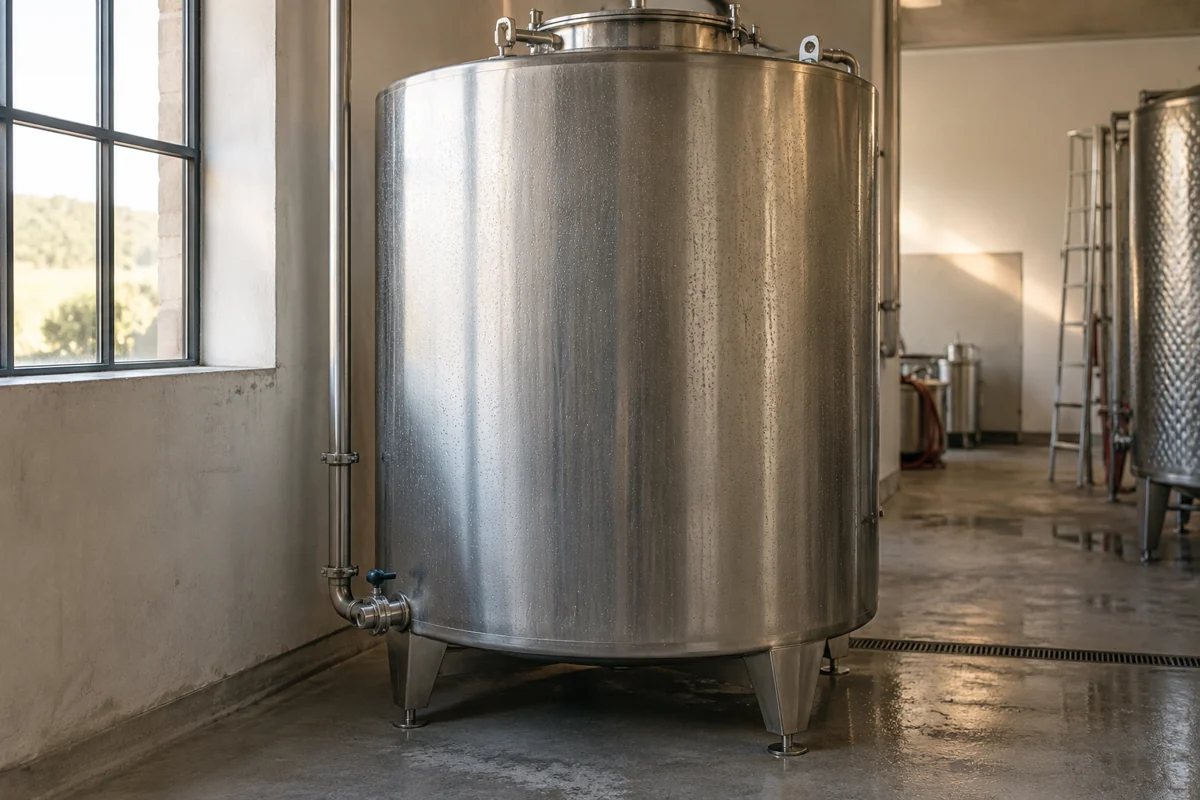
- Chill under selected conditions. The winemaker chooses conditions suited to the wine and the intended stability target. Some processes use KHT seed crystals to encourage crystallization.
- Allow crystals to form. Precipitating material in a tank is an intermediate step, rather than proof that the wine is ready to bottle.
- Separate the wine from the crystals while cold. Racking or appropriate filtration removes the deposited material. Warming first can allow KHT to redissolve.
- Check stability of the final wine. Confirm the result after the relevant cellar operations and before packaging.
Virginia Tech describes chilling and contact seeding, including the importance of separation at the treatment temperature. The Australian Wine Research Institute (AWRI) also lists warming before separation, insufficient filtration and blending after treatment among reasons a previously stabilized wine may fail a later cold-stability check.
That separation step should not be confused with every other use of wine filtration. Different filters serve different purposes; unfined vs unfiltered wine explains the processing terms.
What can cold stabilization prevent, and what needs another check?
The target is KHT precipitation. A successful KHT assessment does not establish the other forms of stability below.
| Stability question | What conventional cold stabilization addresses | What remains to establish |
|---|---|---|
| Potassium bitartrate crystals | Encourages KHT precipitation and removal before bottling | Whether the final wine meets the chosen test and conditions |
| Calcium tartrate crystals | Does not reliably remove this separate instability through ordinary chilling | Calcium-specific risk assessment where relevant |
| Protein haze | Does not establish protein stability | Appropriate protein-stability testing and treatment if required |
| Yeast and bacteria | Does not demonstrate microbial stability | A separate microbial-control strategy appropriate to the wine and packaging |
Calcium tartrate is the important crystal exception. Its precipitation responds differently to temperature and can be slow. AWRI’s calcium-instability reference explains why simple cold tests are ineffective indicators and cold stabilization is not a reliable way to remove this risk. A KHT result should not be extended to every crystalline salt.
Protein haze is another problem. AWRI’s protein-stability fact sheet describes haze-forming grape proteins in white and rosé wine, predictive heat testing, and bentonite treatment to remove proteins. Chilling a wine and obtaining a satisfactory KHT result does not replace that assessment.
Microbial stability concerns living organisms. AWRI’s filtration guidance distinguishes particulate removal from filtration intended to remove microorganisms. Saying that tartrate crystals were filtered out does not identify the filter’s microbial-removal capability or establish the condition of the bottled wine.
Why can a wine pass a cold test and develop crystals later?
A test describes a sample under its stated conditions. It is not an unconditional prediction for the wine’s entire life.
AWRI distinguishes current stability, the tendency to precipitate KHT when chilled now, from potential instability, the possibility of becoming unstable as the wine changes. Naturally occurring crystallization inhibitors can limit crystal growth; maturation and processing can change their effect. AWRI identifies the saturation-point test, often written as Tsat, as a way of assessing potential instability, while the other tests it lists assess current stability.

The practical reading is to ask what was tested and when. Virginia Tech explains that cellar operations affecting wine composition can alter bitartrate stability, supporting a check after those operations, close to bottling. An earlier test on a wine that was subsequently blended answers a different question from a test on the final lot.
Does red wine need cold stabilization too?
Red wine can also have KHT instability. Its color does not establish that it is stable, nor does it prescribe an identical treatment to a white wine.
Virginia Tech discusses the complexing effects of wine constituents, including red-wine components. AWRI notes that changes involving anthocyanins over time can increase susceptibility to KHT crystallization. The useful question is therefore whether the particular red wine has been assessed against its intended stability target, rather than whether every red wine should receive the same chilling treatment.
What temperature and treatment time are required?
There is no single temperature-and-time answer suitable for every wine and process. Wine composition, the treatment approach and the selected stability target need to be considered together. Virginia Tech’s chapter describes these interacting factors and different stabilization approaches.
A laboratory test’s temperature and duration describe that test; they should not be copied as a bulk-wine production schedule. Likewise, the fact that a bottle spent time in a refrigerator does not document a controlled cellar treatment, crystal separation or a stability assessment.
What should you ask about a cold-stability claim?
For a producer’s explanation or a cellar record, these questions help define the claim:
- Which instability was assessed? Establish whether the answer concerns KHT, calcium tartrate, protein or microorganisms.
- Which sample and lot? Check whether it represents the final wine intended for bottling.
- Which method, conditions and date? A bare “passed” leaves the test’s scope unclear.
- What happened after treatment or testing? Ask about blending and further processing, and whether another check followed.
- How were the crystals separated? For a chilling process, treatment and removal belong in the same explanation.
These are questions for interpreting a claim, not a substitute for a winemaker’s release decision. If the question instead concerns material already visible in a bottle, start with the sediment composition guide and seek the producer’s lot-specific information.
Method and sources
Updated October 16, 2026. This article brings together the Virginia Tech technical chapter and AWRI resources opened on that date. The sequence and comparison table summarize their published guidance for general readers. No wine sample was tested, no cellar treatment was observed, and no lot-specific result is asserted. Treatment settings, additive rates and bottle-specific identification are outside this explanation. More related reading is available in the wine knowledge library.