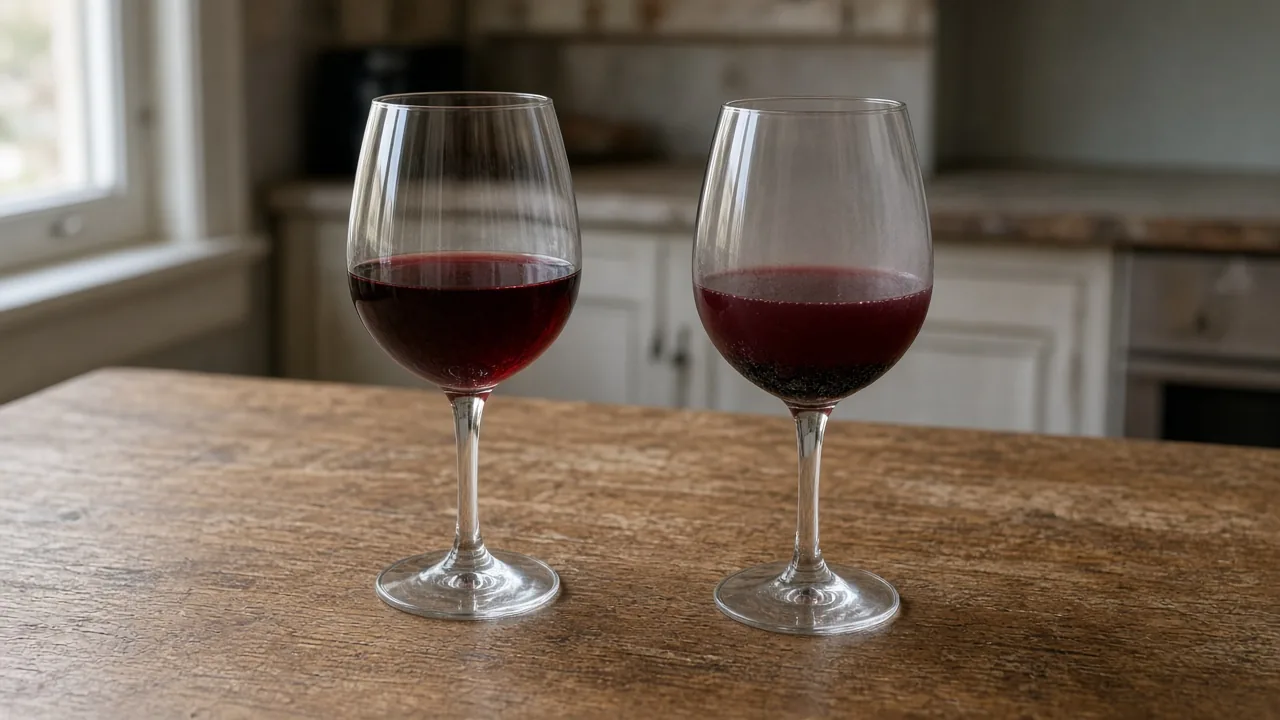
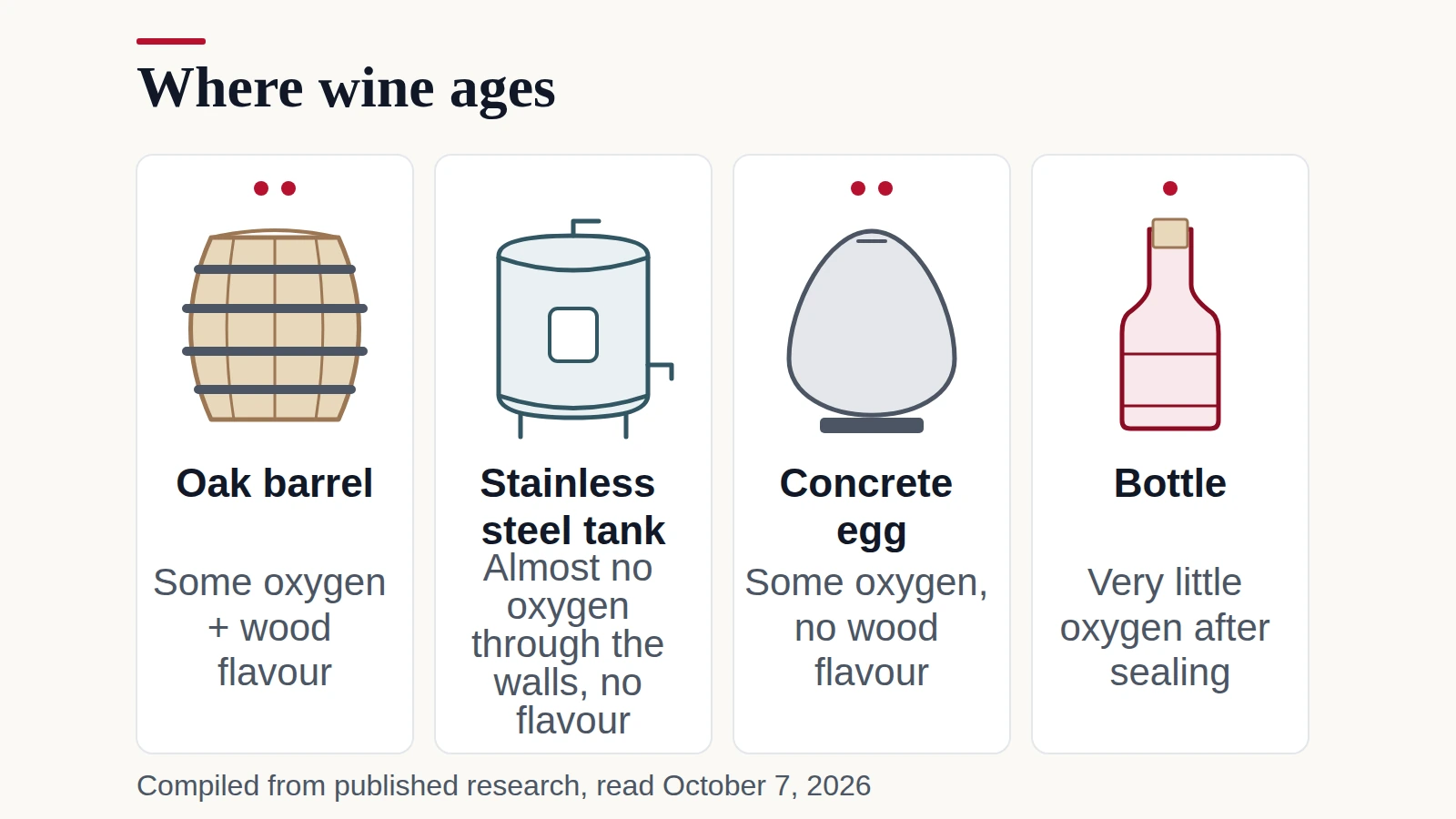
Calling every particle a tartrate crystal can lead to the wrong explanation of a bottle deposit. Wine sediment can contain tartrate salts, pigments and tannins, proteins and polysaccharides, or yeast-containing lees.
Sediment describes material that has settled, rather than a single chemical ingredient. Crystals, a dark deposit and a soft layer suggest different possibilities, but their appearance cannot establish the composition of an unfamiliar sample. This guide separates the main groups, including potassium and calcium tartrate, without treating a photograph as a bottle diagnosis.
What can wine sediment contain?
The main groups are crystalline salts, non-crystalline wine compounds and fermentation-related particles. The Australian Wine Research Institute (AWRI) also lists other particulate material, including grape matter and residues from clarification, in its filtration overview.
Use this table to name a possibility. The visual column is a clue for discussion, not a test result.
| Possible material | Appearance or context that may fit | What still needs confirmation |
|---|---|---|
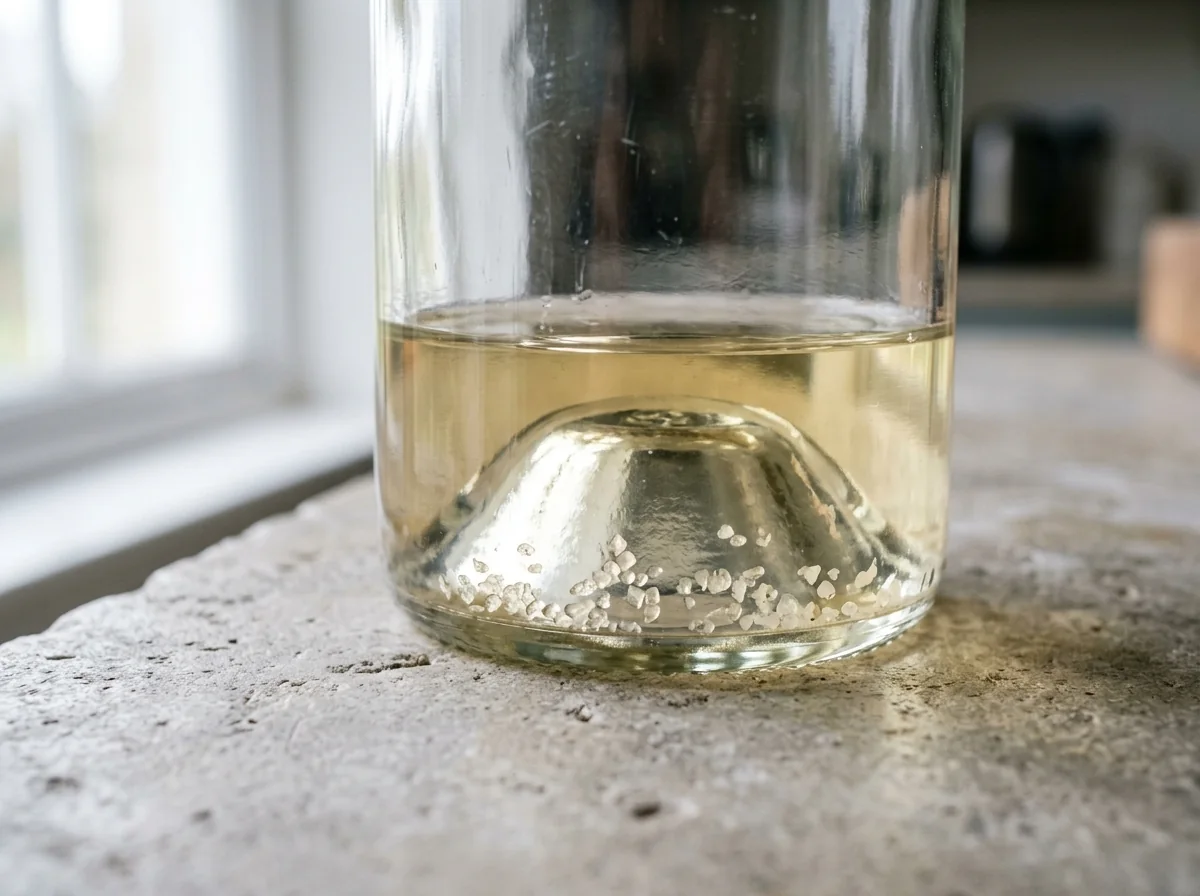
| Potassium hydrogen tartrate, also called potassium bitartrate or KHT | Crystalline material; AWRI describes boat or lens shapes under magnification, with other shapes possible | Whether the crystals are actually KHT |
| Calcium tartrate | Crystals, sometimes appearing well after bottling; often colourless or white under examination | Identity and whether other material is mixed in |
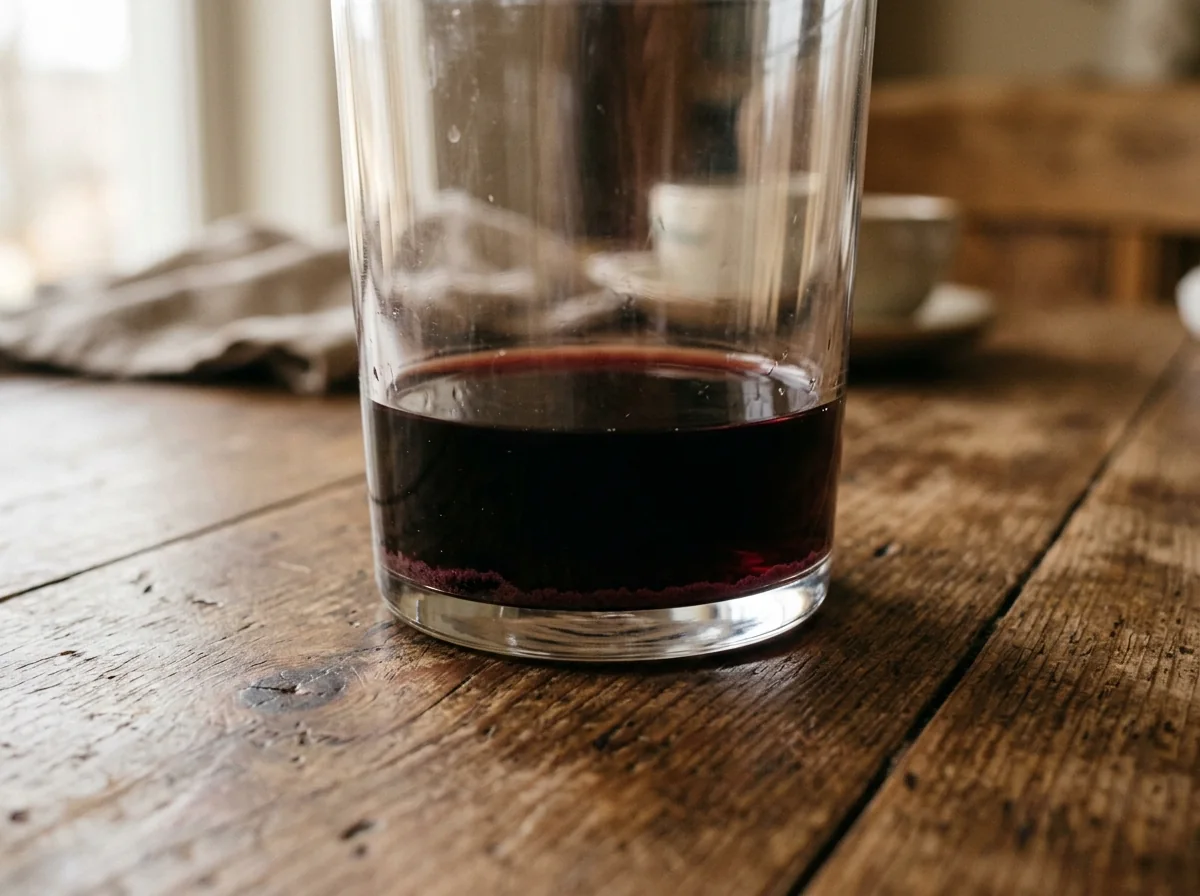
| Pigments and tannins | A coloured deposit in red wine | Which compounds or mixtures are present |
| Proteins and polysaccharides | Non-crystalline material, sometimes associated with haze | Composition; visual inspection does not distinguish these reliably |
| Yeast-containing lees | Settled fermentation material in a cellar vessel | Whether a particular bottle deposit contains yeast or other solids |
| Cork particles or other foreign material | Separate particles that may be confused with wine-derived deposits | Identification of the particle and its origin |
The entries draw on AWRI’s crystalline, amorphous and other-deposits references. Several materials can occur together. A tidy category table does not mean every deposit fits just one row.
Are wine crystals always potassium bitartrate?
No. KHT is the most common crystalline deposit identified by AWRI, but calcium tartrate and less common crystalline compounds also occur.
KHT forms when potassium ions combine with bitartrate ions derived from tartaric acid. Both originate naturally in grapes and wine. Calling crystals simply “tartaric acid” leaves out the distinction between an acid and its salts. The AWRI crystalline-deposits reference describes infrared spectroscopy as a strong identification method: the isolated material’s spectrum is compared with reference spectra.
Potassium tartrate and calcium tartrate behave differently
Cooling promotes KHT precipitation. Winery cold stabilisation therefore addresses a different problem from simply removing particles already visible in a bottle. AWRI’s cold-stabilisation guidance distinguishes KHT stability from calcium tartrate stability.
Calcium tartrate can form slowly, sometimes months after bottling. According to AWRI’s calcium-instability reference, temperature has little effect on its precipitation rate. Simple cold tests are consequently unreliable indicators of this particular instability, and cold stabilisation is not a reliable way to prevent it.
That difference matters when discussing a deposit with a producer: “the wine was cold stabilised” does not, on its own, rule out calcium tartrate. Nor does the timing of a deposit prove which salt it contains.
What makes a dark deposit in red wine?
Pigments and tannins can contribute to red-wine sediment as wine compounds combine and become insoluble. The material need not be pure tannin.
AWRI’s amorphous-deposits reference describes phenolic compounds joining into larger polymers that can eventually precipitate. It also describes mixtures involving proteins, phenolics and polysaccharides. “Amorphous” means the particles lack a definite shape under magnification; “colloidal” describes fine material dispersed in the liquid. A haze and a settled deposit describe different appearances, not necessarily different ingredients.
This is why a dark line at the bottom of a glass does not reveal the precise chemistry. AWRI states that even microscopy alone cannot positively identify an amorphous haze or deposit. Laboratory work must go beyond its colour and shape.
For the broader changes during maturation, see how wine aging works.
Are lees the same as tartrate crystals?
No. Lees are settled cellar material associated with fermentation, including yeast cells; tartrates are crystalline salts.
AWRI’s lees-contact overview explains that yeast-cell components enter wine during contact through passive transfer and autolysis, the breakdown of the cells. Lees contact names a winemaking treatment, not a visual identification of every soft deposit in a finished bottle.
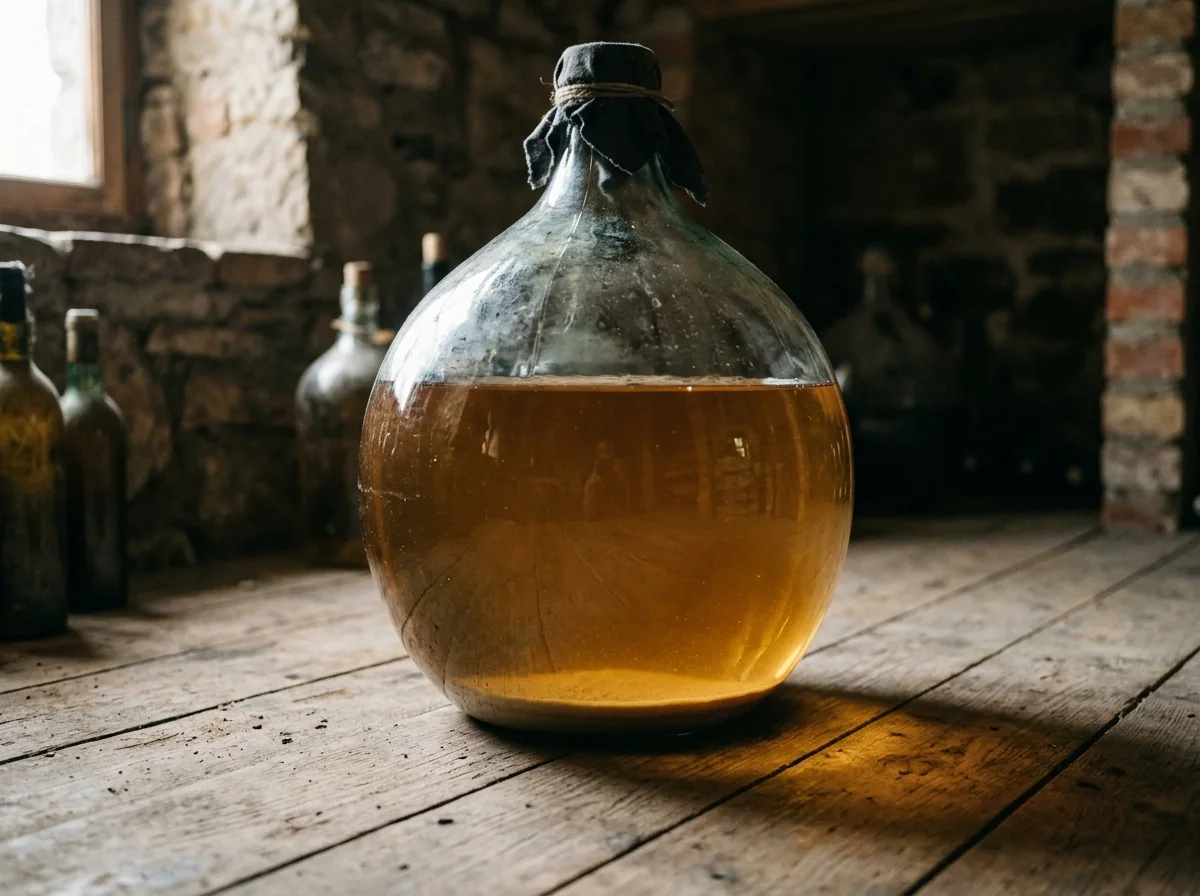
A cellar-vessel photograph helps show what a settled layer looks like. It cannot establish the ingredients in another vessel. Likewise, “unfiltered” describes a processing choice rather than identifying a particle. The distinction between those processing terms is covered in unfined vs unfiltered wine.
What can you establish from appearance alone?
You can describe the deposit and when you noticed it. You cannot confirm its composition, the wine’s processing history or its suitability to drink from that description alone.
The limitation extends beyond different wine compounds looking alike. AWRI’s other-deposits reference includes cork dust, fibres and occasional glass fragments. Its glass discussion specifically notes that shard-like material can be mistaken for a crystalline deposit. “Looks like wine diamonds” is therefore an observation, not a confirmed identification.
For a useful question to the producer or retailer, record:
- The bottle identity and lot information, if available.
- Whether the material is settled, suspended or attached to the glass or closure.
- Its visible colour and form, preferably photographed without disturbing the bottle.
- When it appeared and the storage or chilling history you know.
Ask whether that appearance is expected for the wine and whether the material needs examination. A producer’s records and, where necessary, laboratory identification can answer questions a picture cannot. This article does not provide household chemical tests or decide whether a particular bottle should be consumed.
Method and sources
Updated October 2026. This explanation uses AWRI technical pages opened on October 15, 2026, linked beside the relevant claims and listed below. The composition table brings together their material categories; it is not a diagnostic key. No bottle sample, chemical analysis or tasting was performed for this article. Further explainers are in the wine knowledge library.