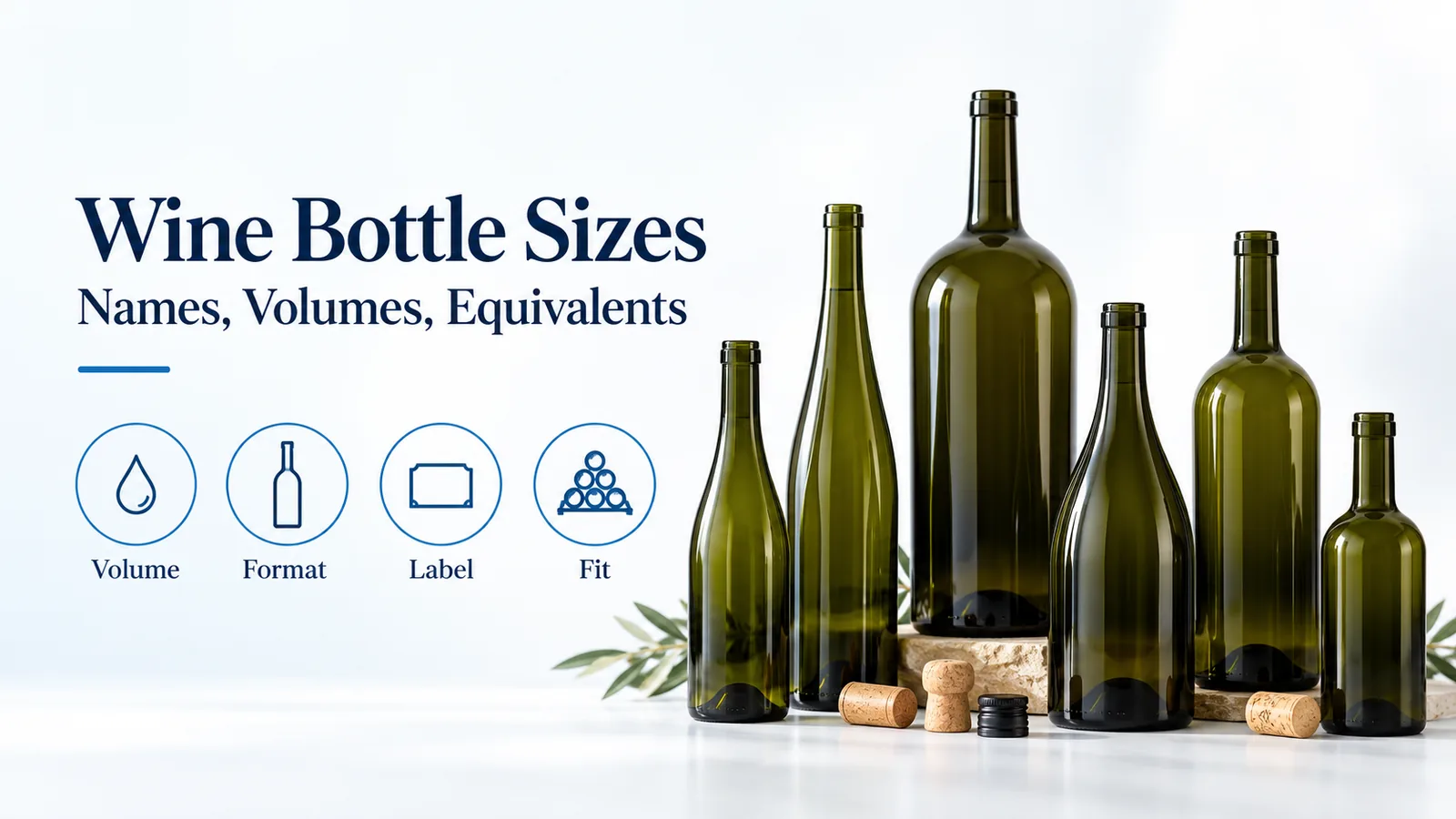
A standard wine bottle holds 750 mL; a magnum holds 1.5 L, equivalent to two standard bottles; and a Nebuchadnezzar holds 15 L, equivalent to twenty. Those are Champagne format definitions from the Comité Champagne’s bottling sheet, fetched October 19, 2026. The equivalents compare nominal wine volume.
Bottle names need context. A traditional format name, an authorized fill size and the dimensions of the glass answer different questions. Start with the chart, then check the volume printed on the particular bottle. More explanations of wine terminology are in the articles collection.
Wine bottle sizes chart: split to Nebuchadnezzar
The table uses Champagne terminology except for the split row, which follows the first-party seller Etched Wine’s format chart. Each equivalent is calculated against a standard bottle’s nominal volume. It does not describe a serving or an external bottle dimension.
| Format name and context | Nominal wine volume | Equivalent standard bottles |
|---|---|---|
| Split — Etched Wine’s terminology | 187.5 mL | 0.25 |
| Quarter — Champagne | 200 mL | About 0.267 |
| Half-bottle / demie — Champagne | 375 mL | 0.5 |
| Medium / pinte — Champagne | 500 mL | About 0.667 |
| Standard / bouteille — Champagne | 750 mL | 1 |
| Magnum — Champagne | 1.5 L | 2 |
| Jeroboam — Champagne | 3 L | 4 |
| Rehoboam — Champagne | 4.5 L | 6 |
| Methuselah — Champagne | 6 L | 8 |
| Salmanazar — Champagne | 9 L | 12 |
| Balthazar — Champagne | 12 L | 16 |
| Nebuchadnezzar — Champagne | 15 L | 20 |
Sources fetched October 19, 2026: Etched Wine’s BIG Bottle FAQ for split; the Comité Champagne format sheet for quarter through Nebuchadnezzar; and the Comité Champagne FAQ for medium/pinte. Centiliter entries have been converted to milliliters; equivalent counts are arithmetic, rounded where marked.
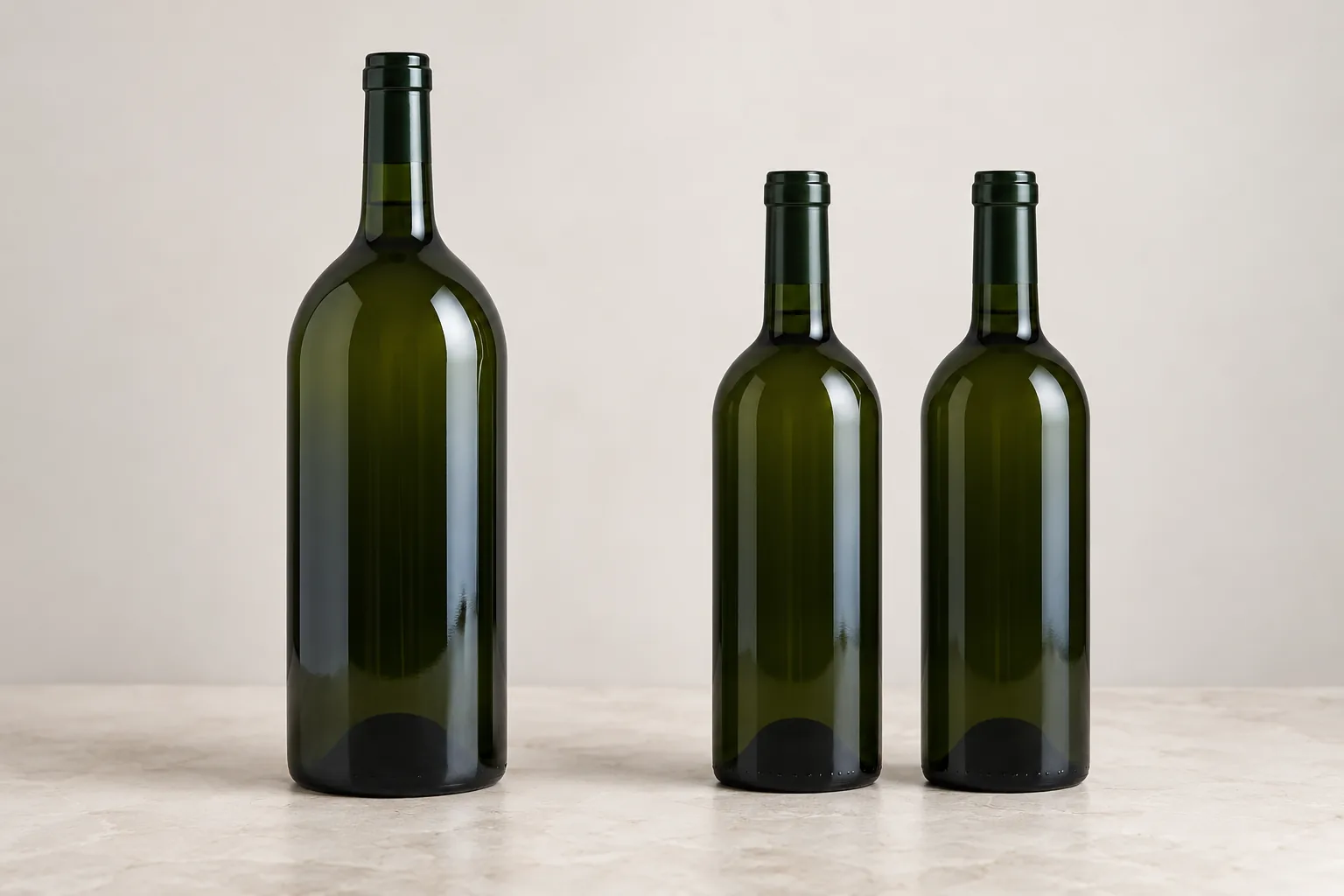
Which named formats are larger?
The Comité Champagne FAQ, fetched October 19, 2026, explicitly defines these additional Champagne formats. Their equivalents use the same standard-bottle baseline as the chart above.
| Champagne format | Nominal wine volume | Equivalent standard bottles |
|---|---|---|
| Salomon | 18 L | 24 |
| Souverain | 26.25 L | 35 |
| Primat | 27 L | 36 |
| Melchizedek or Midas | 30 L | 40 |
This is the source’s named range, without a claim that every producer offers every format or that the final entry is the largest bottle ever made.
How do you convert a large format into standard bottles?
Divide the format’s nominal wine volume by the standard bottle’s nominal volume, using matching units:
Standard-bottle equivalents = format volume in mL ÷ standard-bottle volume in mL.
For the Champagne Nebuchadnezzar, substitute the capacities in the Comité Champagne format sheet, fetched October 19, 2026, and apply the metric liter-to-milliliter conversion:
15 L × 1,000 mL/L ÷ 750 mL = 20 standard-bottle equivalents.
That result describes how much wine the named format contains. It supplies neither a bottle height nor a count of glasses: those require different inputs.
Why do wine bottle size charts disagree?
Names can belong to different conventions. Etched Wine’s chart, fetched October 19, 2026, calls its 3 L entry a double magnum and assigns Jeroboam to still wine at 4.5 L. The Champagne chart above follows its own authority. Keep the wine category and the source beside the name when comparing lists.
Small formats also expose the difference between a nickname and a listed fill. The split convention in Etched Wine’s chart differs from the Champagne quarter entry. Separately, TTB’s net contents guidance, updated May 21, 2026 and fetched October 19, 2026, lists 187 mL among authorized US wine standards of fill. Do not silently change a printed quantity to make it match a traditional fraction.
TTB defines net contents as the quantity of wine in the container. Its guidance lists volumes rather than establishing the traditional names in this article. A name on a chart therefore cannot establish whether a particular package meets US requirements.
There is a source-stated physical threshold for reading that statement: under the same TTB guidance, its numerals and letters must be at least 2 mm high on containers larger than 187 mL, and at least 1 mm on containers of 187 mL or less. That threshold concerns net contents lettering, rather than bottle height, storage clearance or aging time.
What should you check before keeping a large-format bottle?
Record the printed wine volume, then inspect the actual package and the space available for it. The chart establishes capacity; planning storage also requires the bottle’s shape, support and access. The checks below are practical recommendations, not a ranking based on measured failure rates.
| Basis for comparison | What it helps establish | Dominant Failure Mode & Prevention |
|---|---|---|
| Traditional name alone | A format within a stated naming convention | Misidentifying capacity across conventions; keep the source and wine category with the name, then verify printed net contents. |
| Printed net contents | The stated quantity of wine | Treating volume as a rack dimension; measure the actual bottle’s height and widest body, including closure clearance. |
| External bottle and storage space | Whether the particular shape can be accommodated | Discovering an access or support problem after moving the bottle; check the opening, support and handling arrangement first. |
| Format as an aging clue | A reason to investigate the wine’s development conditions | Assigning extra keeping time from size alone; consider the wine, closure and storage history together. |
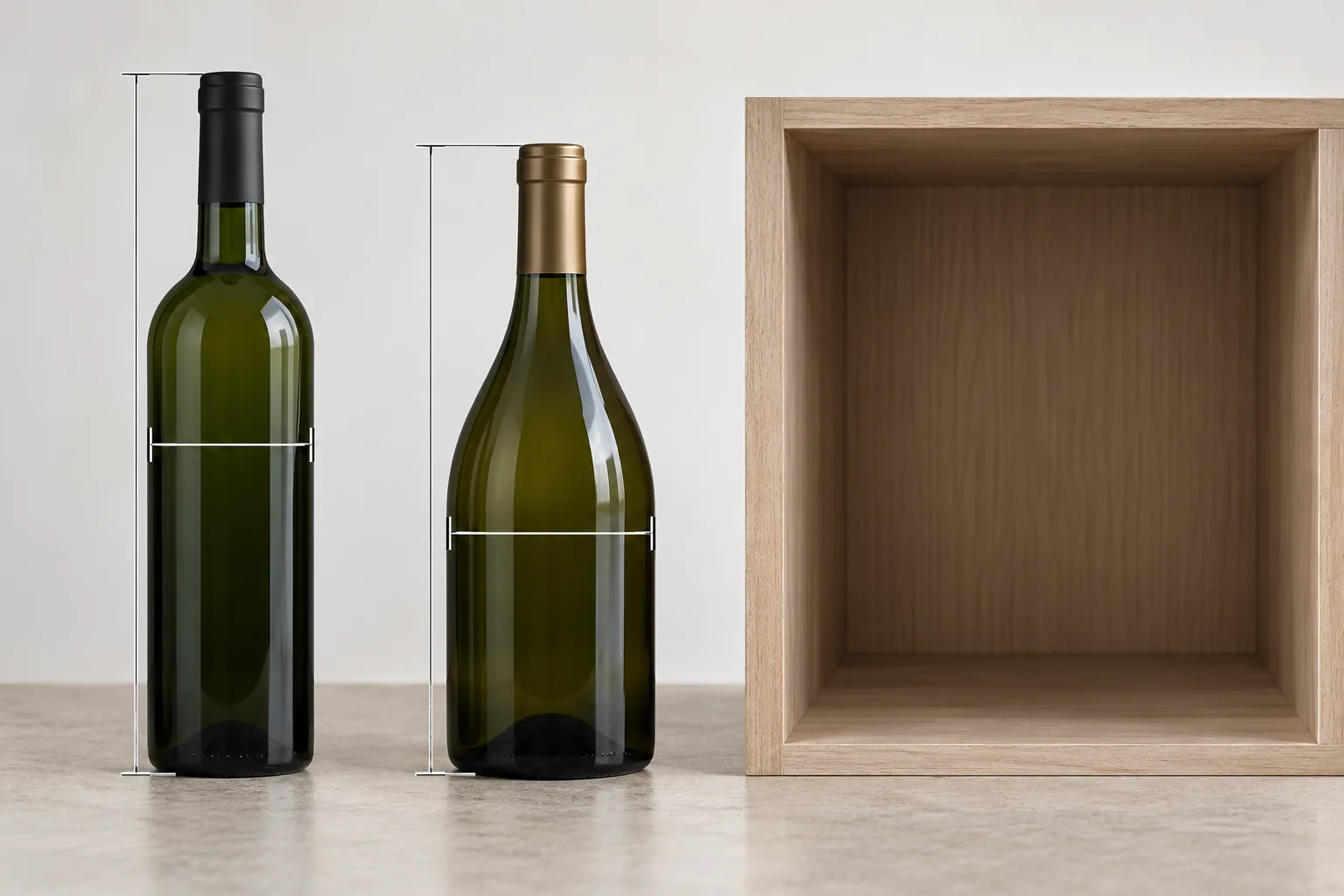
The Comité Champagne’s bottle page, fetched October 19, 2026, describes the magnum as providing favorable aging conditions relative to the standard format. It gives no fixed extension to a bottle’s keeping time. The mechanisms belong in how wine aging works.
If the next decision is where to keep the bottle, use the unopened-wine storage note to assess its surroundings and history. A format name cannot supply those missing conditions.
Sources and calculation method
This chart combines Comité Champagne’s format definitions with Etched Wine’s split and still-wine terminology, all fetched October 19, 2026. US fill and lettering statements come from TTB’s dated guidance. Standard-bottle equivalents are calculated from nominal capacities; the fit checks are editorial recommendations. The chart supplies no universal bottle dimensions or format-based shelf-life promise.