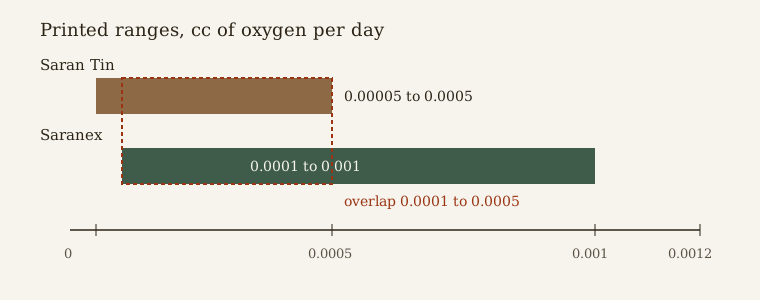
Treating every Saranex liner as ten times a Saran Tin liner fails the ranges AWRI prints. The applying-screw-caps page gives Saran Tin 0.00005–0.0005 cc of oxygen per day and Saranex 0.0001–0.001 cc of oxygen per day, and those intervals overlap.
Koeppel on Wine is an independent information site. The About page states who operates it. This page compares published liner ranges. It does not score a wine, describe a flavor, or say which cap to buy. The separate page on whether a screw cap can be corked covers taint, not these rates.
The two printed ranges overlap
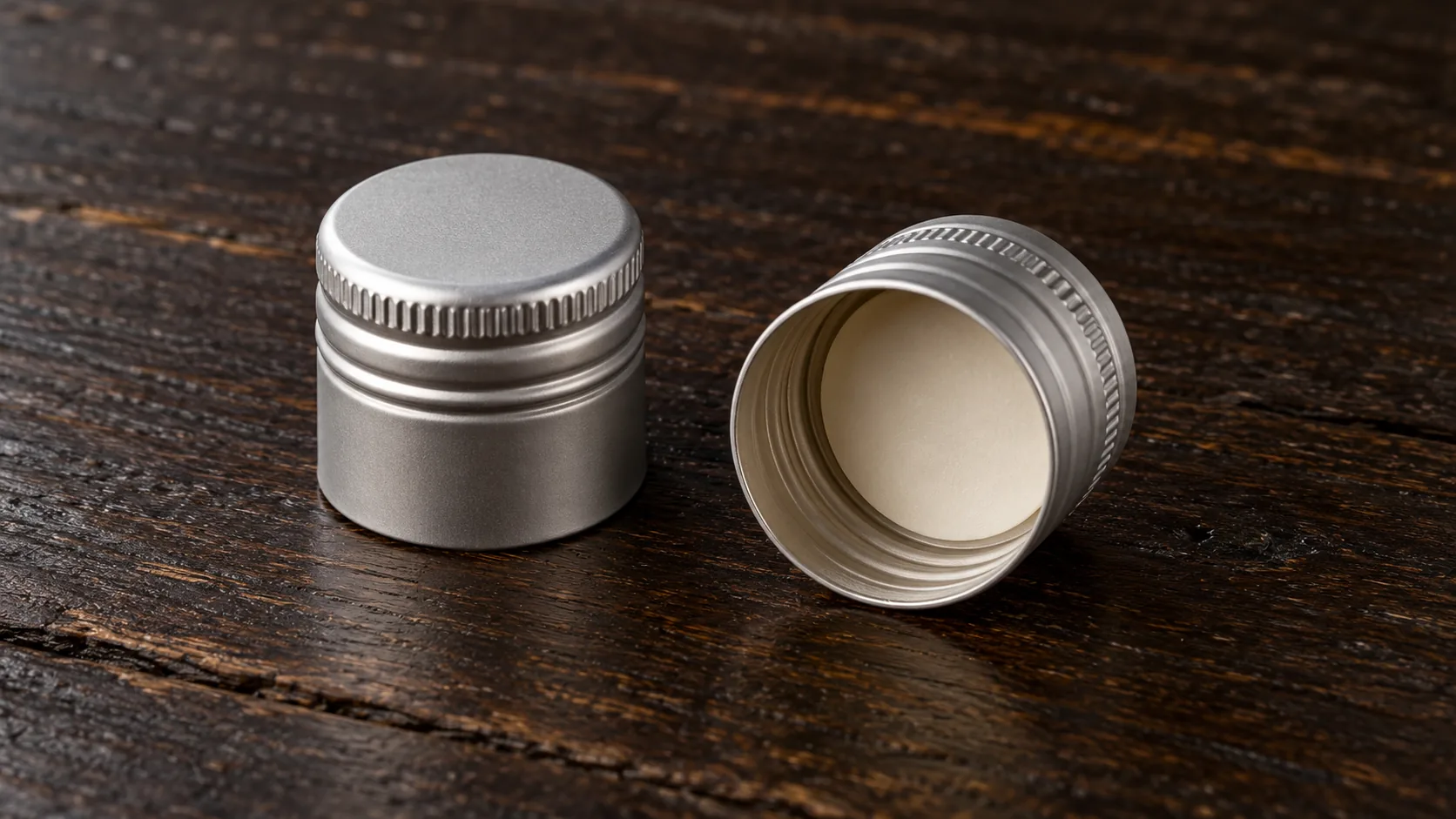
AWRI’s applying-screw-caps page names two liner types. Saran is polyvinylidene chloride (PVDC). Saran Tin has a fine tin layer to reduce oxygen permeability. Saranex does not. Each liner is three or four main layers plus an expandable polyethylene compression layer. The screw cap itself is aluminium. It seals by compressing a disc against the bottle rim, not against the bore.
The same page prints the oxygen transmission rates above and says the Saranex rate is an order of magnitude higher, at around 0.0001–0.001 cc of oxygen per day. A second AWRI sheet, “Oxygen transmission rate,” says Saranex is typically marginally higher than tin/Saran. Both sentences are on AWRI pages. They do not say the same thing, and the numbers in the first sentence already overlap.
| Liner fact | What AWRI prints | Dominant failure mode and prevention |
|---|---|---|
| Saran Tin | 0.00005–0.0005 cc O2/day; a tin layer to cut permeability; a large role in the Australian and New Zealand market | Treating every tin liner as ten times tighter than every Saranex liner. Prevention: the printed ranges overlap from 0.0001 to 0.0005 |
| Saranex | 0.0001–0.001 cc O2/day; called an order of magnitude higher on the applying page and marginally higher on the OTR sheet | Importing one of those two wordings as if it cancelled the other. Prevention: quote both, then divide the printed ends |
| Units | Cubic centimetres of oxygen per day on these three AWRI sources | Mixing in a milligram-per-year figure from another paper. Prevention: leave other units off this comparison |
| Redraw | The closure elongates by about 0.5 mm | Checking only the top of the finish. Prevention: the applying page cites CE.T.I.E Bottling Guide No. 6 (2016) for a seal on the top and the side |
| Ullage | Greater than 30 mm for a standard BVS at 20–25°C | Filling to the rim and blaming the liner. Prevention: keep the ullage the applying page names |
Saran Tin liners play a large role in the Australian and New Zealand market on that applying page. Producers in Europe who use screw caps, the same page says, tend towards Saranex because of a perception that wines sealed with Saran Tin can develop reductive characters from very low oxygen ingress. That sentence is a perception. It is not a measurement that every tin liner causes a fault.
What the October 2020 review adds
Technical Review No. 248 (October 2020) says Saran/tin is the most common screwcap lining in Australia and that Saranex is also available. Screwcaps have the lowest oxygen transmission rate, and that rate still varies by lining. The review says the best performing natural corks have rates comparable to screwcaps, and that screwcap variability is very low.
Figure 2 in that review is a bar chart. Its vertical axis is marked from 0.000 to 0.012 cc of oxygen per day, in steps of 0.002. The categories include Screw Cap (Saran/Tin) and Screw Cap (Saranex), then technical cork, glass, synthetic cork, and natural cork. This page does not assign heights to those bars. The text extract does not print a number for each bar.
The same review says low-OTR closures do not cause reductive characters. If a wine was made with that propensity, low oxygen transmission makes the character more likely to appear, and a higher rate may only modulate it. International Wine Challenge data in the review show the same rejection share for reductive or sulfide character across cork, synthetic closures, and screwcaps. The review does not print a separate number for that sulfide share. Figure 3’s axis runs from 0.0% to 5.0%, and this page does not read a bar height off it.
The OTR sheet adds a market figure: screw caps seal ~90% of all bottled wine in Australia, and their transmission is very low to low and consistent. That share is packaging, not an oxygen rate.
The ratio of the printed endpoints
Worked example. Use the four ends on the applying-screw-caps page. Do not pick one cap and call it the typical rate. The page prints ranges, and it says the Saranex figure is “around” those ends.
Top end of Saranex divided by the top end of Saran Tin:
0.001 / 0.0005 = 2
Bottom end of Saranex divided by the bottom end of Saran Tin:
0.0001 / 0.00005 = 2
The overlap is the stretch where a printed Saranex rate is also inside the tin range: from 0.0001 to 0.0005 cc of oxygen per day. The widest gap between a printed end of one range and a printed end of the other is:
0.001 / 0.00005 = 20
That 20 is the high end of Saranex over the low end of Saran Tin. It is not the ratio of two caps taken from the same point in each range. “An order of magnitude” remains AWRI’s phrase on the applying page. “Marginally higher” remains the phrase on the OTR sheet. The endpoint ratio of the numbers they print beside the first phrase is 2.

Redraw, ullage, and an immediate torque test
The applying page cites CE.T.I.E Bottling Guide No. 6 (2016) for redraw: the closure elongates by approximately 0.5 mm, and the seal is formed on the top and the side of the glass finish. A cap that looks seated from above can still miss the side seal.
Ullage for a standard BVS should be greater than 30 mm so the wine can expand at 20–25°C. That threshold is a fill height. It is not an oxygen-transmission rate.
The same page cites Stelzer (2005) for opening torque. GlobalCap’s printed range is 0.68–2.83 Nm when the test is twenty-four hours after capping. If the test is immediate, the limits increase by 10%. The low end of that immediate check is:
0.68 × 1.10 = 0.748 Nm
The page also prints Auscap at 1.40–2.80 Nm and Péchiney at 0.90–1.81 Nm for a 30 mm diameter. Those are the cited ranges. They are not a ranking of liners.
What this page does not decide
- A flavor, a score, or a statement that one liner makes a better wine. Koeppel on Wine is an independent information site. The About page states who operates it.
- A claim that low oxygen transmission causes reductive character. The October 2020 review says it does not.
- A conversion from cubic centimetres per day into milligrams per year. These three AWRI sources are left in cc/day.
- A bar height from Technical Review Figure 2 or Figure 3. Figure 2’s axis runs to 0.012 cc of oxygen per day. Figure 3’s axis runs to 5.0%. This page does not read a height off either chart.
- Which closure to buy, or a health effect of wine.
FAQ
Is every Saranex liner ten times a Saran Tin liner?
No. The applying page calls Saranex an order of magnitude higher and prints 0.0001–0.001 against 0.00005–0.0005. Each matching pair of ends divides to 2, and the ranges overlap.
Do the two AWRI liner ranges overlap?
Yes. From 0.0001 to 0.0005 cc of oxygen per day is inside both printed intervals. The 20-fold gap is only the high Saranex end over the low tin end.
Does a low oxygen transmission rate cause reductive character?
The October 2020 review says it does not. A wine made with that propensity is more likely to show it under low transmission, and the review does not print a rejection percent.