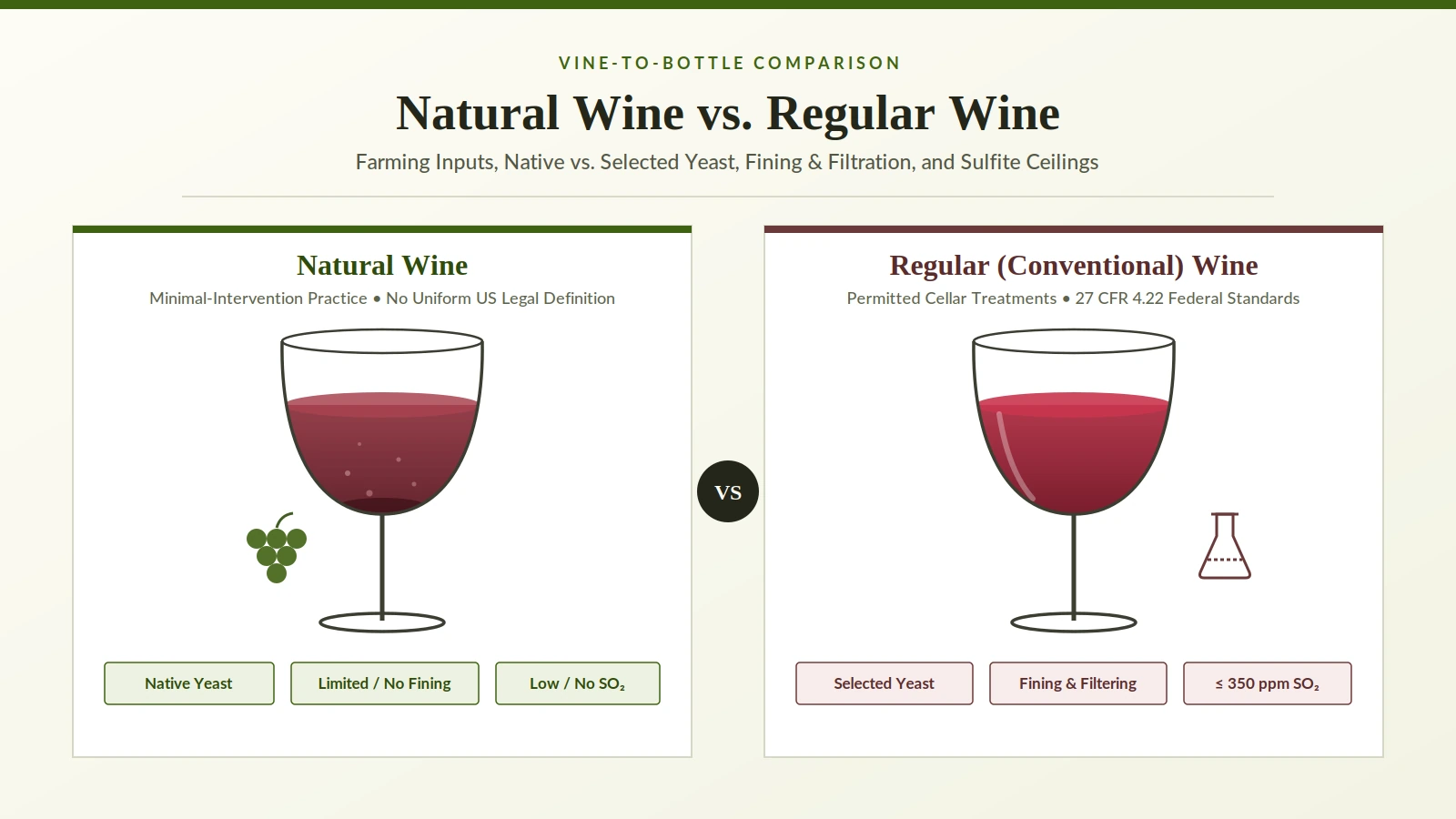
Natural wine differs from regular conventional wine in vineyard inputs, fermentation yeast, cellar clarification, sulfite limits, and legal oversight. While natural wine lacks a uniform international definition, it is usually made from pesticide-free grapes fermented with native yeast, given limited or no fining and filtration, and bottled with limited or no sulfur dioxide, whereas regular U.S. wine allows permitted cellar treatments and up to 350 ppm total sulfur dioxide.
Separating actual vineyard and cellar interventions from marketing shorthand helps readers compare bottles accurately across Wine Explained and the wider wine knowledge library. Treating natural wine as legally identical to certified organic or biodynamic wine—or mistaking cellar spoilage for terroir—leads to common misreadings at the shelf and in the glass.
What Winemaking Interventions Separate Natural Wine From Regular Wine?
Natural wine typically eliminates synthetic vineyard chemicals, commercial yeast inoculation, routine fining and filtration, and conventional sulfite doses, relying instead on small-scale traditional techniques. Regular conventional wine in the United States may legally use filtering equipment, fining or sterilizing agents, pasteurization, refrigeration, corrective cellar treatments, and up to 350 ppm total sulfur dioxide under federal cellar regulations.
Although natural wine has no uniform universal definition, producers commonly follow four practical boundaries: grapes farmed without pesticides or herbicides, spontaneous fermentation with native yeast, limited to no filtration and fining, and no additives other than limited to no sulfur dioxide (SO₂). Regular U.S. winemaking operates under 27 CFR § 4.22, which governs blends, cellar treatment, and alteration of class or type. Paragraph 4.22(b)(1) permits up to 350 parts per million of total sulfur dioxide in finished wine, while paragraphs 4.22(c)(1) through (c)(4) permit filtering equipment, fining or sterilizing agents, pasteurization, refrigeration, and minimal corrective treatments for cloudiness, precipitation, or abnormal color, odor, or flavor.
| Production Stage | Natural Wine (Typical Practice) | Regular Conventional Wine (U.S. Rules) | Primary Practical Effect |
|---|---|---|---|
| Vineyard farming | Grapes farmed without pesticides or herbicides | Conventional fertilizers, pesticides, and herbicides permitted | Changes chemical input rules in the vineyard |
| Fermentation yeast | Spontaneous fermentation with native yeast | Commercial or non-native yeast strains permitted | Shifts fermentation kinetics and microbial diversity |
| Fining and filtration | Limited to no fining or physical filtration | Filtering equipment and fining or sterilizing agents allowed under 27 CFR 4.22(c)(1) | Controls haze, sediment retention, and microbial removal |
| Stabilization and correction | Minimal physical or chemical cellar intervention | Pasteurization, refrigeration, and minimal corrective treatments allowed under 27 CFR 4.22(c)(2)–(4) | Reduces cloudiness, precipitation, and off-odors |
| Sulfur dioxide (SO₂) | Limited to no SO₂ (40 mg/L ceiling in Georgia’s 2026 law) | Up to 350 ppm total SO₂ in finished wine under 27 CFR 4.22(b)(1) | Governs antioxidant and antimicrobial protection |
| Legal oversight | No U.S. statutory definition or mandatory audit | Federal cellar rules and mandatory 10 ppm label trigger under 27 CFR 4.32(e) | Determines what claims are audited on the label |
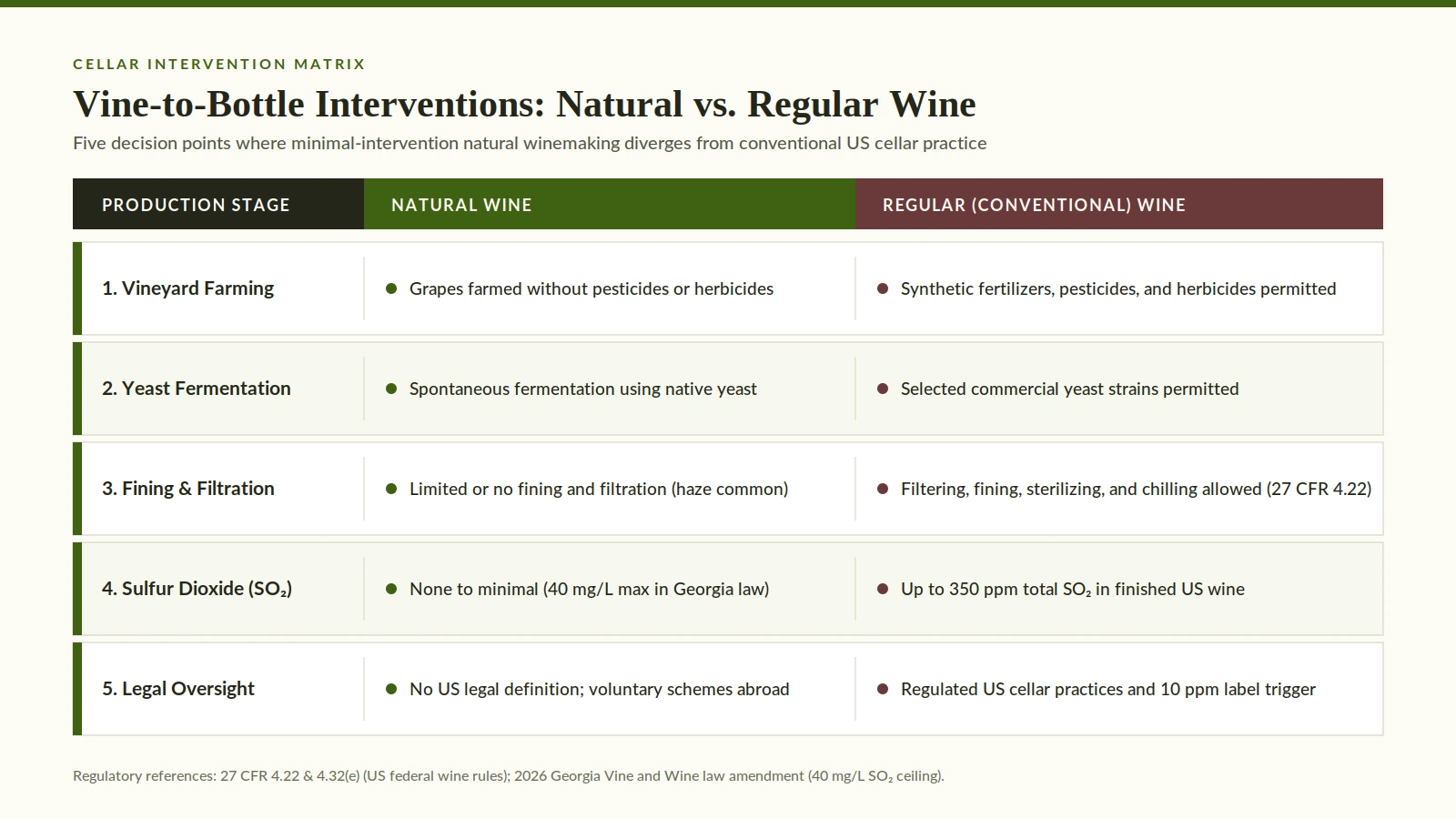 Five cellar decision points separating minimal-intervention natural wine from conventional U.S. wine governed by 27 CFR 4.22.
Fining and filtration are two separate cellar steps rather than one combined action: fining uses an added preparation that binds and precipitates targeted compounds, whereas filtration physically removes solids or microbes. For a detailed process breakdown of clarification mechanics and bottle solids, see our guides to unfined versus unfiltered wine and what wine sediment is made of.
How Do Organic, Biodynamic, and Natural Wine Definitions Differ on the Bottle?
Organic wine and biodynamic wine are audited certification categories tied to published farming and cellar rules, whereas natural wine remains an informal production movement with no U.S. statutory definition. In the United States, USDA certified organic wine forbids added sulfites, Made with Organic Grapes allows up to 100 ppm total sulfites, and biodynamic wine requires Demeter Association certification.
By definition, organic wine is made from grapes grown under organic farming principles that exclude artificial chemical fertilizers, pesticides, fungicides, and herbicides. Biodynamic wine builds on organic farming—employing compost as fertilizer and avoiding most pesticides—while adding soil supplements prepared according to Rudolf Steiner’s 1924 Agriculture Course formulas and following a planting calendar tied to astrological configurations. To carry the biodynamic label, a wine must satisfy certification standards laid down by the Demeter Association; by 2013, over 700 vineyards worldwide covering more than 10,000 hectares (24,710 acres) held biodynamic certification.
| Wine Category | Farming Requirement | Yeast Rule | Sulfite Ceiling | Certification & Legal Status |
|---|---|---|---|---|
| Natural wine | Usually grapes farmed without pesticides or herbicides | Native spontaneous yeast | Limited to no SO₂ (40 mg/L max under Georgia’s 2026 law) | No U.S. law or mandatory audit; voluntary French Vin Methode Nature label (2020) |
| USDA Certified Organic Wine (U.S.) | Certified organic grapes excluding synthetic fertilizers, pesticides, fungicides, and herbicides | Organic yeast required unless commercially unavailable under 7 CFR 205.605(a)(30) | No added sulfites permitted under USDA NOP | Federally regulated under the USDA National Organic Program |
| Made with Organic Grapes (U.S.) | Certified organic grapes | Non-native yeasts permitted | Up to 100 ppm total sulfites under 7 CFR 205.605(b)(35) | Federally regulated U.S. category with no European equivalent |
| EU Organic Wine | Harmonized EU organic farming rules across member states | Subject to harmonized EU organic winemaking rules | Added sulfites permitted at lower caps than conventional EU wine | Harmonized statutory framework across EU member countries |
| Biodynamic Wine | Organic farming plus Rudolf Steiner soil preparations and astrological calendar | Follows certifying body standards alongside organic principles | Governed by Demeter certification and local law | Third-party certification by the Demeter Association required |
| Regular Conventional Wine (U.S.) | Conventional synthetic vineyard inputs permitted | Commercial or native yeast permitted | Up to 350 ppm total SO₂ under 27 CFR 4.22(b)(1) | Governed by federal TTB cellar and labeling regulations |
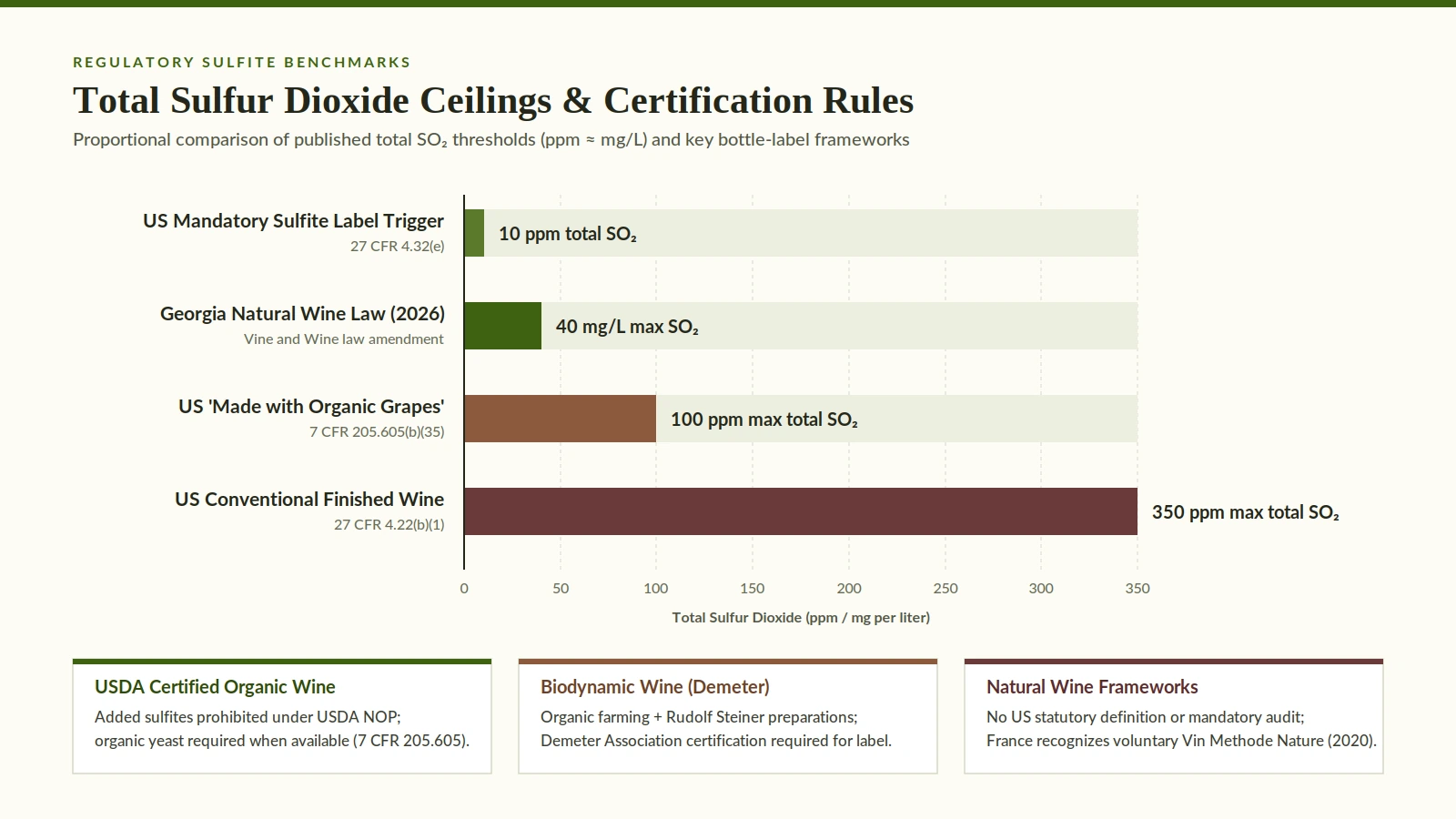 Published total sulfur dioxide ceilings and third-party certification requirements across U.S., Georgian, and voluntary international wine frameworks.
US, European, French, and Georgian Regulatory Boundaries
Federal organic ingredient lists under 7 CFR § 205.605 draw a sharp divide inside the U.S. organic market. Under paragraph (a)(30), yeast used as a fermentation agent in organic-labeled products must be organic for human consumption, although nonorganic yeast may be used when organic yeast is not commercially available. Under paragraph (b)(35), synthetic sulfur dioxide is allowed only in wine labeled Made with Organic Grapes, provided total sulfite concentration does not exceed 100 ppm. Europe has no comparable Made with Organic Grapes tier; instead, harmonized European Union rules permit added sulfites in organic wine at lower maximum levels than conventional production.
For natural wine specifically, standards have historically been shaped by producer associations and private schemes rather than national statutes. Two developments stand out internationally. In 2020, France recognized the producer-developed voluntary label Vin Methode Nature, which sets requirements for vineyard management, fermentation methods, and additives without establishing a statutory legal definition of natural wine. In 2026, the Parliament of Georgia went further by amending its Vine and Wine law to define natural wine legally as wine produced through the spontaneous fermentation of organically grown grape must, prohibiting other general oenological practices and substances while capping sulfur dioxide at 40 mg/L. For complete U.S. sulfite declaration and bottling SO₂ chemistry details, see sulfites in wine label declaration and bottling SO₂.
Why Does Natural Wine Often Taste Cloudier, Tangier, or Funkier Than Regular Wine?
Natural wine often appears hazier and tastes tangier or funkier because skipping fining, sterile filtration, and protective sulfur dioxide leaves suspended solids and viable microbes in the wine. Without those conventional safeguards, yeasts and bacteria can generate higher volatile acidity, barnyard-like Brettanomyces phenols, palate-emerging mousiness, premature oxidation, or slight in-bottle spritziness.
Visual Haze, Sediment, and In-Bottle Refermentation
Visual differences between an unfiltered natural bottle and a clarified regular bottle start with unremoved solids and live microorganisms. In wine fault diagnostics, unusual breaks in a wine’s color can signal excessive copper, iron, or proteins that were not removed during fining or filtering.
Live microbes create additional visual and textural shifts after bottling. When wine containing residual sugar is bottled under non-sterile conditions, yeast can referment the remaining sugar in glass, causing cloudiness, excess ethanol, slight carbonation, and coarse odors; winemakers prevent refermentation by bottling wines dry below 1.0 g/L residual sugar, sterile filtering prior to bottling, or using preservatives such as dimethyl dicarbonate. Similarly, wines that have not completed malolactic fermentation can be contaminated by lactic acid bacteria, triggering in-bottle refermentation that leaves the wine turbid, swampy, and slightly effervescent or spritzy—an outcome conventionally avoided by sterile filtering directly before bottling.
Volatile Acidity, Brettanomyces, Mousiness, and Oxidation Thresholds
Wine tasting separates minor flaws—attributes that depart from typical profiles while leaving the wine drinkable to most tasters—from major wine faults that overwhelm the wine. Critics of minimal-intervention winemaking note that traits such as elevated volatile acidity are often considered faulty in conventional winemaking, whereas supporters may view restrained levels as part of stylistic diversity. Published chemical thresholds help distinguish subtle complexity from clear microbial spoilage:
| Compound or Condition | Microbial or Chemical Origin | Published Sensory Threshold | Typical Sensory Descriptor | Conventional Cellar Control |
|---|---|---|---|---|
| Acetic acid (volatile acidity) | Acetic acid bacteria and spoilage yeasts | Above 700 mg/L detectable; above 1.2–1.3 g/L unpleasant | Sharp, burning vinegar acidity | Hygiene, oxygen control, and SO₂ management |
| Ethyl acetate | Esterification of ethanol and acetic acid | Linked to elevated acetic acid levels | Vinegar, paint thinner, and nail polish remover | Limiting acetic acid bacteria and spoilage yeasts |
| 4-ethylphenol (Brettanomyces) | Brettanomyces yeast metabolism | Above 140 μg/L | Band-aids, barnyard, horse stable, antiseptic | Barrel sanitation, SO₂, and sterile filtration |
| 4-ethylguaiacol & isovaleric acid | Brettanomyces yeast metabolism | Above 600 μg/L (4-ethylguaiacol) | Bacon, spice, cloves, smoky; sweaty, cheese, rancidity | Barrel sanitation, SO₂, and sterile filtration |
| Mousiness | Brettanomyces or Lactobacillus brevis, L. fermentum, L. hilgardii | Non-volatile at wine pH; emerges with basic saliva | Mouse cage or mouse urine at back of palate | Microbial control during malolactic fermentation and bottling |
| Phenolic oxidation | Oxygen reacting with anthocyanins, catechins, and epicatechins | Visual yellowing or browning plus aroma loss | Flattening of color, flavor, and fresh fruit aroma | Sulfur dioxide or erythorbic acid additions and oxygen control |
Mousiness deserves special attention in zero-sulfite wines because it hides from the nose. Because the causal compounds are not volatile at wine pH, a mousy bottle can smell clean on opening, only revealing its mouse-cage or mouse-urine character at the back of the mouth after mixing with slightly basic saliva. To evaluate oxidative browning and spoilage aromas in any bottle, see how to tell if wine has gone bad from oxidation and faults.
What Is the Practical Winemaking Point of Minimal-Intervention Natural Wine?
The practical goal of minimal-intervention natural wine is to produce small-scale, traditional wine from pesticide-free grapes without industrial additives, prioritizing vintage diversity and perceived authenticity over uniform consistency. That philosophy trades predictable bottle-to-bottle stability for an unadjusted snapshot of harvest fruit and native cellar microbiology.
Some historical accounts trace the modern natural wine movement to 1960s Beaujolais in France, where winemakers Marcel Lapierre, Jean Foillard, Charly Thevenet, and Guy Breton—known as the Gang of Four—sought a return to pre-World War II winemaking without synthetic pesticides or chemicals, guided by oenologists Jules Chauvet and Jacques Neauport who studied low-additive vinification. Even after rapid expansion in wine bars across Paris, Copenhagen, London, New York, Tokyo, and Tbilisi, natural wine remains a small niche: in France, natural wine accounted for roughly 2% of wine estates in 2024.
Debate within the trade centers on reproducibility and agricultural evidence. Critics emphasize that low-intervention cellar work increases variation in quality, stability, and consistency between bottles and vintages. In the vineyard, controlled comparisons also separate farming philosophies from mystical claims: a commercial vineyard study in Ukiah, California comparing biodynamic and general organic blocks found no differences in soil quality, yield per vine, clusters per vine, or cluster and berry weight, underscoring that meticulous farming itself—rather than esoteric preparations—drives measurable vineyard outcomes.
How Can You Tell Certified Biodynamic or Organic Wine From Informally Labeled Natural Wine?
You can tell certified organic or biodynamic wine from informally marketed natural wine by looking for audited third-party seals and regulated wording rather than the word natural. Biodynamic labels require Demeter Association certification, U.S. organic tiers use exact USDA wording, and U.S. sulfite statements follow strict federal 10 ppm testing thresholds.
When checking a bottle, verify these five concrete label indicators instead of relying on retail shelf tags:
- Biodynamic certification mark: Confirm Demeter Association certification; in the United States, natural winemaking carries no statutory inspection or verification process unless the bottle holds an audited certification such as biodynamic or organic.
- Exact U.S. organic wording: Distinguish USDA certified organic wine (no added sulfites allowed) from Made with Organic Grapes (certified organic grapes with up to 100 ppm total sulfites permitted under 7 CFR 205.605(b)(35)).
- Voluntary natural wine logos abroad: On French bottles, look for the voluntary Vin Methode Nature certification introduced in 2020 and recognized by the French government, which audits vineyard, fermentation, and additive rules.
- Mandatory U.S. sulfite declaration: Under 27 CFR § 4.32(e), any U.S. wine containing 10 or more ppm total sulfur dioxide—whether added or naturally occurring—must state Contains sulfites or a sulfiting agent declaration on a front, back, strip, or neck label.
- Sulfite waiver rules and prohibited claims: Under TTB G 2019-3, TTB will not approve a grape-wine label omitting the sulfite declaration unless a TTB Beverage Alcohol Laboratory analysis confirms less than 10 ppm total sulfur dioxide. TTB strictly prohibits claims such as sulfite free, free of sulfites, or contains no sulfites, noting that naturally occurring sulfite levels vary between batches, production cycles, and vintages.
Where Does Low-Intervention Wine Sit Between Natural and Conventional Cellar Practice?
Low-intervention wine sits in the broad middle ground between strict zero-sulfite, unfiltered natural wine and full conventional cellar treatment. Producers in this middle tier commonly farm organically or biodynamically and ferment with native yeast while selectively using small sulfur dioxide additions, chilling, or filtration to control oxidation and bottle-to-bottle spoilage.
Because natural wine lacks a universal statutory definition in the United States and most major markets, cellar practices operate along a continuum rather than a binary split. At one end sits strict additive-free, unfiltered natural wine accepting higher bottle and vintage variation; at the opposite end sits conventional production utilizing the full toolkit permitted under 27 CFR 4.22, including fining, sterile filtration, refrigeration, pasteurization, and up to 350 ppm total sulfur dioxide. Many low-intervention producers occupy the space between those poles—retaining pesticide-free farming and minimal cellar manipulation while adding modest sulfur dioxide or sterile filtration when residual sugar, incomplete malolactic fermentation, or high oxygen exposure would otherwise trigger bottle refermentation, volatile acidity spikes, or phenolic oxidation.