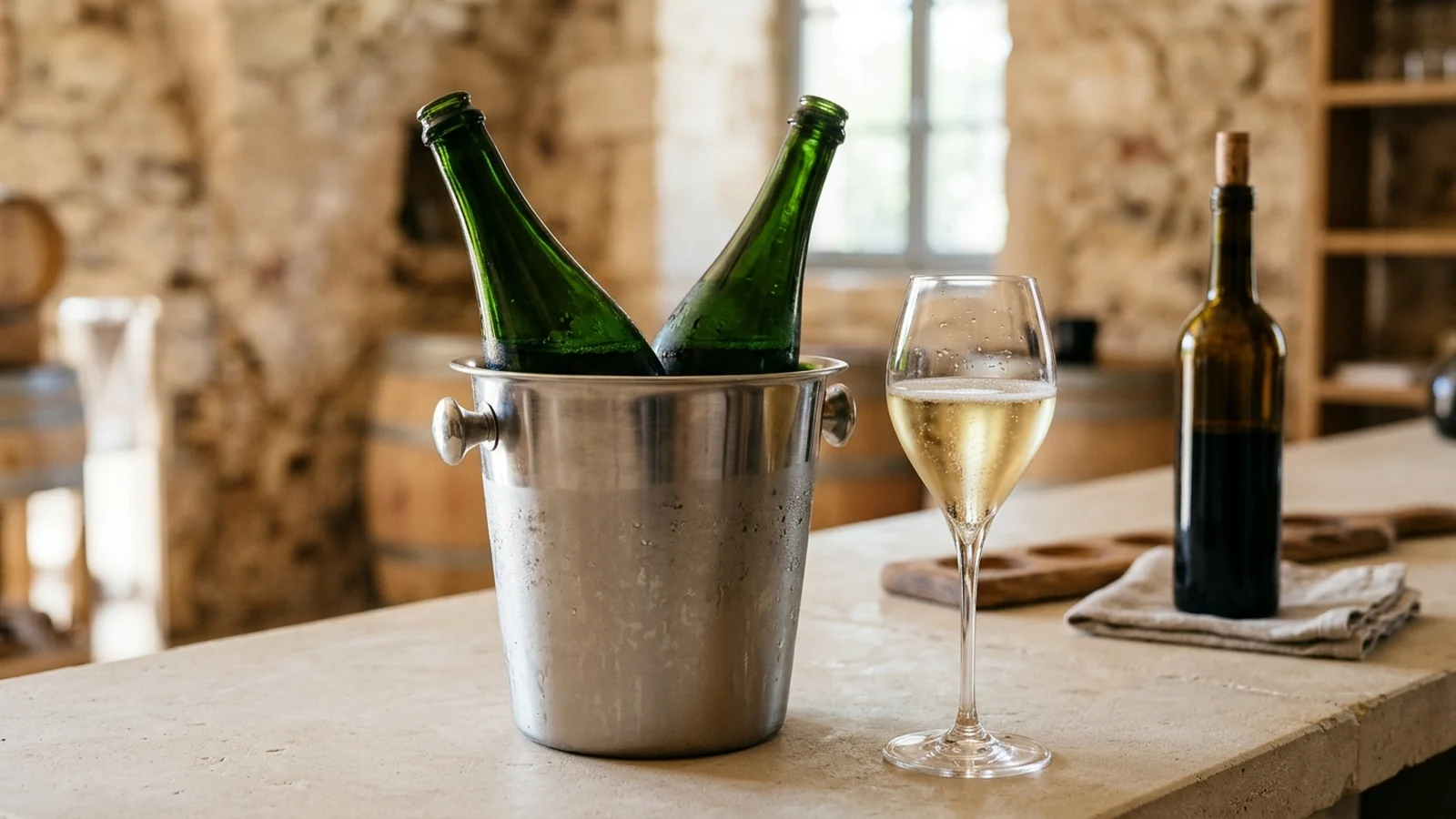
Comité Champagne states that the ideal serving temperature for a bottle of Champagne is between about 8-10°C, served chilled but not ice-cold.
Under DO Cava Regulatory Board guidelines, Cava de Guarda—which has the shortest aging time—is served coldest at around 8ºC, whereas in the case of Reserva and Gran Reserva, the serving temperature increases to about 10ºC.
Iowa State University Extension recommends chilling sparkling wine, white wine, and a rosé wine between 50°F and 54°F before opening, storing red wines at cool or room temperature to reduce the burning sensation of alcohol, and keeping red wine out of cold rooms (less than 50°F) that could make it seem more bitter and acidic.
As WineMaker Magazine notes, a colder beverage will hold onto dissolved gas more readily, and suggests serving white or rosé dessert wines at least slightly chilled (54–56 °F / 12–13 °C)—or try ~50–52 °F (10–11 °C)—rather than refrigerator temperature (37 °F / 3 °C), where delicate aromas are repressed.
For red wine service temperature, winemaker Alison Crowe serves red wines at around 50–58 °F (10–14 °C) or sticks the bottle in the fridge for 30 minutes because when ambient temperatures rise above 68 °F (20 °C), volatile components in red wines (alcohol, aldehydes, and volatile acidity) become more noticeable even at 13.8% alcohol.
In the Journal of Sensory Studies, Ross and Weller determined the sensory impact of white wine serving temperature (4, 10 and 18C) and red wine serving temperature (14, 18 and 23C) on wine sensory attributes.
In Ross and Weller’s study, white wine sweetness and acidity intensities were impacted by the interaction between the panelist and temperature (P ≤ 0.05), and red wine serving temperature significantly affected aroma intensity; the paper also notes the convention that cooler white wine serving temperature is thought to suppress sweetness while enhancing acidity and serving red wine close to room temperature is thought to enhance wine aroma while diminishing perceived bitterness and astringency.
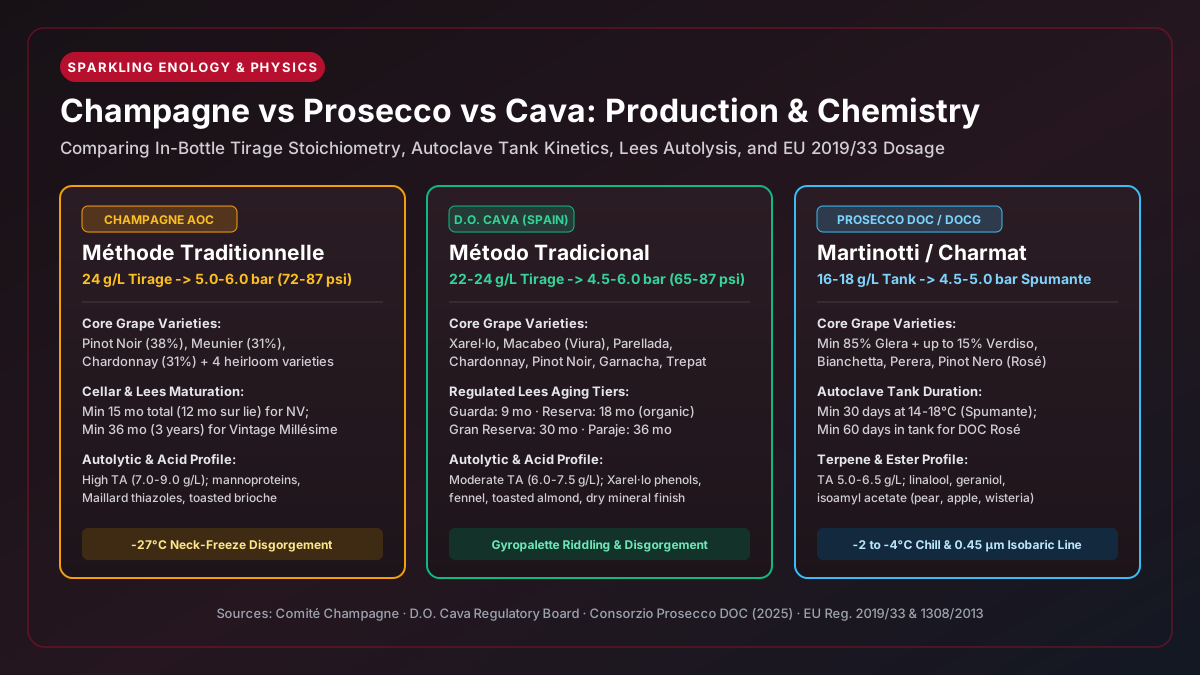
Readers exploring our published wine guides and our comparison of Champagne, Prosecco, and Cava production methods can compare recommended wine serving temperatures by style in the table below.
| Wine Style or Sensory Study | Recommended Serving or Test Temperature | Documented Sensory or Physicochemical Effect |
|---|---|---|
| Champagne Bottle Service (Comité Champagne) | 8-10°C | Chilled but not ice-cold bottle service temperature |
| D.O. Cava by Aging Tier (Cava de Guarda vs Reserva & Gran Reserva) | 8ºC vs 10ºC | Cava de Guarda served coldest at around 8ºC; Reserva and Gran Reserva increase to about 10ºC |
| Sparkling, White, and Rosé Pre-Opening Chill (Iowa State Extension) | 50°F to 54°F | Chilled before opening; cold rooms below 50°F make red wine seem more bitter and acidic |
| White or Rosé Dessert Wine (WineMaker Magazine) | At least slightly chilled 54–56 °F (12–13 °C); try ~50–52 °F (10–11 °C) | Avoids 37 °F (3 °C) refrigerator temperature where delicate aromas are repressed |
| Red Wine Cool Service (WineMaker Magazine) | 50–58 °F (10–14 °C) or 30 minutes in fridge | Cool service preferred when ambient >68 °F (20 °C), when alcohol/aldehydes/VA become more noticeable (e.g. even at 13.8% ABV) |
| Trained Panel Sensory Trial (Ross & Weller) | White: 4, 10 and 18C; Red: 14, 18 and 23C | White: sweetness/acidity panelist×temperature (P ≤ 0.05); Red: aroma intensity affected by serving temperature |
Sparkling Wine Serving Temperature, Henry’s Law CO2 Solubility, and Headspace Bite
From a physicochemical standpoint, champagne wines are multicomponent hydroalcoholic solutions with a surface tension of γ ≈ 50 mN m–1 (due to ~12–13% ethanol by volume) and a viscosity close to 1.5 mPa s (~50% more than that of pure water).
During the second in-bottle fermentation (prise de mousse), adding saccharose (classically approximately 22–24 g L–1) and selected yeasts inside sealed bottles generates gas-phase CO2 pressure reaching approximately 6 bar (at 12 °C).
At a cellar temperature close to 12 °C, the Henry’s constant for CO2 in a sugar-free wine with 12.5% ethanol by volume is kH ≈ 1.88 g L–1 bar–1 (≈ 4.3 × 10⁻⁴ mol m–3 Pa–1).
At 12 °C with 24 g L–1 of fermentable sugar, standard 75 cL bottles with xV ≈ 30 reach a dissolved carbon dioxide concentration of CPDM ≈ 11.5 g L–1 and a gas-phase pressure of PPDM ≈ 6.1 bar, whereas 150 cL magnums with xV ≈ 45 reach CPDM ≈ 11.6 g L–1 and PPDM ≈ 6.2 bar.
At 20 °C, the average Henry’s constant determined across old champagne vintages is ≈ 1.59 ± 0.14 g L–1 bar–1, and for a sugar-free wine with 12.5% ethanol by volume, applying empirical equation 1 leads to kH ≈ 1.50 g L–1 bar–1.
Should the concentration of dissolved CO2 in champagne reach or fall under a critical value close to 2.5 g L–1 (at 12 °C), bubble nucleation in a tasting glass would become thermodynamically impossible.
In winemaking gas comparisons, nitrogen has 1.25 g/L compared to air’s 1.29 g/L, argon clocks in at 1.78 g/L, and carbon dioxide is 1.98 g/L; carbon dioxide, especially under cold conditions, will readily dissolve into wine.
When lightly carbonating a dessert wine and serving it somewhere between 52–56 °F (11–13 °C), WineMaker Magazine recommends trying 7–10 PSI, noting that if you chilled it to 45 °F (7 °C) then carbonated it and waited a few days, the gas would integrate a lot better.
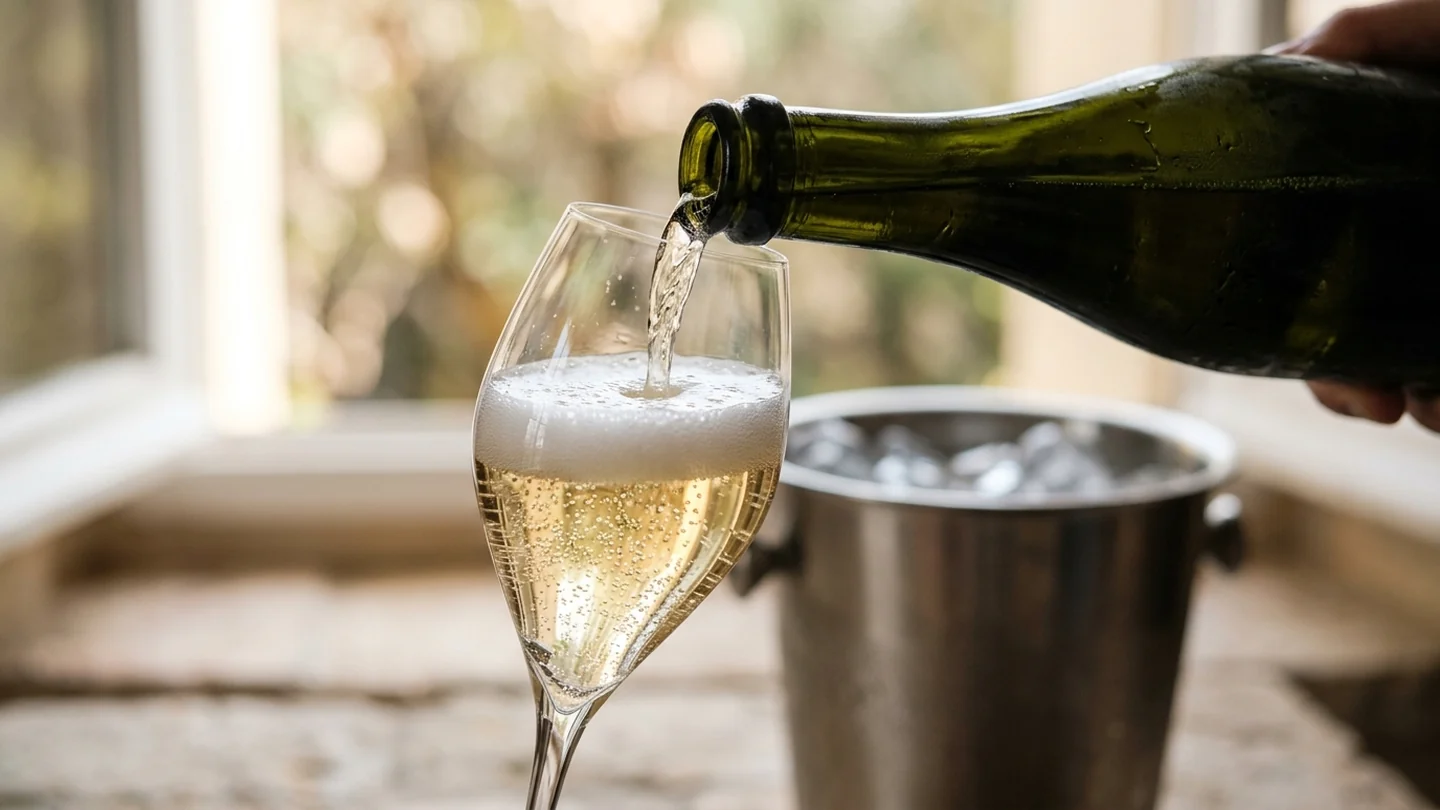
In champagne glasses, bursting bubbles cause stimulation of the trigeminal receptors, and above a concentration of 30%, gas-phase CO2 triggers very unpleasant nasal irritation known as carbonic bite.
Diode laser absorption spectroscopy during champagne pouring recorded a maximum CO2 concentration close to 70% at the end of the pouring step, followed by a decay from 70% to about 30%, while during the first 5 s rotation of swirling the glass, the CO2 concentration drastically falls below 10%.
Comité Champagne classifies Champagne dosage levels as Extra brut (between 0 and 6 grams of sugar per litre), Brut (less than 12), Extra dry (between 12 and 17), Sec (between 17 and 32), Demi-sec (between 32 and 50), and Doux (more than 50).
The recommended serving temperature for Champagne is between 8 and 10°C, and when uncorking you should take hold of the bottle, tilt it to a 30-45° angle, and rotate the bottle to gently slide the cork out.
For D.O. Cava service, the Regulatory Board instructs servers to tilt the bottle at about 45º (upwards), twist the bottle from its base (never by the neck), and hold the bottle at a slight angle so that the pressure inside stabilises and the foam is not wasted.
White, Rosé, and Dessert Wine Drinking Temperature and Headspace Aroma Volatility
While chilling wine depresses the kinetic energy and hence the availability of all aromas in the headspace, adding ice cools the wine while slightly diluting the alcohol, tannins, acids, and other flavor compounds.
In young Riesling wine (12.3% v/v alcohol, titratable acidity 7.3 g/L, sugar content 7.5 g/L, and pH 3.2) evaluated in ISO 3591 tasting glasses containing 35 mL, sensory thresholds for TDN were determined as about 4 µg/L for detection threshold, 10–12 µg/L for recognition threshold, and 71–82 µg/L for rejection threshold.
Comparing Riesling wine samples at room temperature (22 ± 1 °C) versus a lower serving temperature of 11 ± 1 °C showed that at TDN concentrations ≥ recognition threshold (10–12 µg/L), panelists distinguished TDN aroma at 11 ± 1 °C with 99.9% significance, because in the case of a higher temperature, the volatility of all wine aroma components rises, but not proportionally.
Across still wine styles, levels of total phenolic compounds (PC) of red wines are among 1–5 g/L and 0.2–0.5 g/L in white wines; hence, white wines are not commonly subjected to aging, since they are far less resistant to oxidation.
In oxidized wines, acetaldehyde provides a fruity aroma at low concentrations (≈30 mg/L) and a rotten-like flavor at higher levels (≈100 mg/L), while oxidation of ethanol produces acetaldehyde and acetic acid alongside ethyl acetate, which has a nail polisher aroma.
Readers diagnosing off-odors in warm or opened bottles can consult our guide on how to tell if wine has gone bad from oxidation faults.
Red Wine Service Temperature, Ethanol Partitioning, and Sensory Evaluation Standards
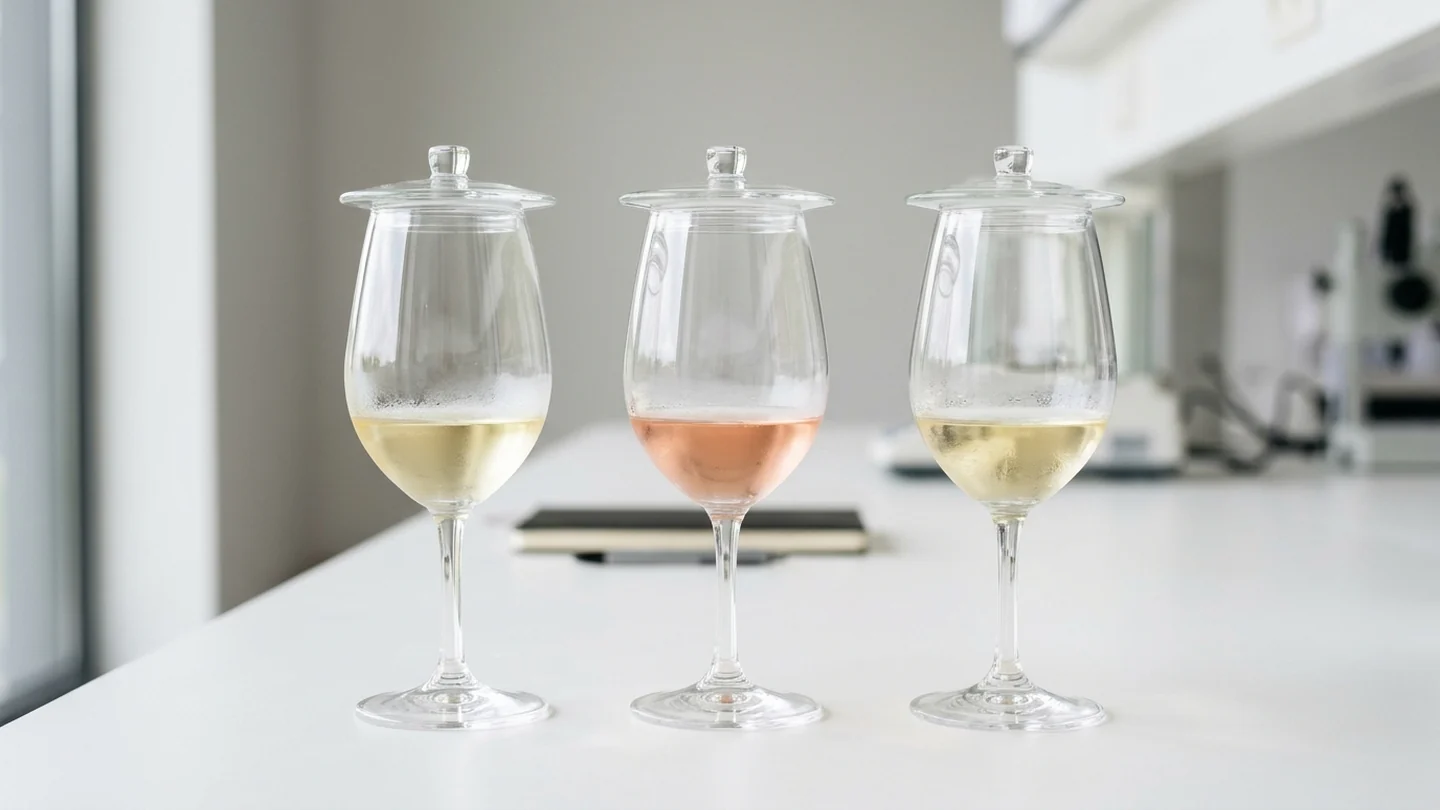
In sensory evaluations of reconstituted red wine matrices across ethanol levels (Low = L: 12% v/v; Medium = M: 14% v/v; High = H: 16% v/v) and pH/TA ratios of 0.4, 0.55, and 0.8, sessions were conducted at a controlled room temperature (20 ± 2 °C) using covered black ISO glasses containing 40 mL.
In that red wine matrix study, headspace volatile concentration increased in the HL matrix (16% v/v ethanol; pH/TA 3.2/8) via Marangoni-driven interfacial effects, whereas enhanced solubilisation in the hydroalcoholic matrix can counteract release, and ethanol dynamics induce discontinuities in the sensory profile at ethanol concentrations around 13–13.5% and 14.5–15%.
For formal wine evaluations, the Australian Wine Research Institute (AWRI) states that ideally samples should be pre-poured at a constant tasting volume (30 mL) and temperature (approx. 20ºC) into covered glasses, and tasters should taste within a set period (e.g. 1 hour).
To reduce effects of fatigue and adaptation during wine evaluation, AWRI states that no tasting should be held for at least half an hour after smoking, eating, or drinking, and ideally a maximum of six to seven wines should be presented.
Chilling Protocols, Glassware Geometry, and Storage vs. Serving Temperatures
To chill Champagne to its serving temperature, Comité Champagne recommends that you put the bottle in an ice bucket half filled with water and ice, from 20 to 30 minutes before serving, or put it in the bottom of the fridge a few hours before you open it.
When selecting glassware for Champagne, Comité Champagne advises choosing a tall, bulbous glass with a narrow top, shaped like a tulip, and doing the pour in two stages by pouring the Champagne slowly and regularly until it is two-thirds full.
Comité Champagne specifies that you should wash Champagne glasses by hand in hot water, without using detergent, as this will prevent formation of elegant bubbles during serving, a requisite for full enjoyment.
According to the D.O. Cava Regulatory Board, tulip glasses are the best for enjoying Cava’s aromatic expression, flute glasses always bring out the sensation of acidity and freshness, and wide glasses retain gas for a shorter time.
Before purchase, Champagne has spent several months (at least 15) in the wine cellars at a constant temperature of between 10 and 15°C, where humidity must be high and constant, between 60% and 80%.
Each bottle of D.O. Cava is stored in a quiet space under perfect conditions for a minimum of 9 months, and at home should be kept at ideally 14ºC with 50% humidity, or stored upright and close at hand at a lower temperature of about 8ºC.
In wine storage reviews, a temperature interval of 15–17 °C is acknowledged as optimum for wine preservation, whereas elevated temperatures (>20 °C) will accelerate oxidative reactions and degrade aromatic compounds (thiols, esters, aldehydes).
According to AWRI storage guidance, faulty flavours and decreasing overall quality were observed after 12 months’ storage of wine at 30°C, temperatures in excess of 40°C cause rapid damage, wine quality suffers when temperature exceeds 25°C for long periods, and wine should be stored with the cork in contact with the wine in a cool (15–20°C) location.
AWRI storage guidance also notes that leakage of wine and/or movement of cork stoppers due to thermal expansion of wine may result following exposure to temperatures which are significantly greater than ambient temperature.
Although it has been argued that the vibrations from the refrigerator’s compressor are detrimental during wine storage, the AWRI states that the Institute has been unable to find any literature on this subject.
Once uncorked, Comité Champagne notes that an opened bottle can be kept for one or two days if it is immediately recorked with a special airtight cap made of metal, with a rubber ring, held in place by two latches.
Under Iowa State University Extension guidelines, opened wine kept with air and temperature control lasts up to three days for sparkling wine, up to five days for white wine or rosé wine, up to seven days for red wines, and up to 4 weeks for fortified wines like port or sherry.
For detailed cellar preservation timelines, compare our guides on unopened wine shelf life and how long wine lasts after opening by style.
| Storage or Service Regime | Temperature & Humidity Specification | Documented Aging or Preservation Window |
|---|---|---|
| Champagne Cellar Aging & Storage (Comité Champagne) | 10 to 15°C; 60% to 80% humidity | At least 15 months in wine cellars; 20 to 30 minutes in water-and-ice bucket before serving |
| D.O. Cava Storage & Short-Term Chill | Ideally 14ºC with 50% humidity; upright at about 8ºC | Minimum of 9 months in cellar before release |
| Bottle Preservation vs Thermal Damage (Molecules & AWRI) | 15–17 °C or cool 15–20°C; avoid >20 °C, >25°C, 30°C, and >40°C | Faulty flavours after 12 months at 30°C; oxidative degradation of thiols, esters, aldehydes above 20 °C |
| Opened Bottle Preservation (Iowa State Extension) | Recorked with air and temperature control | Up to 4 weeks for fortified wines like port or sherry (three days sparkling, five days white/rosé, seven days red) |
Wine Service Temperature and Cellar Preparation Checklist
Use the following cellar and table parameters to standardize wine service across styles:
- Wine Style & Carbonation Classification: Record whether the bottle is a sparkling wine, dry white, rosé, sweet dessert wine, light red, or tannic red style before choosing a chilling target.
- Wine Cabinet Setpoint & Ambient Room Conditions: Log the wine cooler thermostat setting alongside dining room air conditions to plan pre-service cooling or warming intervals.
- Chilling Vessel & Water-Ice Contact: Confirm whether bottles are cooled in an ice bucket filled with water and ice or placed on a lower refrigerator shelf before opening.
- Stemware Geometry & Detergent-Free Rinse: Verify that tulip glasses or covered sensory tasting glasses have been washed by hand in hot water without detergent and air-dried.
- Uncorking Angle & Post-Service Resealing: Check bottle tilt during uncorking and keep latched metal sparkling stoppers or air-control closures ready for remaining wine.
Sources
- Comité Champagne — Preparations for drinking Champagne and Champagne Frequently Asked Questions
- Consejo Regulador D.O. Cava — Serving and storing Cava
- The Australian Wine Research Institute (AWRI) — Practical sensory evaluation considerations and The effects of heat and light on wine during storage
- WineMaker Magazine (Alison Crowe) — Protecting Your Wine, Cap Temperature, Copper Sulfate Additions, and Carbonation Help and Wine Consumer Myths
- Iowa State University Extension and Outreach (Aude Watrelot) — How to Store Wine to Get the Best of It
- Journal of Sensory Studies (Carolyn F. Ross and Karen Weller) — Effect of Serving Temperature on the Sensory Attributes of Red and White Wines
- ACS Omega (Gérard Liger-Belair et al.) — Losses of Yeast-Fermented Carbon Dioxide during Prolonged Champagne Aging: Yes, the Bottle Size Does Matter!
- Sensors (Félicien Lecasse, Clara Cilindre, Gérard Liger-Belair, et al.) — An Infrared Laser Sensor for Monitoring Gas-Phase CO2 in the Headspace of Champagne Glasses under Wine Swirling Conditions
- Foods (Andrii Tarasov, Doris Rauhut, et al.) — TDN Sensory Thresholds in Riesling Wine
- Molecules (Javier Echave, Jesus Simal-Gandara, et al.) — Bottle Aging and Storage of Wines: A Review
- Journal of the Science of Food and Agriculture (Martina Di Fede, Paola Piombino, et al.) — Impact of climate-induced compositional shifts of ethanol and acidity on aroma release and perception in red wine