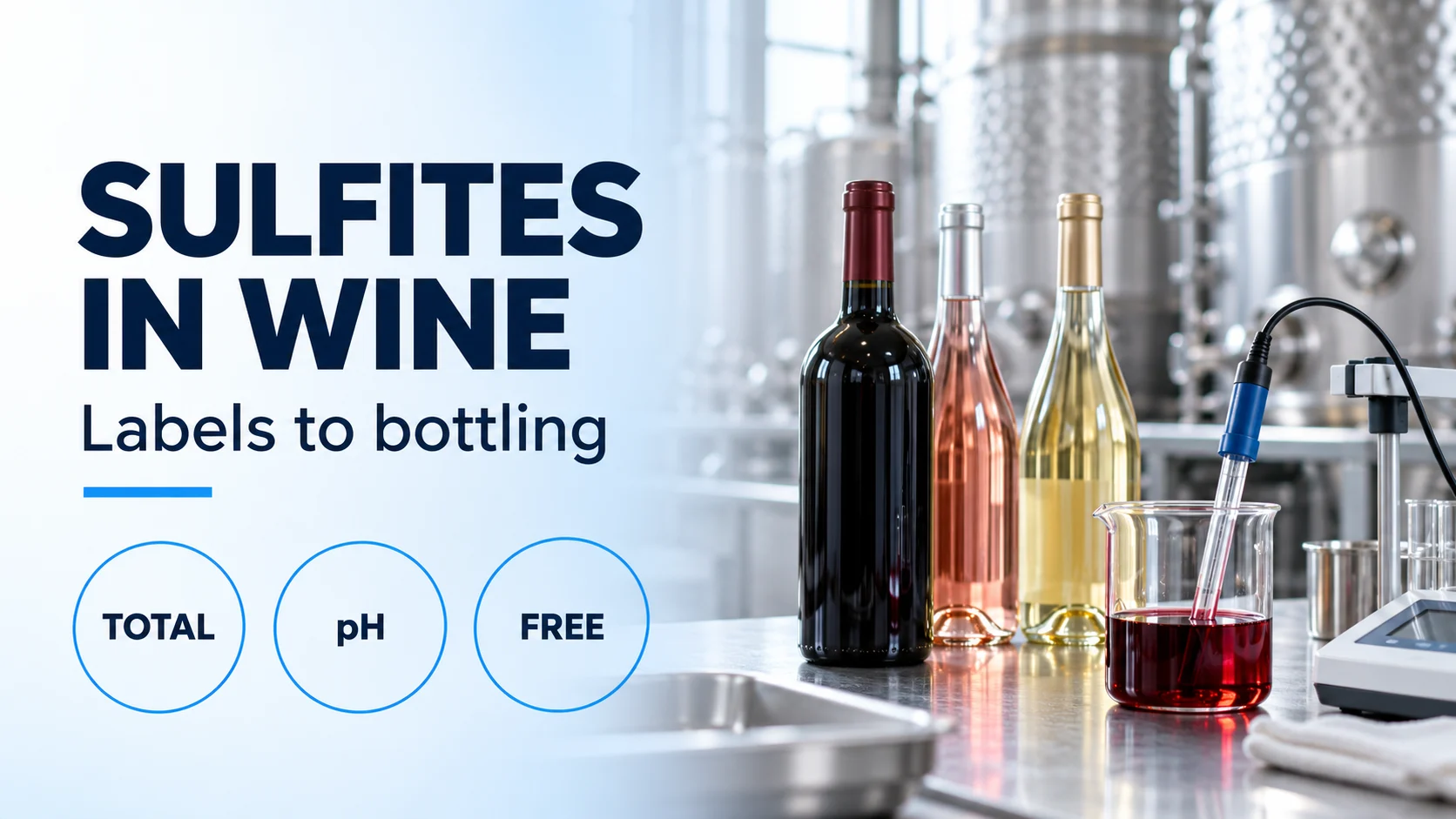
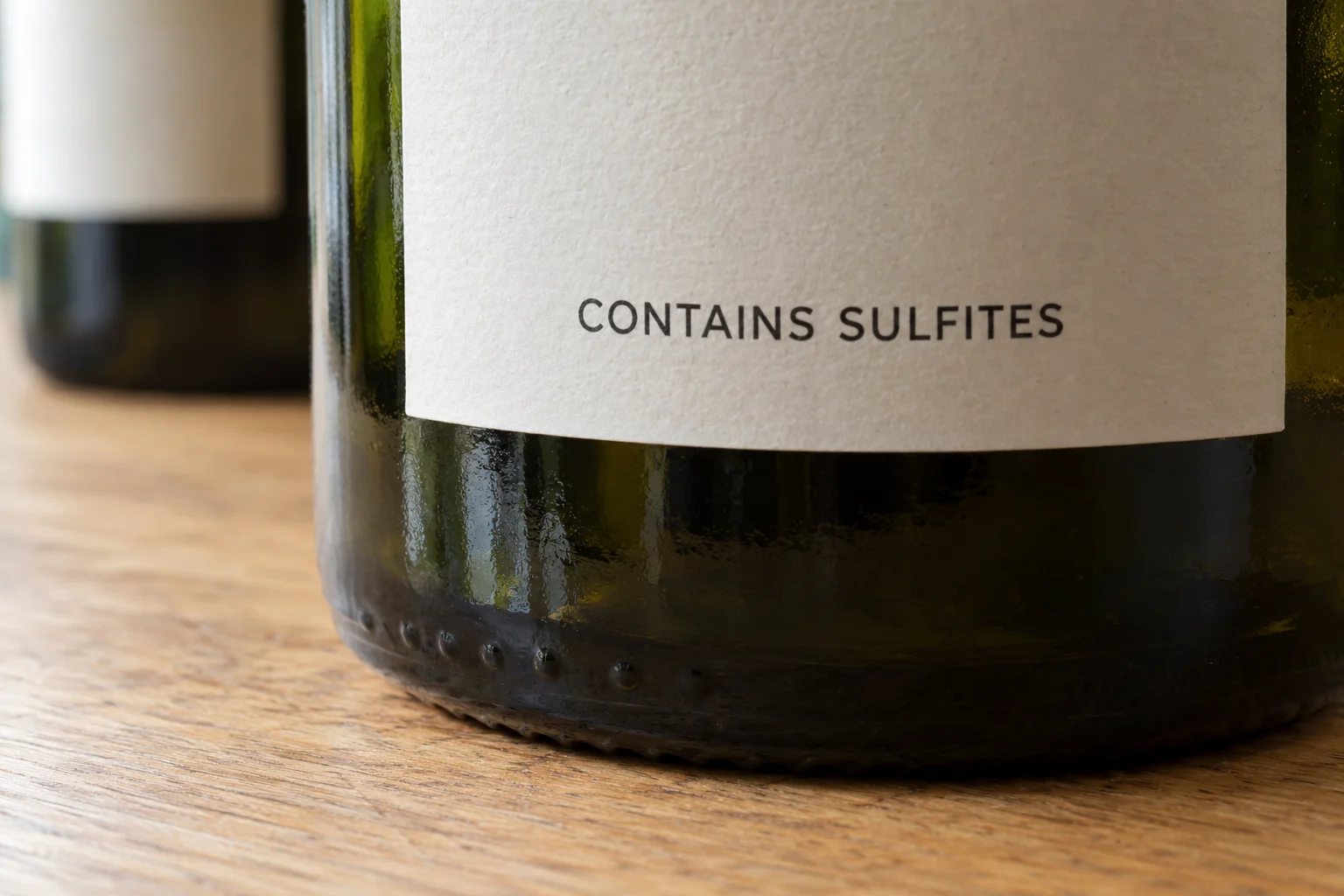
Sulfites in wine include sulfur dioxide (SO₂) and sulfiting agents used to help preserve wine; sulfites can also occur naturally. In the United States, a sulfite declaration is required at 10 parts per million (ppm) or more, measured as total SO₂, under 27 CFR 4.32(e).
The label answers a presence question. To understand protection at bottling, you also need free SO₂ and wine pH: together they determine the estimated molecular SO₂ associated with microbial control. U.S. organic categories add a separate production rule. The distinctions below connect the label, the laboratory result and the bottling check, using U.S. labeling requirements as of October 2026 and dated Australian Wine Research Institute guidance.
What does “contains sulfites” mean on a wine label?
The declaration threshold includes exactly 10 ppm total SO₂. It applies to the measured total, including naturally occurring sulfites. A bottle’s statement alone does not reveal how much sulfite was added or how much free SO₂ remains.
Keep these three U.S. thresholds separate:
| Rule or category | Total SO₂ value | What the value controls |
|---|---|---|
| Mandatory sulfite declaration | 10 ppm or more | Whether the sulfite statement is required |
| “Made with organic grapes” | Up to 100 ppm | Finished-wine ceiling for this organic labeling category |
| General finished-wine limit | Up to 350 ppm | Total SO₂ boundary under 27 CFR 4.22(b)(1) |
The declaration comes from §4.32(e); the general ceiling comes from §4.22(b)(1). The organic-category limit is set out in TTB/USDA’s Labeling Organic Wine. All three concern total SO₂; bottling protection requires additional measurements.
Can a bottle omit the statement below 10 ppm?
For grape wine, TTB’s label-approval route requires a TTB laboratory analysis establishing a result below 10 ppm before omission of the declaration. TTB prohibits absolute wording such as “sulfite free” and “contains no sulfites”; wording about detection depends on the laboratory result. See TTB’s sulfite declaration guidance for the waiver procedure.
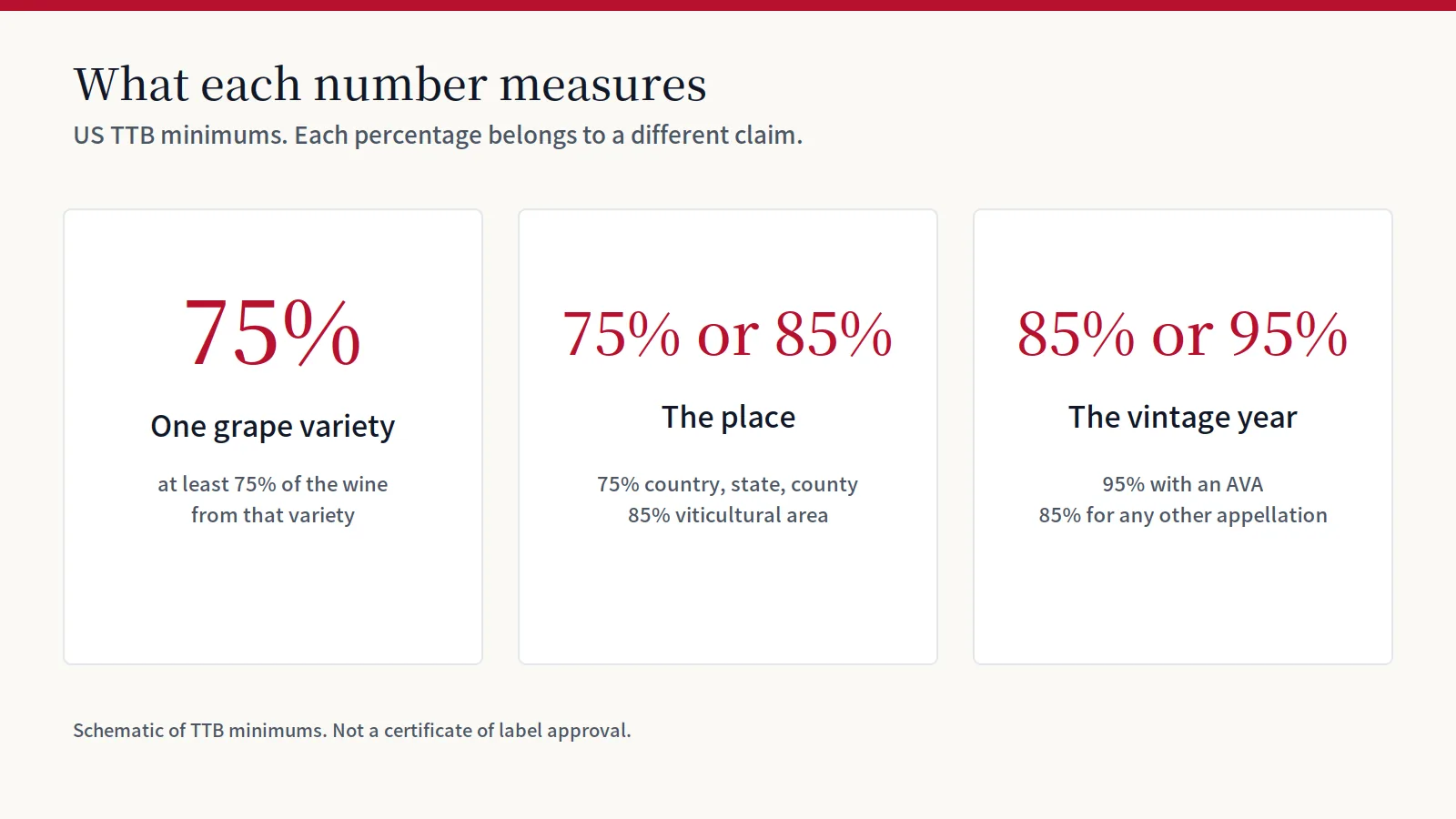
Other label numbers address different questions. The 75–85–95 wine-label rules explain varietal, origin and vintage claims.
Does organic wine have no sulfites?
U.S. “organic” wine prohibits added sulfites, while naturally occurring sulfites may still be present. “Made with organic grapes” is a different category that permits sulfur dioxide within a finished-wine limit. Neither phrase is interchangeable with a claim of zero sulfites.
| Wording | What it tells you | Sulfite distinction |
|---|---|---|
| Organic wine | Wine meets the U.S. organic category requirements | Added sulfites prohibited; the TTB/USDA guide describes naturally occurring sulfites below 10 ppm |
| Made with organic grapes | All grapes must be certified organic; this category cannot use the USDA organic seal | Sulfur dioxide may be used within the 100 ppm total finished-wine ceiling |
| No added sulfites | A statement about addition during production | Naturally occurring sulfites can remain; it does not establish organic certification |
These category distinctions follow TTB/USDA’s organic wine guide. The 100 ppm ceiling includes sulfur dioxide already present in the finished wine. It is not an allowance to add that amount on top of an existing concentration.
For a reader comparing bottles, start with the exact organic wording and the sulfite declaration. For a bottling decision, obtain the analysis: none of these phrases supplies a free or molecular SO₂ result.
Total, free and molecular SO₂: which number matters?
Total SO₂ combines free and bound forms; molecular SO₂ is part of the free pool. Binding and chemical equilibrium explain why two wines with the same total can have different protective conditions.
| Measurement | Meaning | Main use here |
|---|---|---|
| Total SO₂ | Free SO₂ plus SO₂ bound to wine constituents | Label threshold and finished-wine limits |
| Free SO₂ | Unbound forms in equilibrium, including molecular SO₂, bisulfite and sulfite | Assessing available protection and calculating molecular SO₂ |
| Molecular SO₂ | The molecular component of free SO₂ | Interpreting antimicrobial protection in relation to pH |
The Australian Wine Research Institute (AWRI) explains these forms in Revisiting sulfur dioxide use and Adrian Coulter’s January 2019 article, Understanding molecular SO₂ calculators. Free SO₂ has no fixed percentage relationship to total SO₂. Its molecular fraction also changes with wine conditions.
Microbial control and oxidation need separate attention. Molecular SO₂ is the relevant antimicrobial component; oxidative protection also depends on free-SO₂ availability, oxygen exposure and subsequent reactions. When the question concerns a bottle’s changed color or aroma, use the wine oxidation and faults guide.
Why does higher pH require more free SO₂?
As pH rises, the molecular fraction falls at a fixed free-SO₂ concentration and pKa₁. To maintain the same molecular level under that calculation convention, more free SO₂ is needed.
AWRI’s January 2019 explanation gives the relationship:
Molecular SO₂ = free SO₂ ÷ (1 + 10pH − pKa₁)
Both concentrations use the same units. The pKa₁ term describes the acid equilibrium. The commonly used 1.81 value is the historical convention for SO₂ in water at 25°C discussed in that publication. Alcohol, temperature and ionic strength affect the equilibrium, so wine calculators using those inputs can give different estimates. The formula translates a free-SO₂ result into a molecular estimate; calculating an addition requires further cellar information.
A published red-wine comparison
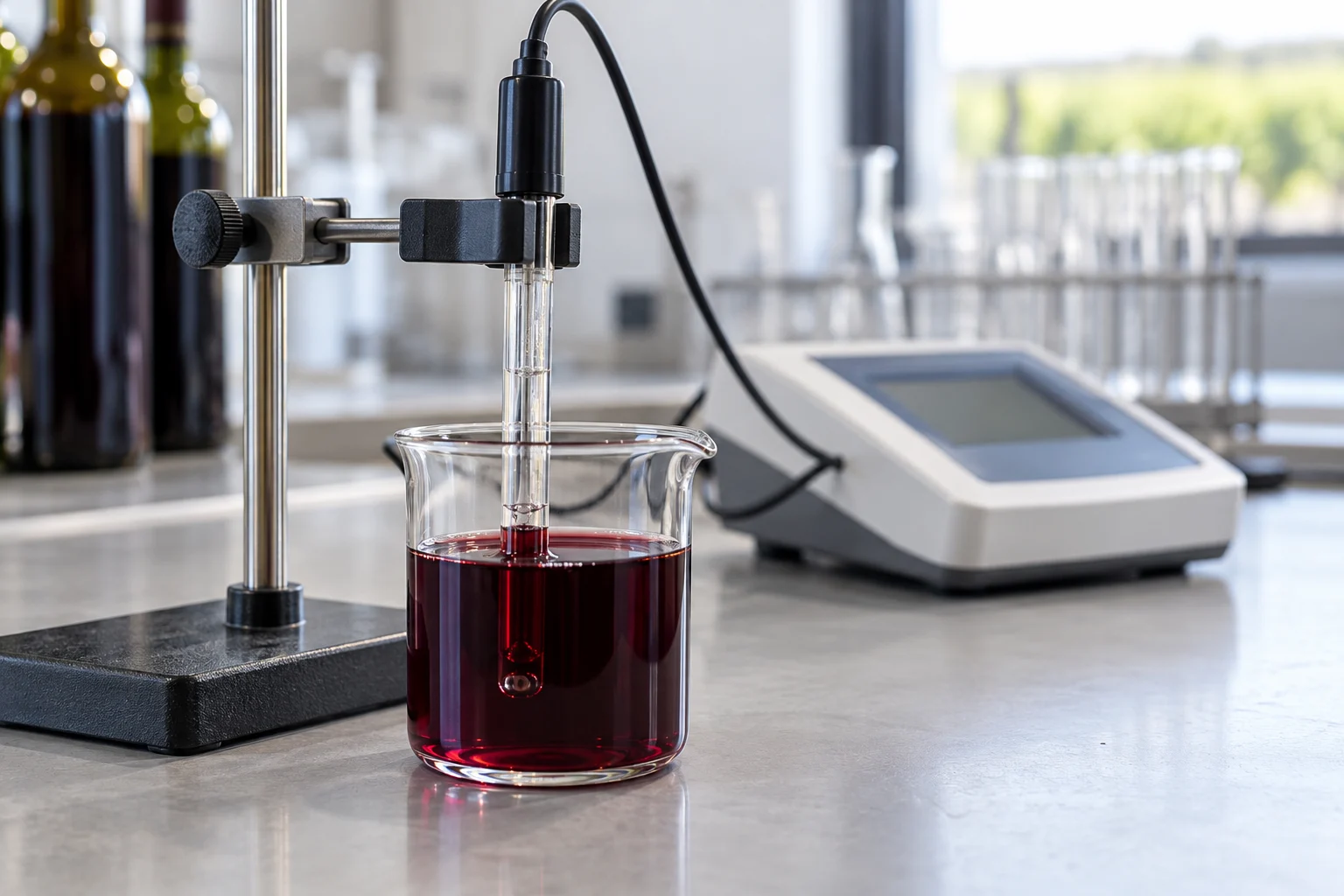
AWRI’s April 2021 article, How much sulfur dioxide (SO₂) is needed at bottling?, gives these rounded entries in Table 1 for a 0.625 mg/L molecular SO₂ target in red wine:
| Red-wine pH | Free SO₂ listed by AWRI (mg/L) |
|---|---|
| 3.4 | 25 |
| 3.5 | 32 |
| 3.6 | 40 |
| 3.7 | 49 |
Using that table’s pH 3.4 and molecular target with the historical convention gives:
Free SO₂ = 0.625 × (1 + 103.4 − 1.81) ≈ 25 mg/L.
The rise from 25 to 49 mg/L across the table shows the effect of pH on the same molecular target. The table omits alcohol, temperature and ionic-strength effects. Its red-wine footnote also warns that measured free SO₂ in young reds can include SO₂ weakly bound to anthocyanins, overstating the amount available to contribute to molecular SO₂.
In the accompanying microbiological discussion, AWRI advises levels above 0.625 mg/L molecular SO₂ for reds and above 0.8 mg/L for white and sweet wines. These are technical recommendations in that publication. Apply them with the wine’s composition, analytical method and microbial condition; U.S. label compliance is assessed separately using total SO₂.
What should be checked at bottling?
Compare the tank result with the packaged wine, because oxygen picked up during transfer and filling can consume SO₂ protection. A pre-bottling result describes an earlier point in the process. Closure and storage conditions also influence how protection develops afterward.
AWRI’s April 2021 bottling article recommends measuring SO₂ in packaged wine 24 hours after packaging to assess the concentration achieved in bottle. Its packaging FAQ also describes variable free-SO₂ losses. Measure the actual change across the line when planning adjustments, rather than applying a fixed loss allowance to every wine.
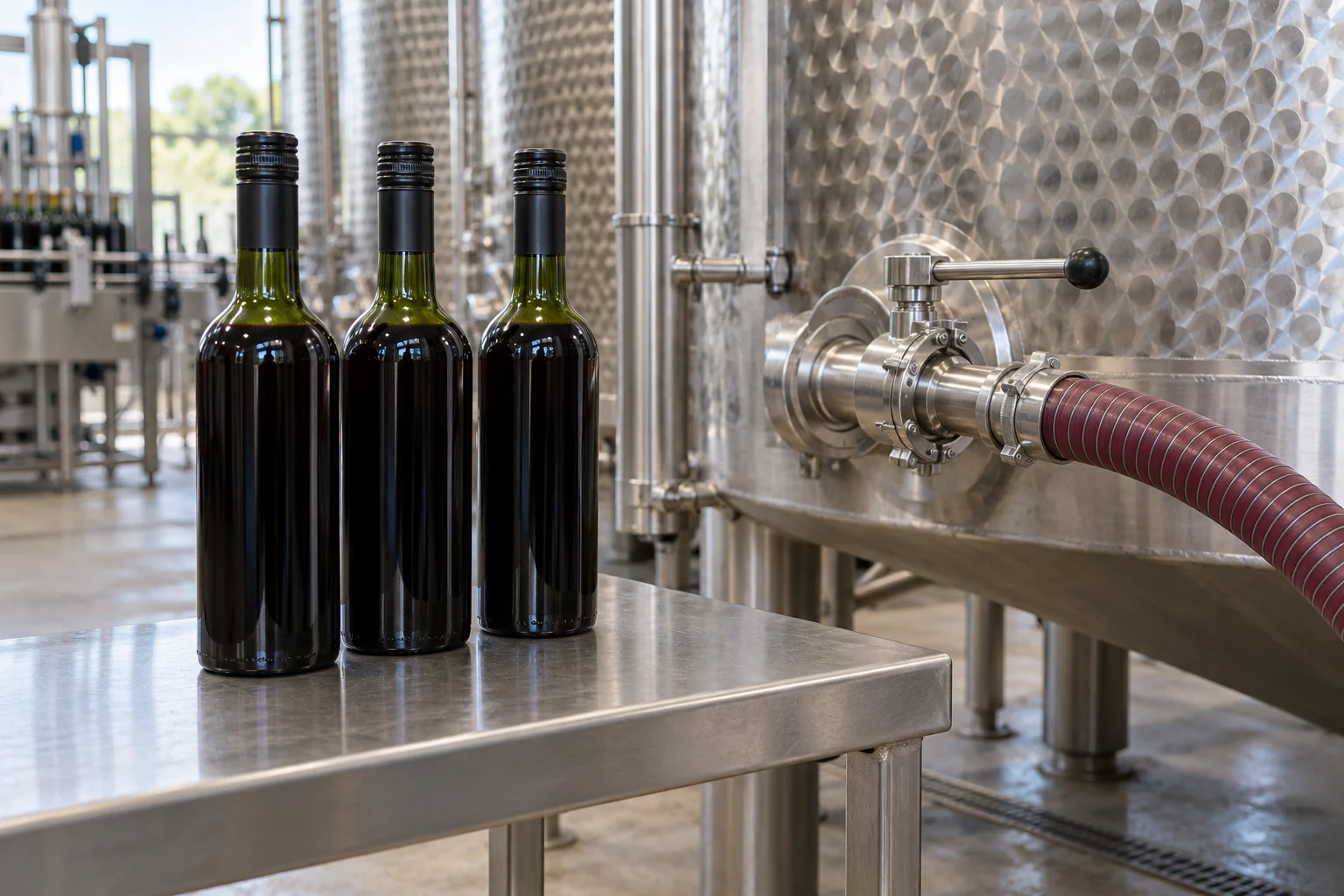
Bring these items together for a bottling review:
- Label and category: the proposed sulfite statement and any organic claim, matched to the finished-wine total SO₂ result.
- Dated laboratory results: pH, free SO₂ and total SO₂, with sampling time relative to packaging and the analytical method.
- Molecular calculation: the free-SO₂ input and pKa₁ convention, including temperature and alcohol inputs where the calculator uses them.
- Packaging conditions: oxygen handling during transfer and filling, closure specification and intended storage conditions.
- Wine condition: microbial assessment, sugar and alcohol considered alongside the chemical protection.
This practical checklist connects AWRI’s chemistry and packaging guidance to the label decision. Discuss the combined record with the producer or laboratory when a result needs interpretation. For the closure side of that review, see screw-cap liners and oxygen exposure; the wine articles collection connects the wider topics of labels, closures and bottling.
Technical reading
- Geoff Cowey and Adrian Coulter, AWRI, How much sulfur dioxide (SO₂) is needed at bottling? — Grapegrower & Winemaker, issue 687, April 2021, pp. 76–77; Table 1 and packaging discussion on p. 76.
- Adrian Coulter, AWRI, Understanding molecular SO₂ calculators — Grapegrower & Winemaker, issue 660, January 2019, pp. 62–63; formula and calculation convention.
- AWRI, Revisiting sulfur dioxide use and Packaging frequently asked questions; free/bound chemistry and packaging oxygen effects.