Four dates can show up around one bottle, and the wine vintage date is only the harvest year. When a US label states a vintage, you can copy that year into the harvest row. Bottling, release, and a date the label never names each need their own line. You fill a line when a source names that event, and you leave the line empty when that source is missing.
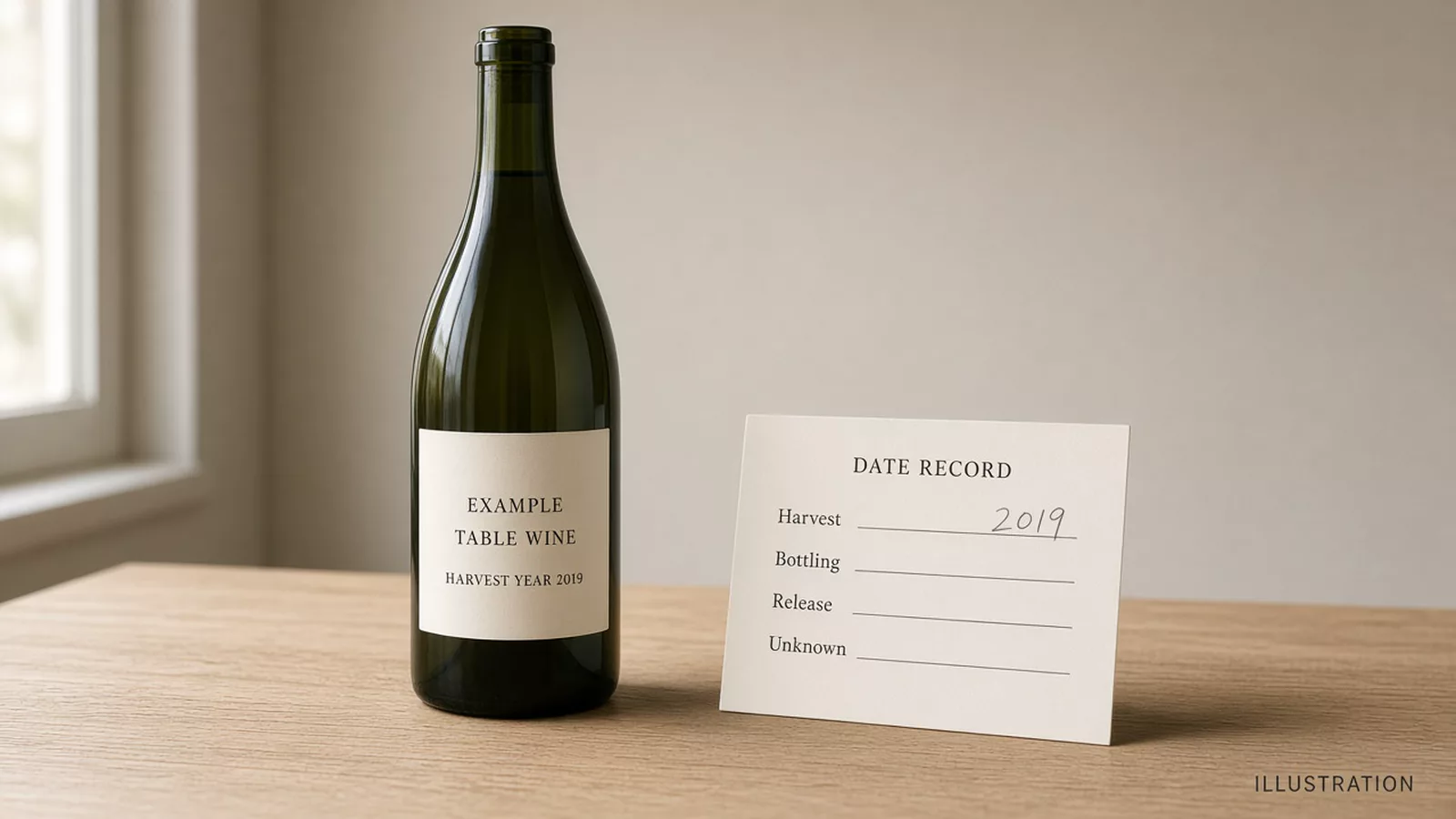
The photograph above is an illustration. The bottle reads EXAMPLE and HARVEST YEAR 2019. The bottling line on the card is blank. It shows no named estate, no shipment, and no tasting.
This page uses two TTB texts read on October 11, 2026. One is the anatomy of a wine label, document TTB G 2019-9, dated September 26, 2019, page last updated January 8, 2026. The other is Wine Boot Camp Basics: Labeling, a PDF created December 11, 2025. More label explainers are in Labels and Filling.
A wine vintage date on a US label is the year the grapes were harvested. TTB’s anatomy page, read on October 11, 2026, says “Vintage date refers to the year of the harvest of the grapes.” The 2025 training, page 34, says “Year or date of harvest,” and the same slide counts the wine by “grapes grown in the vintage year.” Bottling, release, and an unnamed date stay on their own lines. When you do not have the bottling date, leave that cell empty.
Key points:
- A vintage date is the harvest year, and only grape wine may carry one.
- If that year appears, the brand label needs an appellation of origin.
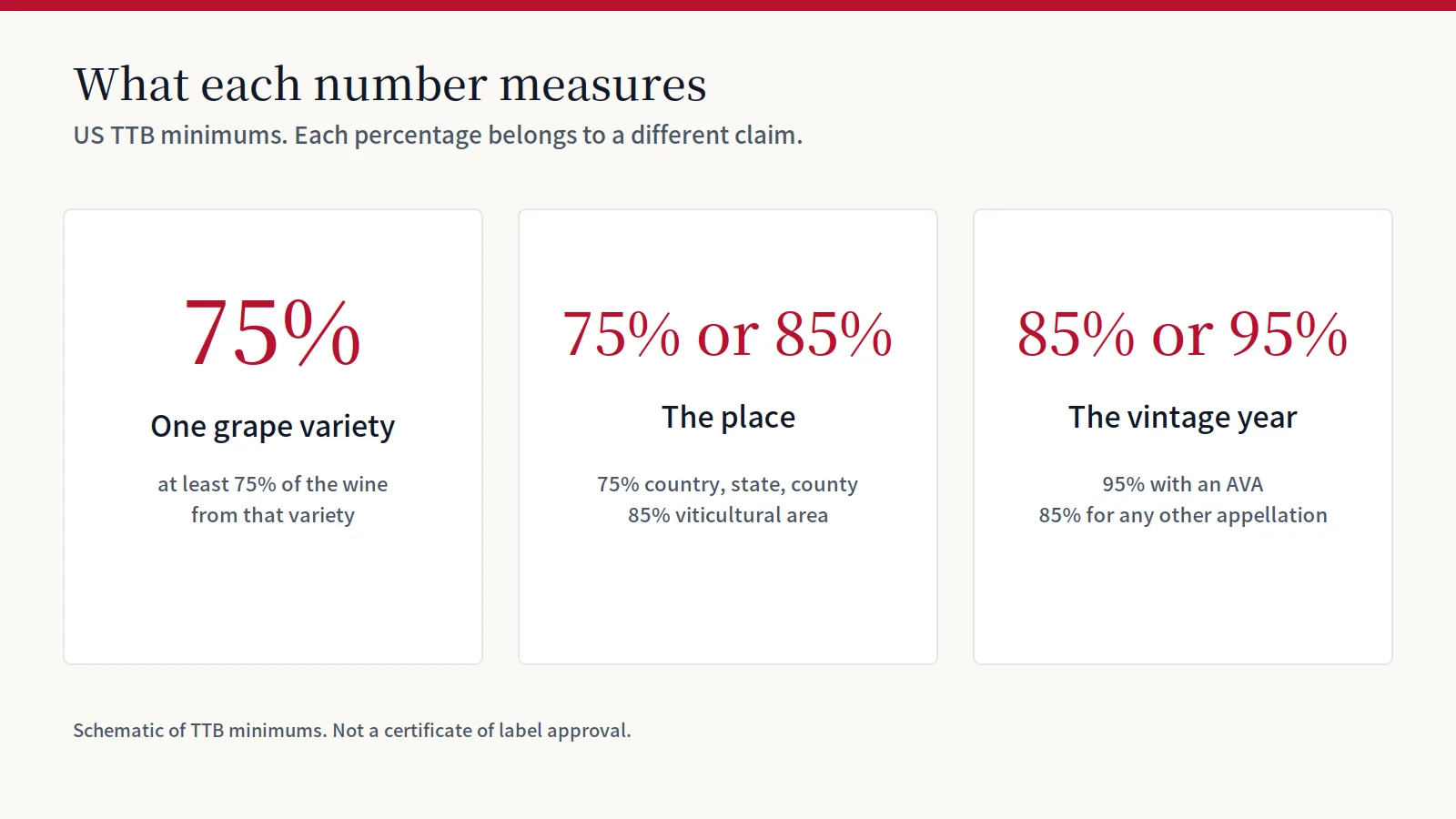
- The 2025 training sets the harvest-year share at not less than 95% for an AVA or a foreign equivalent, and not less than 85% for any other appellation.
- The bottler’s name identifies who bottled the wine. The bottling day stays blank until a record states it.
What does a wine vintage date mean?
A wine vintage is the harvest. The anatomy page states the definition in one sentence: “Vintage date refers to the year of the harvest of the grapes.” The 2025 training’s Vintage Date slide, printed page 34, opens with “Year or date of harvest.” Both wordings were read on October 11, 2026. On that same slide the share is “grapes grown in the vintage year,” so the percentage is counted by year.
| Official wording | Where it is printed | Read on |
|---|---|---|
| “Vintage date refers to the year of the harvest of the grapes.” | TTB anatomy of a wine label, TTB G 2019-9 (September 26, 2019). The page was last updated January 8, 2026. | October 11, 2026 |
| “Year or date of harvest.” | TTB Wine Boot Camp Basics: Labeling, PDF created December 11, 2025, Vintage Date slide, printed page 34, citing 27 CFR 4.27. | October 11, 2026 |
The two sentences agree that the vintage is the harvest. The training’s phrase “year or date” sits on a slide that then measures a vintage year. The anatomy page names a year outright. This page records that harvest year.
The anatomy page adds the conditions around that year. A vintage date is optional, and it may appear on any label. It can be used only with grape wine. If it appears, an appellation of origin has to appear on the brand label. A vintage date is not permitted on wine imported in containers over 5 liters. The anatomy page says the vintage date on a label may be added, changed, or deleted without applying for a new COLA. The training’s commonly used revisions, printed page 50, list “Change or remove vintage date” on a separate line from “Change bottle date.”
A bottle with no year has nothing to copy into the harvest cell. The anatomy page marks the vintage date as not mandatory. The two TTB texts read here do not define the letters NV. If you want the harvest years inside a bottle that states no vintage, you need a blend record that names them.
Takeaway: Write a stated vintage year in the harvest row, and name the TTB sentence you used. Leave the row empty when the label has no vintage date.
Which US conditions apply to that harvest year?
The percentage travels with the vintage claim, and it follows the kind of place printed with the year. Variety minimums, place minimums, and the full 75, 85 and 95 comparison live on the 75-85-95 label page. The lines below are only the vintage-year test.
From the 2025 training, Vintage Date slide, printed page 34, citing 27 CFR 4.27, read October 11, 2026:
- The vintage date requires an appellation of origin.
- If the appellation is an AVA or a foreign equivalent, not less than 95% of the wine must be derived from grapes grown in the vintage year.
- For any other appellation, not less than 85% of the wine must be derived from grapes grown in the vintage year.
An 85% vintage account from outside that slide, including one written for an Australian wine, does not set the share for a US AVA. For a US AVA the training states not less than 95%.
The anatomy page does not restate those two percentages. It points readers to 27 CFR 4.27 for the complete requirements. The training slide prints the shares under that same citation. Both were read on October 11, 2026. The full Code of Federal Regulations was not the source. The citation is the one printed on the TTB pages.
Takeaway: Pair the harvest year with the 95% or 85% share from training page 34, chosen by the appellation type. The other shares in the 75-85-95 nickname are on the other page.
What can the label show about bottling and release?
The label has to identify the bottler or the importer. A bottling day is a further record.
The anatomy page says the name and address, city and state, of the bottler or importer must appear on the label. The 2025 training, printed page 20, citing 27 CFR 4.35, accepts “Bottled By,” “Packed by,” or “Imported by.” Printed page 21 lists phrases such as “Produced and bottled by,” “Cellared and bottled by,” and “Vinted and bottled by,” each tied to a process condition at that location, again citing 27 CFR 4.35. The lines on pages 20 and 21 name the person and, on page 21, a process condition. No calendar day is printed in those lines.
Printed page 50 lists “Change bottle date” among commonly used revisions, and it lists “Change or remove vintage date” as a different item. The slide does not define bottle date. This page leaves that definition unknown. A date you cannot match to harvest, bottling, or release stays on the unknown line.
Release stays on its own line for a related reason. Neither TTB text read on October 11, 2026 defines a release date, a ship date, or a first day of sale. The vintage year does not fill the release cell. A catalog that rates a region and a year does not fill it, and that catalog does not fill the bottling cell for the single bottle in your hand.
When the label is silent, the missing records are specific:
- Bottling day: a cellar book, bottling log, or other record that states the day for this bottling.
- Release day: a record of when this bottling was offered or shipped.
- An unnamed printed date: a record that says which event that date belongs to.
Until the record exists, the cell stays empty. Copying the vintage year into the bottling row, or promoting a code you cannot read, writes a date the sources do not support.
Takeaway: The label can show the harvest year and the bottler’s name. Bottling day, release day, and an unnamed date each wait on a record that identifies them.
How does the example sheet sort one bottle?
The bottle in this section is an example made for the sheet. The year 2019 is a placeholder. The label is a grape wine. It shows a type, an appellation, and 2019 used as the vintage date. It includes a “Bottled by” name and city. It includes no bottling day and no release day. A small sticker reads 03/2022 and does not say what that month is.
| Record | Entry for this example | Source of the entry | Record still needed |
|---|---|---|---|
| Harvest | 2019, the year the grapes were harvested | TTB anatomy page, read October 11, 2026: the vintage date is the year of the harvest. Training page 34, same day: year or date of harvest, counted as the vintage year. The 95% or 85% share follows the appellation type. | The year itself is on the label. Which share applies is on the 75-85-95 page. |
| Bottling | left blank | Training page 20 names the bottler under 27 CFR 4.35. Page 50 lists “Change bottle date” and does not define it. | A bottling log for this bottling. |
| Release | left blank | Not defined in the TTB texts read on October 11, 2026. | A record of the offer or shipment for this bottling. |
| Unknown | 03/2022, role not named | Printed on the example sticker. No TTB sentence assigns it to harvest, bottling, or release. | A record that says which event 03/2022 is. |
The bottling cell is empty on purpose. Leave 2019 in the harvest row. Leave 03/2022 in the unknown row until a record says that month is the bottling.
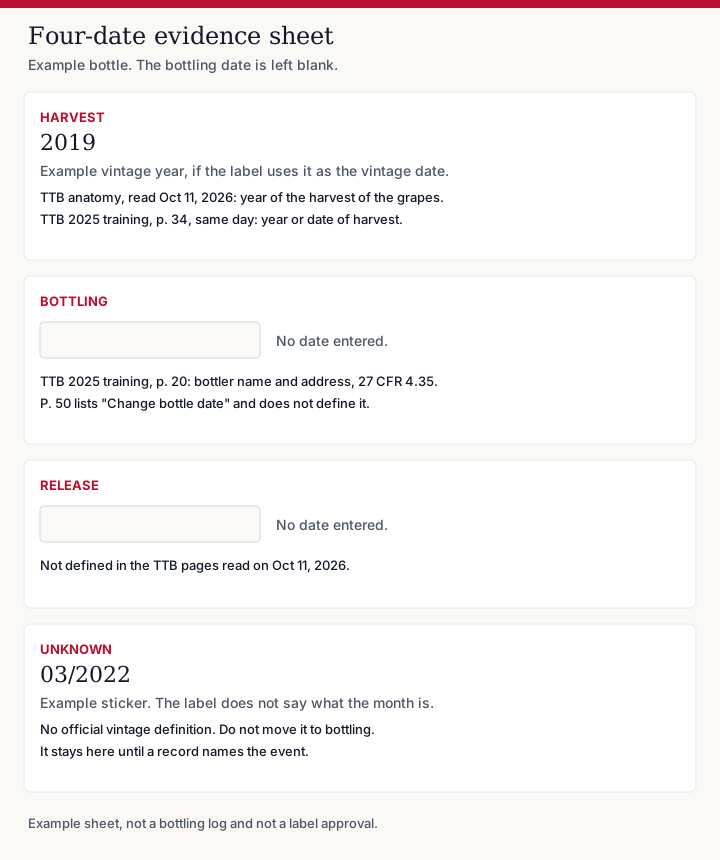
Takeaway: On the example bottle, 2019 is the harvest year, 03/2022 is unknown, and bottling and release stay blank.
What does the harvest-to-bottling timeline leave blank?
The same example, drawn as a sequence, runs from the harvest year to a bottling date you do not have. The cellar stretch between them has no length on the label, so the timeline leaves that length unknown. What oxygen, wood, tanks, and the bottle do during cellar time is the subject of how wine aging works. How a sealed bottle is stored is the subject of how long unopened wine lasts. Those pages cover the reactions and the storage conditions. This timeline shows the order of the four records.
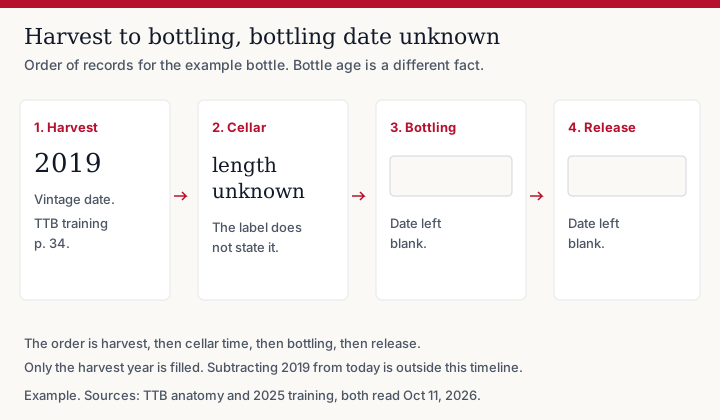
Subtracting the vintage year from today’s date is a different calculation, and it is not a step on this sheet. A 2019 harvest can be bottled in a later year. Until the bottling log arrives, you do not know which later year, and you do not write one in.
Takeaway: Keep the harvest year, leave the bottling date blank, and treat the years between them as unknown until a record states the interval.
What this page leaves unresolved
The tables are readings of the TTB pages named above, in the versions read on October 11, 2026. Several decisions sit outside them.
- A Certificate of Label Approval, or a judgment that a bottle you own meets a claim.
- A state’s own wine statute, where an appellation rule requires conformity with the named area.
- The legal meaning of “bottle date” on training page 50. The words are quoted. The definition is not on the slide, so the point stays unknown.
- The letters NV. The vintage date is optional. A definition of NV is not in the two texts.
- Bottle age, a storage life, a score, or a ranked list of vintages. Koeppel on Wine is an independent information site. The About page states who operates it. These articles are general information about labels. They do not encourage drinking, and they do not decide that a bottle is safe to drink.
Takeaway: Use the vintage year as the harvest year under the TTB sentence you cite, and leave every other date blank until a record names it.
How this page was put together
We took the vintage wording from TTB’s anatomy page and from the 2025 Wine Boot Camp slides titled Wine Boot Camp Basics: Labeling, including the Vintage Date slide on printed page 34, the name-and-address slides on printed pages 20 and 21, and the allowable-revisions list on printed page 50. The PDF was created December 11, 2025. The anatomy document is TTB G 2019-9, September 26, 2019, and the page was last updated January 8, 2026. Both were read on October 11, 2026. The 27 CFR citations are the ones printed on those pages. The example bottle, the year 2019, and the sticker 03/2022 were made for the sheet. No producer confirmed a bottling, and nothing here comes from a tasting. Other explainers are listed on the articles page.
Takeaway: A filled cell names the TTB sentence or the record it came from. An empty bottling cell means that record was not in hand.