Treating estate bottled and single vineyard as one place guarantee is the wrong reading of a US wine label. Estate bottled is a defined claim in the TTB texts read for this page, and the words single vineyard are not given a definition in those texts.
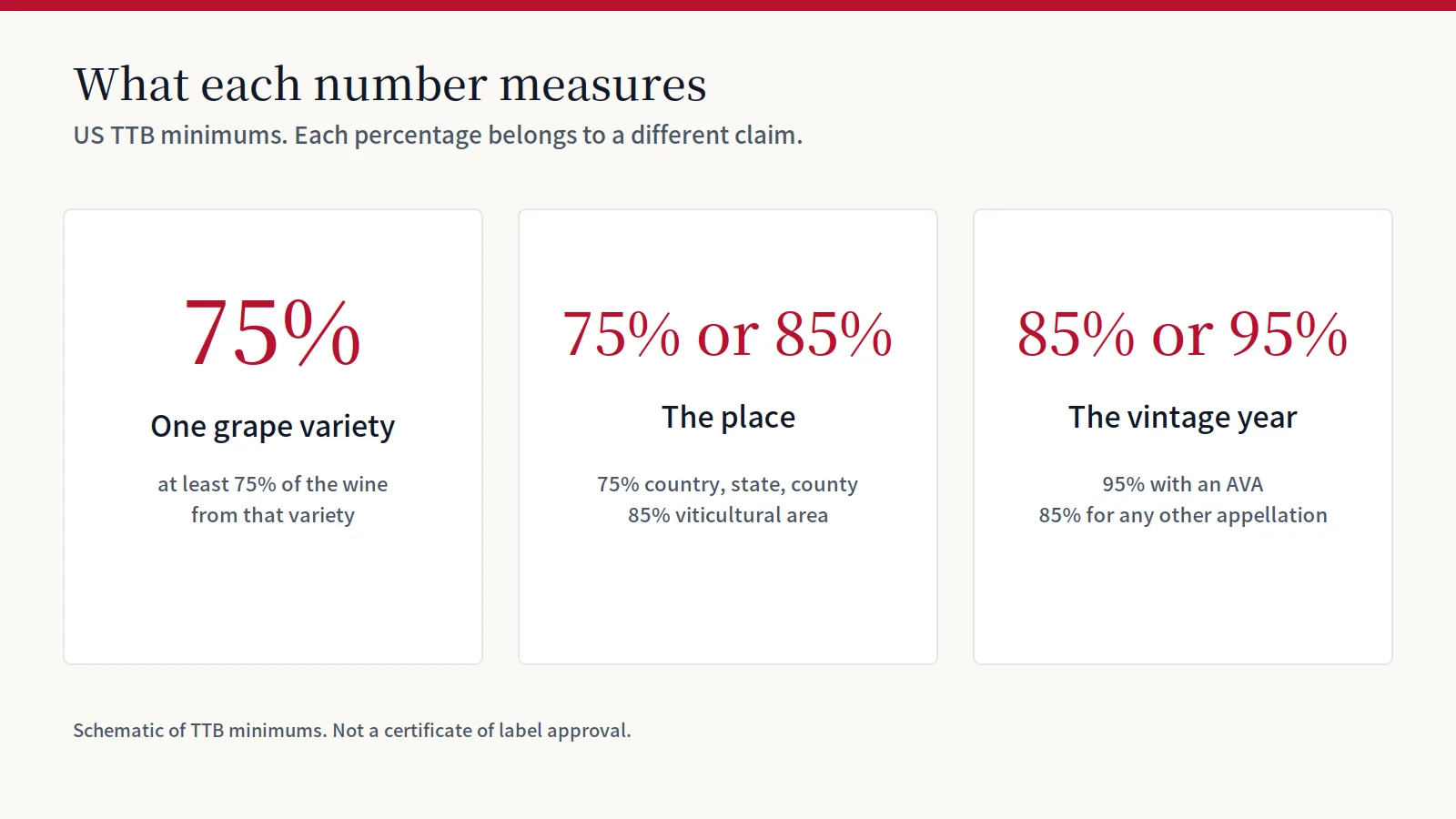
This page uses TTB’s appellation of origin page, last updated November 20, 2020, and the 2025 Wine Boot Camp labeling slides, printed pages 32, 35 and 36. All of them were read on October 11, 2026. The slides’ opening notice says the presentation is not intended to establish any new definitions, and that readers should consult the regulations. The sentences below are the ones printed on those pages. They are not a label approval, a score, or a buying list. Variety, place and vintage percentages are on the 75-85-95 label page. More label explainers are in Labels and Filling.
On a US label, estate bottled and the words single vineyard are different lines, and neither TTB text read here ranks one above the other. TTB’s appellation page, last updated November 20, 2020 and read on October 11, 2026, says estate bottled means that 100 percent of the wine came from grapes grown on land owned or controlled by the winery, that both the winery and the vineyard are inside the labeled viticultural area, and that the winery crushed, fermented, finished, aged, processed and bottled the wine in a continuous process on its premises, the wine at no time having left those premises. The 2025 training, printed page 35, citing 27 CFR 4.26, requires an AVA on the label, all the grapes from that AVA on land the producing and bottling winery owns or controls, and the same continuous process on the premises. The words single vineyard do not appear in either text.
Key points:
- Estate bottled, in the appellation-page sentence, is a 100 percent grape-source claim tied to land the winery owns or controls, inside the labeled viticultural area.
- The same page, and training page 35, require the crush-to-bottle work to stay on the winery’s premises.
- The words single vineyard are not stated as a defined term in these two TTB texts.
- A vineyard name inside the brand has its own test on training page 36. That test is not a definition of single vineyard.
- Neither text says one phrase makes a better wine.
| Input or item | Typical value or source | Why it matters |
|---|---|---|
| Estate bottled, grape source | 100 percent of the wine from grapes grown on land owned or controlled by the winery, inside the labeled viticultural area. TTB appellation page, updated November 20, 2020, read October 11, 2026. | A place name alone, or the words single vineyard, is a different line on the label. |
| Estate bottled, premises | Crush, ferment, finish, age, process and bottle in a continuous process on the winery premises. The wine does not leave. Same page. | Grapes from one place still miss this claim if the wine left the premises. |
| The words single vineyard | Not stated in the appellation page or the 2025 training slides read here. | Do not copy the estate bottled tests, or a percentage, onto those words from these texts. |
| Vineyard name inside the brand | Not less than 95 percent of the wine from primary winemaking material grown on the named property, or the brand matches the company or trade name in the name and address statement. Training page 36. | That test belongs to the brand name. It does not define single vineyard. |
| Quality | Not stated for either phrase. | These texts do not pick a winner. |
What does estate bottled require?
Estate bottled, on the appellation page, is one sentence plus a labeling condition. The sentence sets the grape source, the location of the winery and the vineyard, and the work that stays on the premises. The labeling condition says the wine must meet the requirements for a viticultural area and be labeled with that viticultural area.
The appellation page, read on October 11, 2026, prints this meaning:
“Estate bottled” means that 100 percent of the wine came from grapes grown on land owned or controlled by the winery, and both the winery and the vineyard must be located within the boundaries of the labeled viticultural area. The winery must crush and ferment the grapes, and finish, age, process, and bottle the wine in a continuous process on its premises (the wine at no time having left the premises of the bottling winery).
The same page says wine labeled estate bottled must be labeled with that viticultural area. An earlier section of the page lists an “estate bottled” claim among the items that require an appellation of origin, and it says estate bottled wine must be labeled with a viticultural area.
The 2025 training’s Estate Bottled slide, printed page 35, citing 27 CFR 4.26, states four conditions. Read on October 11, 2026, they are:
- The wine must be labeled with an AVA as the appellation of origin.
- The winery that produced and bottled the wine must be located in the AVA.
- All the grapes used to make the wine must have been grown in the labeled AVA on land owned or controlled by the winery that produced and bottled the wine.
- That winery must have crushed the grapes, fermented the juice resulting from the crushing, finished, aged and bottled the wine in a continuous process, the wine at no time leaving the winery’s premises.
The two wordings agree on ownership or control, on the labeled area, and on a continuous process that does not leave the premises. They do not use the same noun for the land. The appellation page says “the vineyard.” The training slide says “land” and “all the grapes.” Neither sentence defines one parcel versus several parcels inside the AVA. This page leaves that definition unstated.
The word controlled is printed in both texts. A lease length, a contract form, and a test for what control requires are not stated.
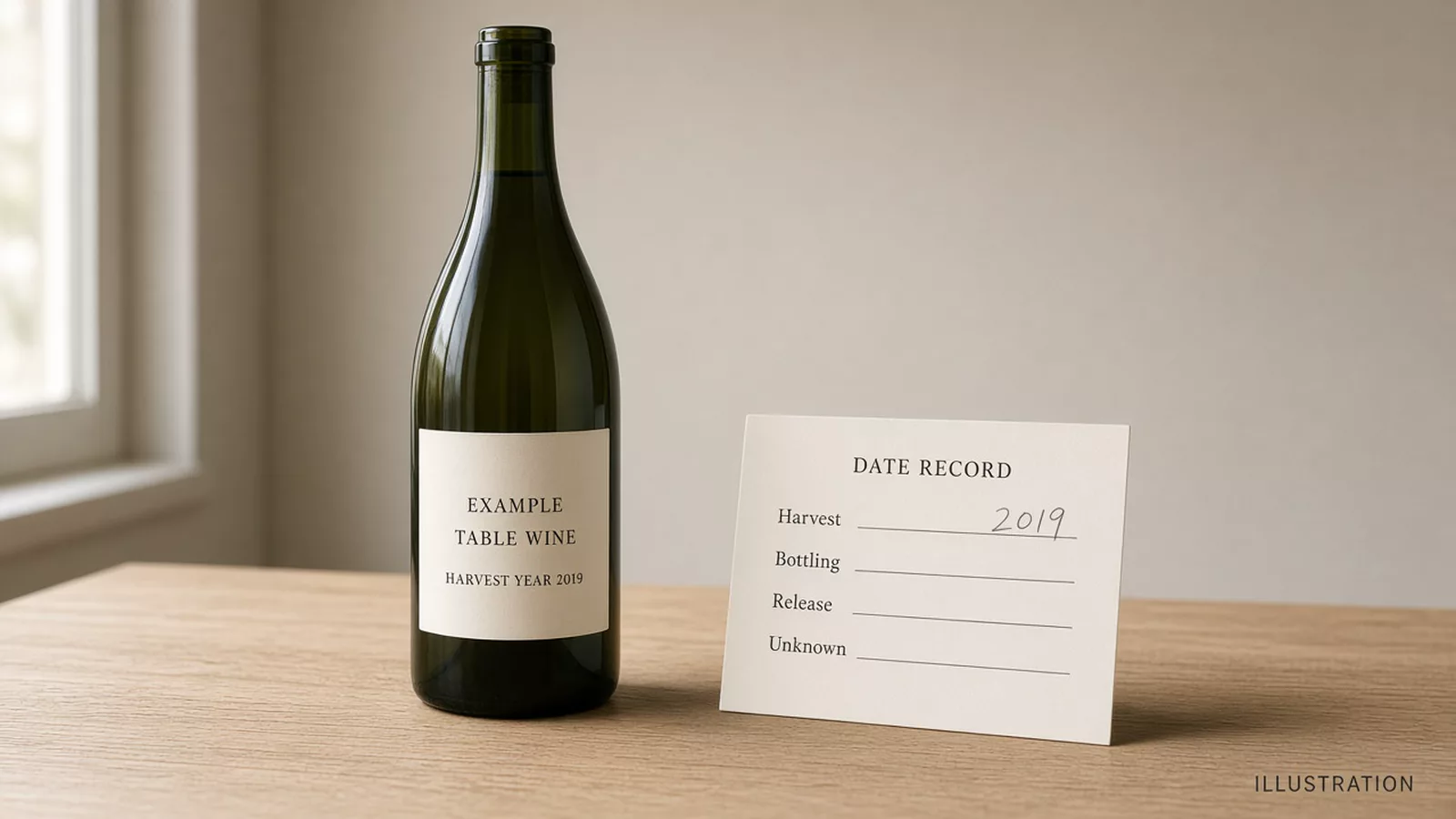
An AVA used as an appellation has a separate floor on the same appellation page: not less than 85 percent of the wine from grapes grown in the named viticultural area, with the finishing exceptions that page prints. That 85 percent floor is not the estate bottled sentence. The place floors and the vintage floors are on the 75-85-95 label page. The premises condition is also not a bottling date. Harvest year and bottling day are separate records on wine vintage dates.
Takeaway: Write the 100 percent grape-source sentence and the premises sentence as two checks. Leave the meaning of controlled, and the meaning of one vineyard versus several, unstated.
Is single vineyard defined in these texts?
The words single vineyard are not stated in the appellation page or in the 2025 slides read here. Do not treat them as a shorter name for estate bottled.
Printed page 32 of the training lists optional label claims on separate bullets. Estate Bottled is one bullet. “Vineyard, Orchard, Ranch, or Farm Name” is another. “Produced” or “Made By” is a third. This page does not restate the page 21 phrases for produced, made, blended, cellared or vinted.
The vineyard bullet that is printed, on page 36, is about a name inside the brand:
When used in a brand name, a vineyard, orchard, farm, or ranch name having geographical or viticultural significance is subject to the requirements of 27 CFR 4.33(b) and 4.39(i).
The same slide says a brand name that includes such a name is acceptable, in general, in either of two cases. Not less than 95 percent of the wine was produced from primary winemaking material grown on the named vineyard, orchard, farm, or ranch. Or the company name or trade name in the mandatory name and address statement is identical to that brand name. The citations on the slide are 27 CFR 4.33(b) and 4.39(i). The full Code of Federal Regulations was not the source. The citation is the one printed on the slide.
That 95 percent test, and the identical-name alternative, belong to a vineyard name used in the brand. They are not a definition of the words single vineyard on another line of the label. The 75-85-95 page keeps the brand-name row in its own table so it stays apart from the vintage 95 percent.
The words estate grown are not stated in these two TTB texts either. A label that prints them needs a source this page does not have.
Takeaway: If the words single vineyard are not a vineyard name inside the brand, these texts do not give them a percentage.
How do the three checks come apart?
Use the same three questions on every label you compare: where the grapes grew, whether the winery owns or controls that land, and whether the wine stayed on the premises through bottling. A cell is filled only when a sentence opened for this page states it. The cases below are hypothetical. They use no winery name. They are not a decision that a bottle qualifies.
| Claim | Grape source in these texts | Ownership or control | Premises through bottling | Quality ranking |
|---|---|---|---|---|
| Estate bottled | 100 percent from grapes on land the winery owns or controls, inside the labeled viticultural area. Training page 35 adds: all the grapes from the labeled AVA on that land. | Owned or controlled. The word controlled is not defined. | Continuous process on the premises. The wine does not leave. | Not stated |
| The words single vineyard | Not stated | Not stated | Not stated | Not stated |
| A vineyard name inside the brand | Not less than 95 percent from primary winemaking material grown on the named property, or the brand matches the company or trade name | Not stated as an ownership test | Not stated | Not stated |
Case A. Grapes come from more than one block inside one labeled AVA. The winery owns or controls that land. Crushing through bottling stays on the premises. The label says estate bottled and does not use the words single vineyard. Training page 35 describes all the grapes, the AVA, ownership or control, and the premises. It does not add the words one vineyard or several vineyards. The appellation page says “the vineyard” and does not define a parcel. This page does not decide Case A.
Case B. A vineyard name is part of the brand, and not less than 95 percent of the wine comes from primary winemaking material grown on that named property. The winery does not own or control the land, or the wine left the premises before bottling. Page 36 can be read on its own terms for the brand name. The estate bottled list is a different list. Missing ownership or control, or a wine that left the premises, sits outside that list. The words single vineyard are still not defined.
Case C. The label uses the words single vineyard on a line that is not the brand name. Page 36 applies when a vineyard, orchard, farm or ranch name is used in a brand name and has geographical or viticultural significance. A descriptive phrase outside that brand-name rule is not given a percentage in the texts read here. It is not stated.
Takeaway: Fill a cell only from a sentence these TTB pages print. Leave every other cell as not stated, including which case qualifies.
Does pairing the phrases with Napa add a rule?
A search that pairs estate bottled with single vineyard, including a Napa pairing, still lands on the US sentences above. The TTB pages read here do not state a separate Napa test, a Napa percentage, or a Napa boundary. The appellation page’s example of an AVA on a label is Hudson River Region. If a label uses an AVA name, estate bottled still asks for that AVA, for land the winery owns or controls, and for the premises condition. Those questions do not become a list of bottles to buy.
Takeaway: Keep the three checks. A place name in the search does not add a rule these pages do not print.
What this page leaves unresolved
The tables are readings of the TTB pages named above, in the versions read on October 11, 2026. Several decisions sit outside them.
- A Certificate of Label Approval, or a judgment that a bottle you hold meets a claim.
- The legal meaning of controlled. The word is quoted. A lease length and a contract test are not on the pages.
- Whether “the vineyard” means one parcel. The singular noun is quoted. A definition of a parcel is not.
- The words estate grown, and the words single vineyard outside a brand-name vineyard rule. Both are not stated here.
- A state’s own wine statute. The appellation charts say the wine must conform to the laws of the named area. This page does not restate a state statute.
- A score, a ranked list, or a statement that one phrase makes a better wine. Koeppel on Wine is an independent information site. The About page states who operates it. These articles do not encourage drinking, and they do not decide that a bottle is safe to drink.
Takeaway: Stop at the printed conditions. A label approval, a parcel count, and a quality ranking stay outside this page.
How this page was put together
We took the estate bottled sentence from TTB’s appellation of origin page, last updated November 20, 2020, and the four conditions from the 2025 Wine Boot Camp slide titled Estate Bottled, printed page 35, citing 27 CFR 4.26. The brand-name vineyard test is from printed page 36, citing 27 CFR 4.33(b) and 4.39(i). The optional-claims list is printed page 32. The slides are marked 2025, and their opening notice says the presentation does not establish new definitions. Both TTB texts were read on October 11, 2026. The full Code of Federal Regulations was not the source. The example cases have no winery name and no tasting. Other explainers are listed on the articles page.