You can tell if wine is heat damaged before opening by checking for a cork pushed partially out of the bottle, a trace of wine along the cork side, or wine seepage on top of the cork. Once poured, heat-damaged wine smells of cooked fruit and walnuts while turning prematurely brown or brick-colored.
Reputedly, heat damage is the most widespread and common problem found in wines, yet it frequently goes unrecognized when drinkers inspect clarity alone and overlook closure movement or premature browning. Separating thermal spoilage from normal cellar evolution—covered across our wine knowledge library and our guide on how long wine lasts unopened—requires checking both mechanical seal stress at the bottle neck and sensory shifts in the glass.
How Can You Tell If an Unopened Bottle Has Heat Damage?
Before pulling the stopper, you can spot likely heat damage on an unopened bottle when the cork is partially pushed out of the neck, a trace of wine is visible along the length of the cork, or wine seepage sits on top of the cork from excessive headspace pressure.
As documented in Wikipedia’s overview of wine faults and Purdue University Extension’s wine storage guidelines, elevated temperatures build internal headspace pressure inside a sealed bottle. That pressure drives leakage and seepage of wine past the closure, staining labels and packaging materials while leaving visible wine tracks along the bark cylinder or underneath the foil capsule.
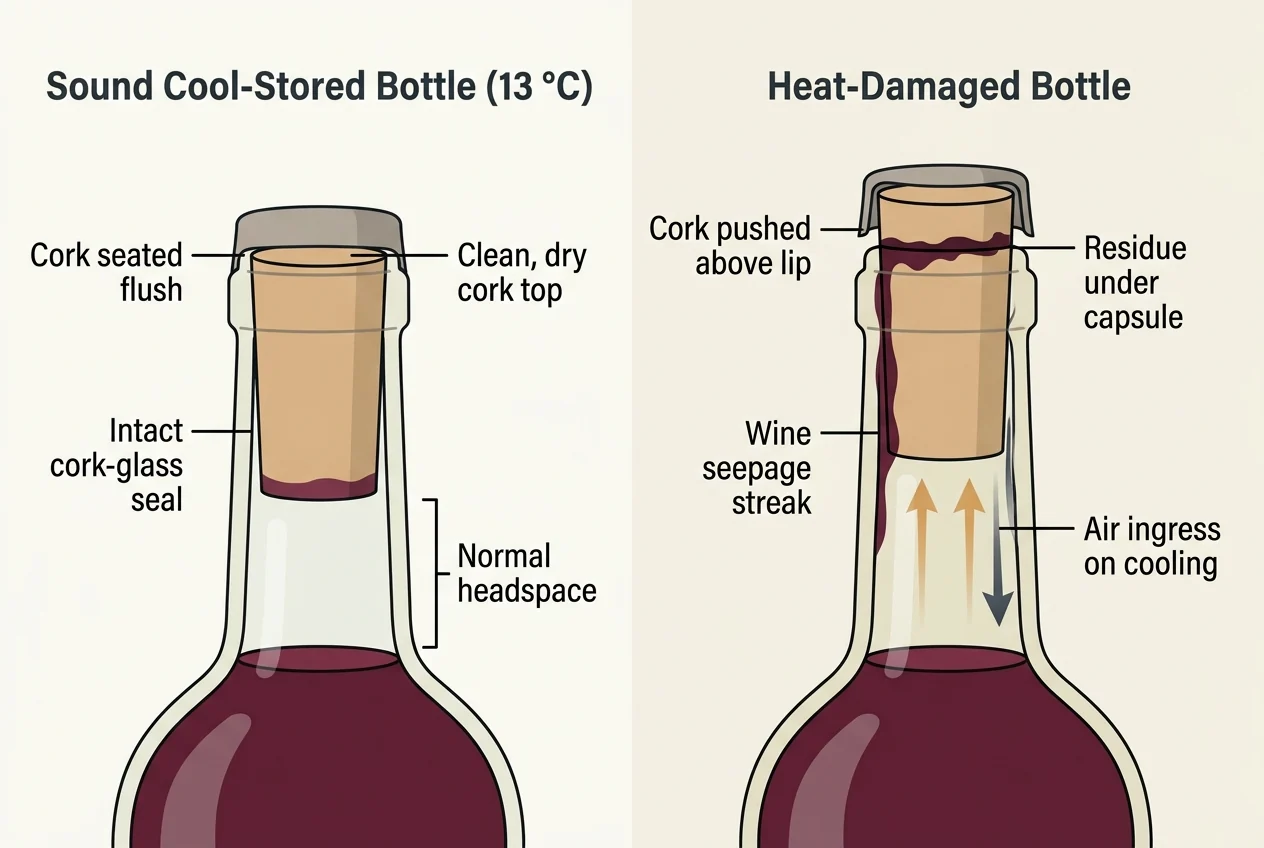 Comparison of an intact cork-glass seal at 13 °C versus cork displacement, longitudinal wine seepage, and air pumping after thermal fluctuations.
How Temperature Fluctuations Pump Air Past the Cork
Extreme peak heat is not required to compromise a cork seal. Even when storage temperatures do not reach extremes, temperature variation alone can damage bottled wine through oxidation. Because all corks allow some leakage of air over time, repeated temperature fluctuations vary the pressure differential between the inside and outside of the bottle and act to pump air into the bottle at a faster rate than will occur at any strictly maintained temperature.
Extreme cold produces a separate mechanical hazard that mimics thermal cork movement. If wine is exposed to temperatures that are too cold, the liquid can freeze and expand, causing the cork to be pushed out or, more usually, the glass bottle to crack, which likewise exposes the wine to excess oxygen.
At What Storage Conditions Does Heat Start Cooking Wine?
Accepted ideal wine storage sits at an appropriate, constant temperature of 13 °C, whereas storing bottles at temperatures greatly higher than 13 °C increases the aging rate and degrades freshness. In white wines, Purdue University Extension cites reaction-rate temperature increments spanning oxygen uptake, 7.8 °C for browning, 16 °C for ethyl carbamate formation, and 30 °C.
Because distinct chemical aging pathways respond unevenly to warmth, high storage temperatures cannot replicate slow cellar maturation. As noted in Wikipedia’s guide to the storage of wine, temperature swings—such as repeatedly transferring a bottle from a warm room to a cool refrigerator—can also cause adverse chemical reactions in the wine that may lead to wine faults.
| Storage or Kinetic Parameter | Reference Value or Condition | Documented Effect on Bottled Wine |
|---|---|---|
| Accepted ideal cellar storage | Constant 13 °C | Baseline storage temperature preferred to prevent accelerated thermal aging and pressure-swing oxidation |
| White wine browning kinetics | 7.8 °C reaction-rate increment (alongside oxygen uptake) | Accelerates non-microbial browning and oxidative color darkening in white wines |
| White wine ethyl carbamate & sulfur dioxide kinetics | 16 °C (ethyl carbamate formation) and 30 °C | Uneven thermal acceleration across chemical aging and preservative loss pathways |
| Global shipping & storage benchmarks | Purdue Extension Table 1 conditions | Defines recommended temperature controls during simulated transport or warehouse storage |
| Environmental triad | Temperature, humidity, and light | The three storage factors with the most pronounced effect on bottled wine quality |
| Bottle storage orientation | Slight angle (late 1990s research) | Suggested ideal orientation rather than completely horizontal to manage closure contact and gas exchange |
Light, Humidity, and Bottle Orientation Alongside Heat
The three factors that have the most pronounced effect on wine in storage are light, humidity, and temperature. When wine is exposed to light from sunlight, fluorescent artificial lights, or any other form of lighting, it can change its flavor and aroma even if the room feels cool. Bottle orientation also shapes closure behavior: Purdue University Extension addresses preferred bottle position to limit gas exchange across corks, while research in the late 1990s suggested that the ideal orientation for wine bottles is at a slight angle rather than completely horizontal. Once a sound bottle moves from cellar racks to the table, see our guide to wine serving temperature by style for pouring targets.
Why Does Heat-Damaged Wine Smell Cooked Rather Than Like Vinegar?
Heat-damaged wines—often casually called cooked or maderized wine after Madeira, which is intentionally exposed to heat during winemaking—smell of cooked fruit and walnuts with premature browning. Sharp vinegar and nail-polish-remover aromas instead require high acetic acid from acetic acid bacteria and subsequent ethyl acetate formation rather than heat exposure alone.
Madeira is exposed to high temperatures during its winemaking process and is thereby able to sustain exposure to higher temperatures more easily than other wines. When ordinary unfortified table wines undergo unplanned heating, thermal reactions bake primary fruit aromas into stewed, nutty notes of cooked fruit and walnuts without turning ethanol directly into vinegar.
Nose Detection Versus Laboratory Volatile Profiling
In professional wine evaluation, gas chromatography-mass spectrometry (GC-MS) is used to measure the chemical volatile aroma profile of wine. In everyday practice, however, the vast majority of wine faults are detected by the nose and the distinctive aromas that they give off, with sensory thresholds for fault compounds varying depending on wine components such as sulfur dioxide.
How Does Heat Damage Differ From Oxidation, Volatile Acidity, and Cork Taint?
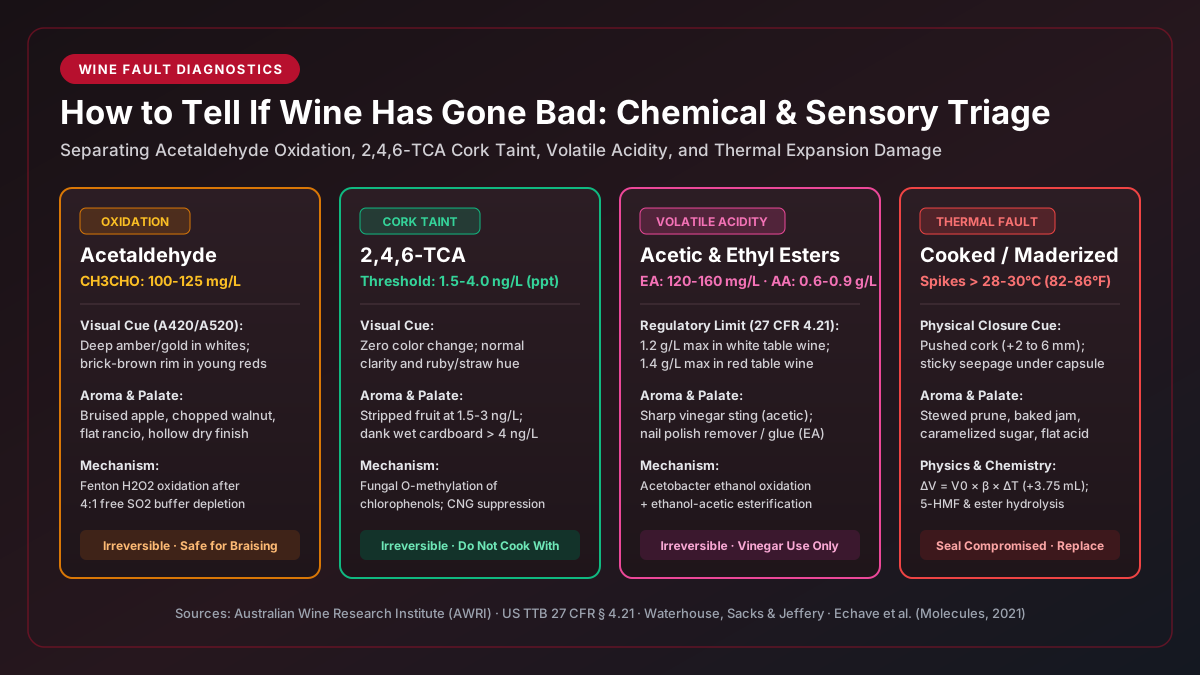
Heat damage pairs cooked-fruit and walnut aromas with premature browning and cork seepage, whereas ordinary oxidation builds acetaldehyde and color loss, volatile acidity stems from acetic acid and ethyl acetate, and cork taint smells of a damp basement, wet cardboard, newspapers, and mushrooms without changing wine color or pushing the cork.
As cork taint has gained a wide reputation as a wine fault, other faults—including cooked or oxidized bottles—are often mistakenly attributed to it. Checking closure position, liquid hue, and headspace aroma together separates thermal abuse from non-thermal spoilage, which we examine across broader fault families in how to tell if wine has gone bad from oxidation and cork taint.
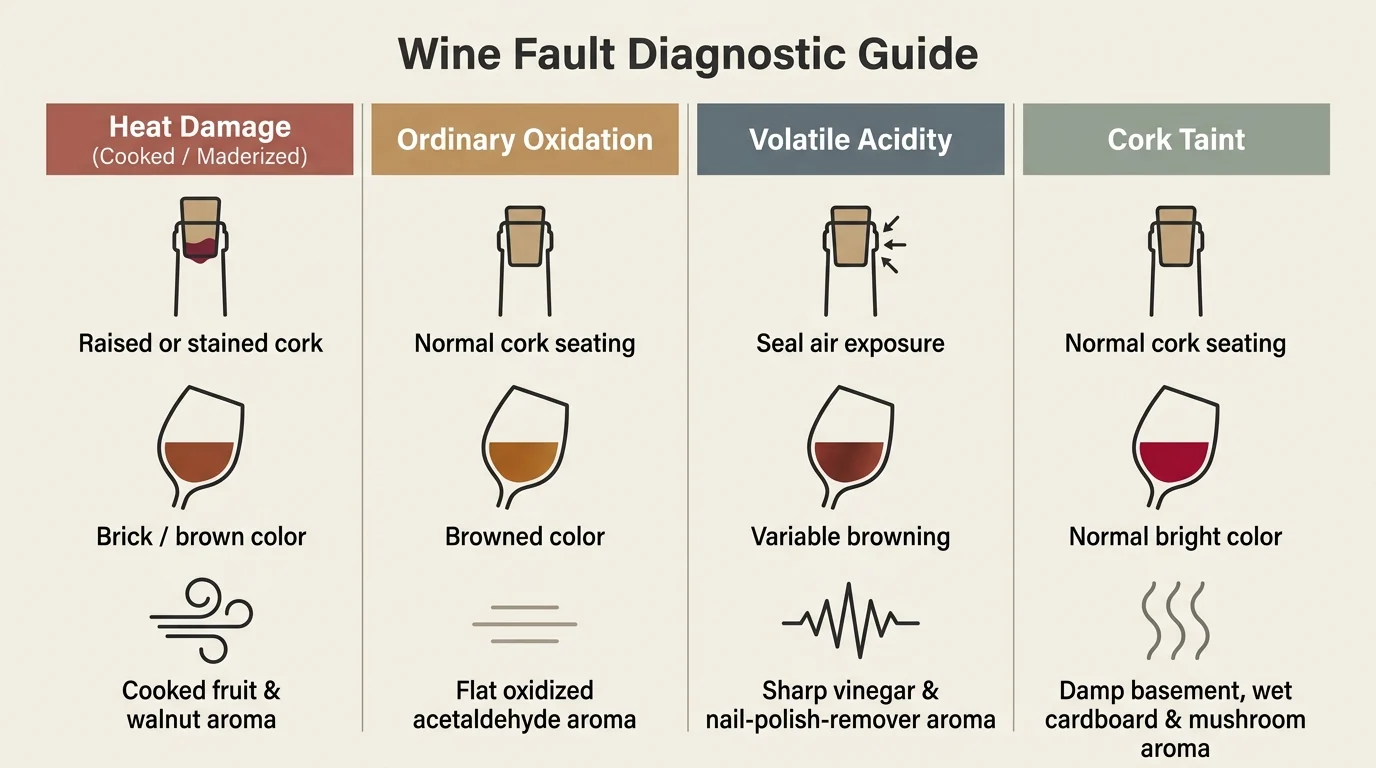 Diagnostic separation of heat damage, ordinary oxidation, volatile acidity, and cork taint across bottle closure, glass color, and aroma.
| Fault Category | Cork & Closure Evidence | Poured Glass Appearance | Distinctive Aroma Profile | Underlying Cause |
|---|---|---|---|---|
| Heat damage (cooked or maderized wine) | Cork partially pushed out; wine trace along cork side or on cork top | Premature white wine browning; red wine brick color | Smell of cooked fruit and walnuts | Elevated storage temperatures and headspace pressure swings |
| Ordinary oxidation | Normal cork seating; slow air leakage or temperature-swing air pumping | Premature yellowing, browning, and loss of vibrant color | Flat oxidized notes associated with acetaldehyde | Oxygen ingress overwhelming protective sulfur dioxide |
| Volatile acidity & ethyl acetate | Variable; frequently linked to air exposure | Variable browning depending on concurrent oxidation | Vinegar sting (acetic acid) and nail-polish-remover odor (ethyl acetate) | Surface film-forming yeasts and acetic acid bacteria; high acetic acid promotes ethyl acetate |
| Cork taint | Normal flush cork seating and clean capsule | Normal bright clarity and varietal color | Smell of a damp basement, wet cardboard or newspapers, and mushrooms | Non-thermal taint frequently misblamed for other wine faults |
While acetaldehyde production in oxidized wine is also associated with surface film-forming yeasts and bacteria such as acetic acid bacteria, opinions differ as to what level of volatile acidity is appropriate for higher-quality wine. Wines with high acetic acid levels are more likely to see ethyl acetate formation—producing solvent or nail-polish-remover aromas—even though ethyl acetate itself does not contribute to volatile acidity.
What Color Shifts and Wine Bricking Show Heat Spoilage?
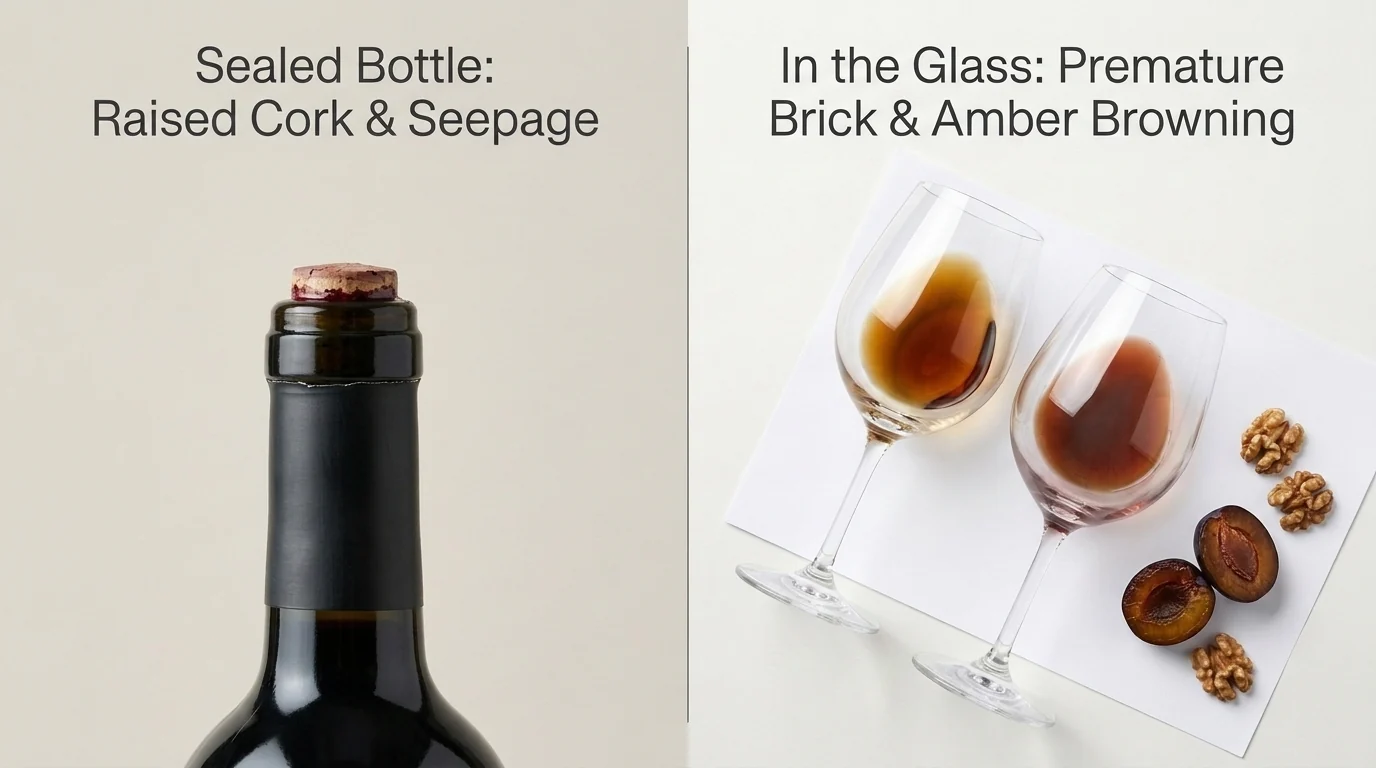
In the glass, heat-damaged white wines develop premature yellowing and browning, while heat-damaged red wines often become oxidized and take on a brick color known as wine bricking. By contrast, clear crystal precipitates in a chilled bottle reflect harmless tartrate instability rather than heat spoilage or aroma degradation.
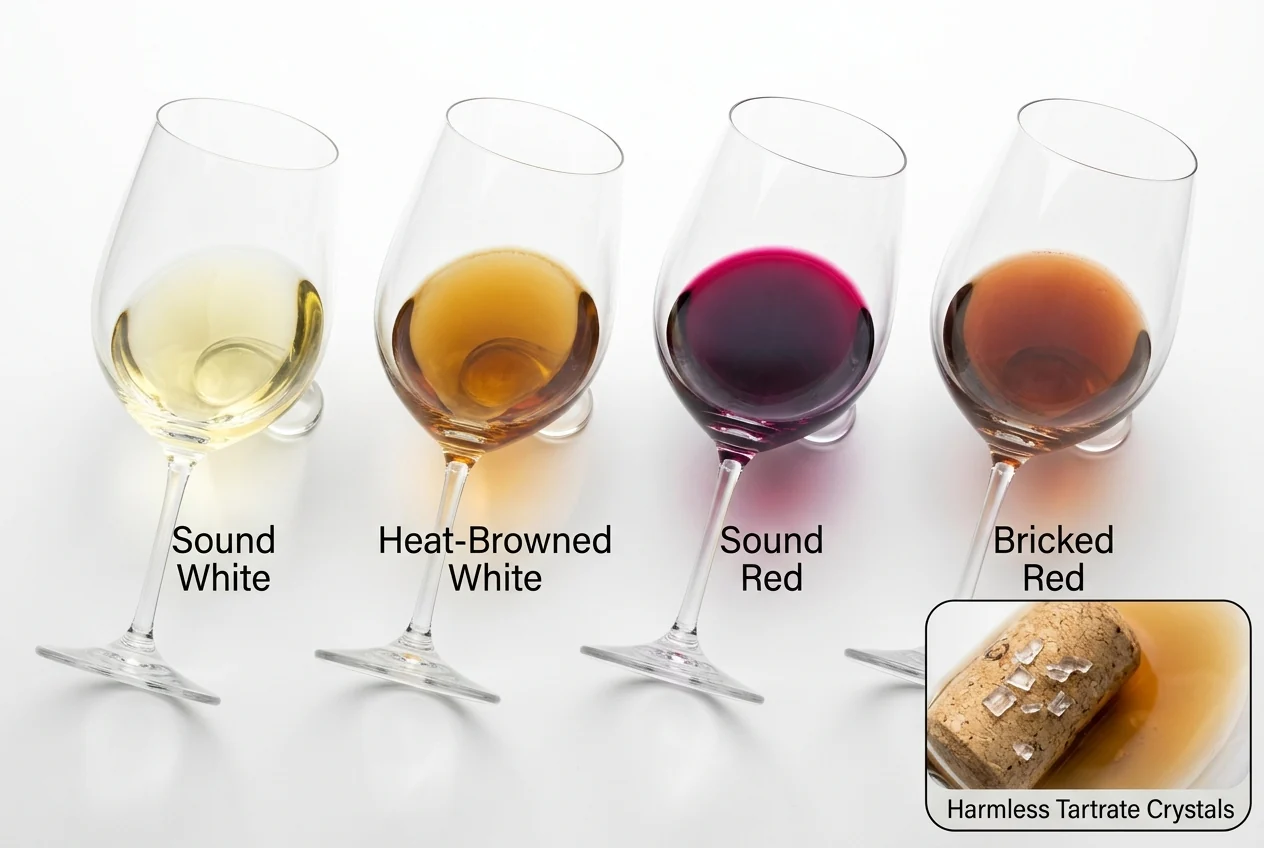 Premature amber browning in white wine and brick color shift in red wine compared against sound pours and harmless crystal precipitates.
Distinguishing Thermal Browning From Winemaking Color Variations and Crystals
Not every unexpected hue or solid particle points to an overheated bottle:
- Premature white wine browning: Purdue University Extension highlights white wine browning as a key temperature-sensitive reaction (with a 7.8 °C reaction-rate increment), shifting young white wines toward dull yellow or amber alongside cooked-fruit aromas.
- Red wine bricking: Heat-damaged wines often become oxidized, causing red wines to lose bright ruby tones and take on a brick color much earlier than cool-cellared bottles.
- Winemaking color anomalies: A wine with an unusual color for its grape variety or wine region can also reflect excessive or insufficient maceration as well as poor temperature controls during fermentation rather than post-bottling transit heat.
- Harmless crystal precipitates: Commercial wines are routinely stabilized against aesthetically objectionable instabilities such as protein hazes or crystal precipitates; finding odorless tartrate crystals on a chilled cork does not indicate thermal damage.
What Should You Check on Warm Wine Shipments Before Uncorking?
When wine arrives in hot weather or crosses very hot climates where refrigerated containers may lose steady cooling, inspect the closure immediately for wine seepage past the cork, a raised stopper, or stained labels before opening, and avoid repeatedly moving warm bottles into a cold refrigerator where temperature swings cause faults.
Purdue University Extension notes that in very hot climates, the ability of refrigerated shipping containers to maintain a steady cool temperature may be compromised, and simulated transport or storage studies track how temperature and sulfur dioxide interact during transit. Because no rapid non-destructive test replaces tasting once a bottle is opened, documenting physical neck evidence before pulling the cork preserves clear proof of transit overheating.
| Inspection Stage | Physical or Sensory Observation | What It Indicates | Practical Action |
|---|---|---|---|
| Pre-opening capsule & rim | Cork partially pushed above glass lip | Internal headspace expansion from heat (or freezing if exposed to extreme cold) | Keep sealed and photograph neck position before uncorking if evaluating a recent shipment |
| Pre-opening cork & label | Sticky wine seepage on cork top, along cork side, or staining label | Excessive temperature drove liquid past the closure seal | Treat as likely heat-damaged; expect compromised oxygen barrier after cooling |
| Poured glass appearance | Premature amber browning in white wine or brick color in red wine | Thermal and oxidative pigment degradation | Confirm on the nose for cooked fruit and walnuts versus normal bottle age |
| Poured glass aroma | Cooked fruit and walnuts (versus damp cardboard or sharp vinegar) | Cooked / maderized heat damage rather than cork taint or acetic acid spoilage | Separate thermal storage failure from cellar cork taint or bacterial volatile acidity |
| Chilled bottle bottom or cork base | Odorless crystal precipitates with bright color and fresh aroma | Physical crystal precipitation rather than heat spoilage | Decant or pour gently off the crystals and serve at appropriate temperature |