Before bottling, put the wine fermentation results side by side: specific gravity, residual sugar and malic acid. Hydrometer readings fall because of both sugar depletion and alcohol accumulation. The Australian Wine Research Institute recommends enzymatic analysis for sugar and malic acid in wine because simpler methods do not give accurate results at low levels.
Use this guide to interpret the measurements, compare the source-specific endpoints and assemble a batch record for your bottling review.
What is wine fermentation?
Yeasts consume sugars and produce alcohol and carbon dioxide.
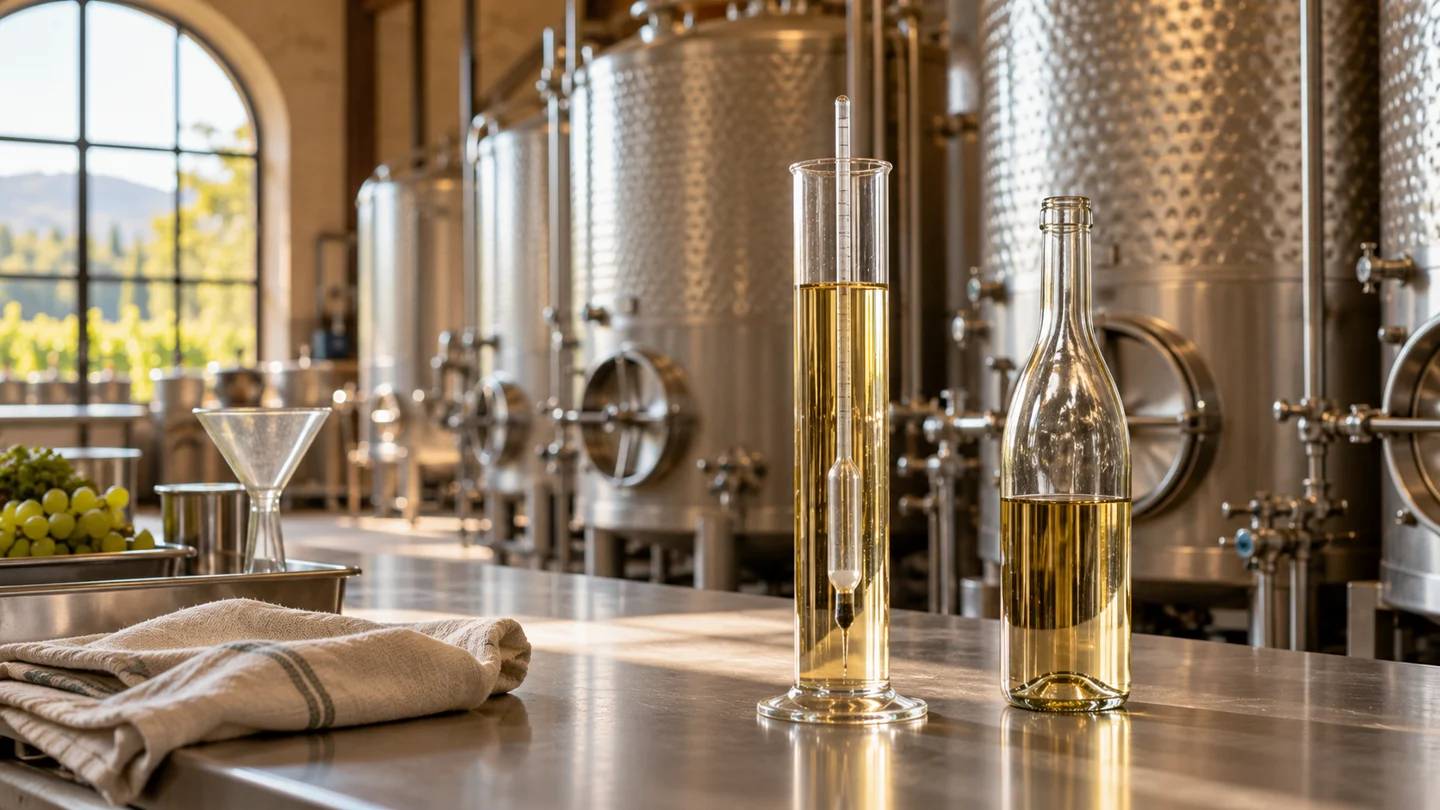
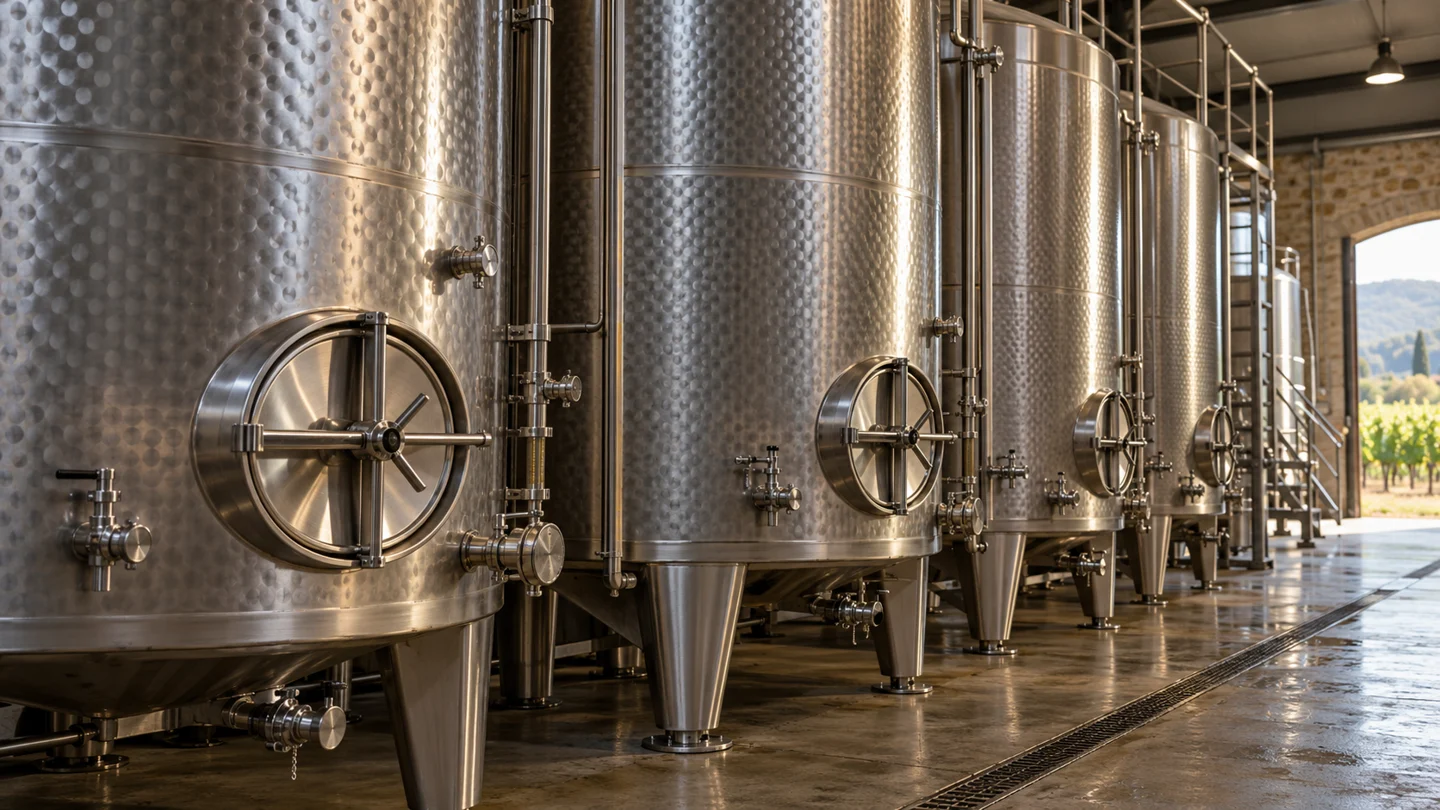
Start with the vessel, then follow the measurements through the wine fermentation process. White-wine fermentation can take place in stainless steel tanks or oak barrels.
What does specific gravity tell you?
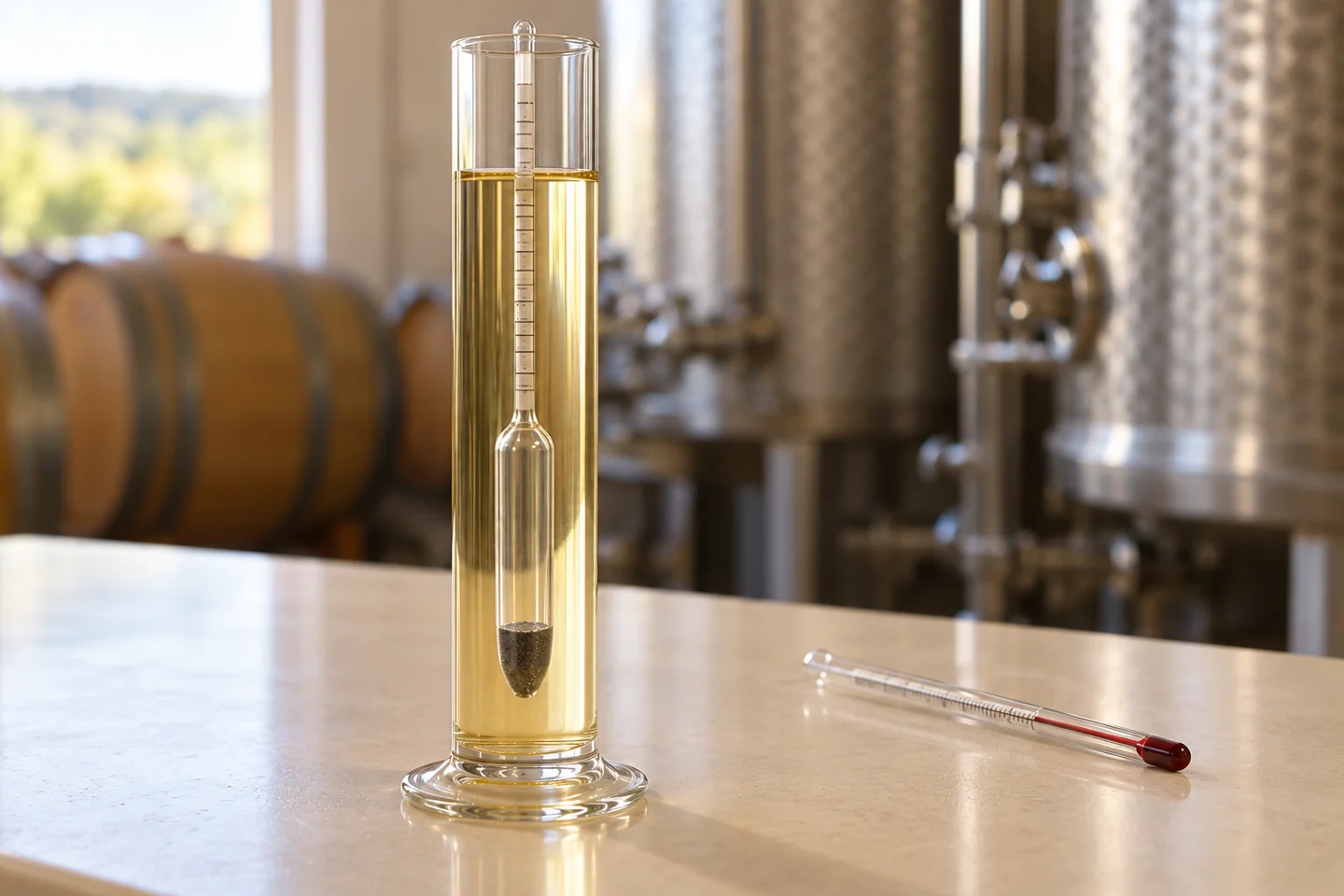
A hydrometer reads liquid density relative to water. Alcohol is less dense than water. Hydrometer readings fall because of both sugar depletion and alcohol accumulation.
Read the gravity trend alongside the sugar analysis. Keep the following instrument checks with your record.
Hydrometers and refractometers are temperature dependent. You should calibrate and check standards every day before you test your samples. Temperature-correction tables are available for devices without a thermometer.
Which residual-sugar test should you look at?
Residual sugar in wine is predominantly glucose and fructose. AWRI recommends enzymatic analysis to determine sugar and malic acid concentrations in wine, as simpler methods do not give accurate results at low levels.
Enzymatic analysis
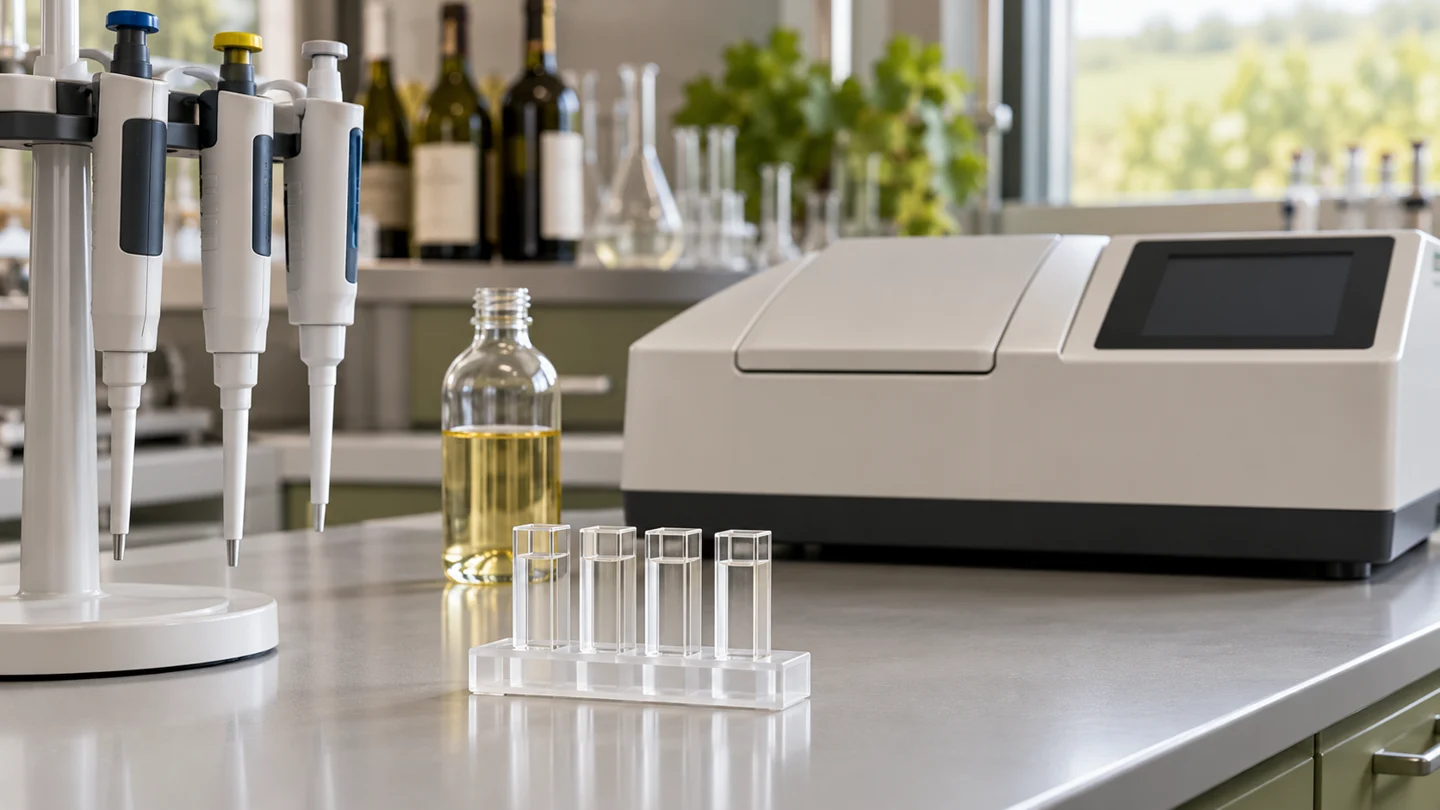
The enzymatic residual-sugar method uses a UV spectrophotometer, cuvettes and autopipettes. The enzymatic residual-sugar method uses glucose standards in water for calibration.
Reducing-sugar titrations
Lane and Eynon and Rebelein reducing-sugar titrations include pentose sugars that are not considered fermentable. These reducing-sugar titrations give higher results than tests of glucose and fructose alone.
Rapid test pills
Clinitest or OenoCheck rapid test pills estimate approximate sugar content in the range 1-20 g/L.
In your batch record, keep the method name beside the result.
Which dryness target belongs to the bottling decision?
The University of Adelaide white-wine process uses < 2 gm/L residual sugar for dry wine at the clarification stage.
For microbiological stability, turn to the substrate measurements.
Residual sugar and malic acid can provide substrates for microbial growth. In AWRI’s experience, any measurable level of sugar or malic acid can potentially support microbial growth. AWRI advises aiming below enzymatic-assay detection limits for glucose plus fructose and malic acid. AWRI lists 0.1 g/L as the glucose-plus-fructose detection level in its microbiological-stability guidance. AWRI lists 0.05 g/L as the malic-acid detection level in this guidance.
Record the intended target, the analytical method and the laboratory’s reporting limit together.
How do you check malolactic fermentation?
Malolactic fermentation (MLF) is a secondary bacterial fermentation carried out in most red wines and some white and sparkling wines. Malic acid is converted to lactic acid during MLF. MLF progress can be followed through decreasing malic acid and increasing lactic acid.
Follow the malic-acid result
Malic acid can be measured by enzymatic reaction. Paper chromatography for malic acid is qualitative. Paper chromatography generally indicates the presence or absence of an acid.
Keep the red-wine endpoint in its context
AWRI’s red-wine MLF guidance says a malic-acid result of 0.1 g/L or less is low enough to consider MLF complete. The red-wine MLF fact sheet describes not detected as usually <0.05 g/L by enzymatic analysis.
Compare that endpoint with the microbiological-stability aim above when reviewing the batch.
What deserves attention before bottling?
Most stuck ferments have higher residual fructose than glucose. Refermentation in the bottle will make your corks pop. Before bottling a hazy wine, AWRI says it is imperative to determine what is causing the haze. AWRI says bottling without filtration poses a considerable spoilage risk.
Continue with unfined versus unfiltered wine for the filtration topic.
A batch record for the bottling review
Bring the results together under these headings. Leave room for the review decision and follow-up actions.
- Batch and wine fermentation tank identification
- Sampling date and time
- Instrument identification and calibration check
- Sample temperature and temperature-correction reference
- Raw and corrected specific gravity
- Glucose-plus-fructose result, method and reporting limit
- Malic-acid result, method and reporting limit
- Intended malolactic-fermentation status
- Haze investigation and filtration review
- Bottling decision and outstanding actions
For related reading, browse the wine guides or continue to cold stabilization in wine.
Sources
- Winemakers Research Exchange — Harvest Reminders Part 1
- AWRI — Avoiding microbiological instabilities
- PA Eats — Wine Fermentation, interview with Scott Neeley
- University of Adelaide — World of Wine: Wine Production Process
- AWRI — Measurement of residual sugar in wine
- AWRI — Achieving successful malolactic fermentation (September 2020)
- AWRI — Measurement of malic acid in wine
- AWRI — Malolactic fermentation in red wine (November 2024)
- AWRI — Procedure for rescue of stuck or slow alcoholic fermentation
- American Wine Society — February 2022 newsletter, Winemaking: Making Wine to Age