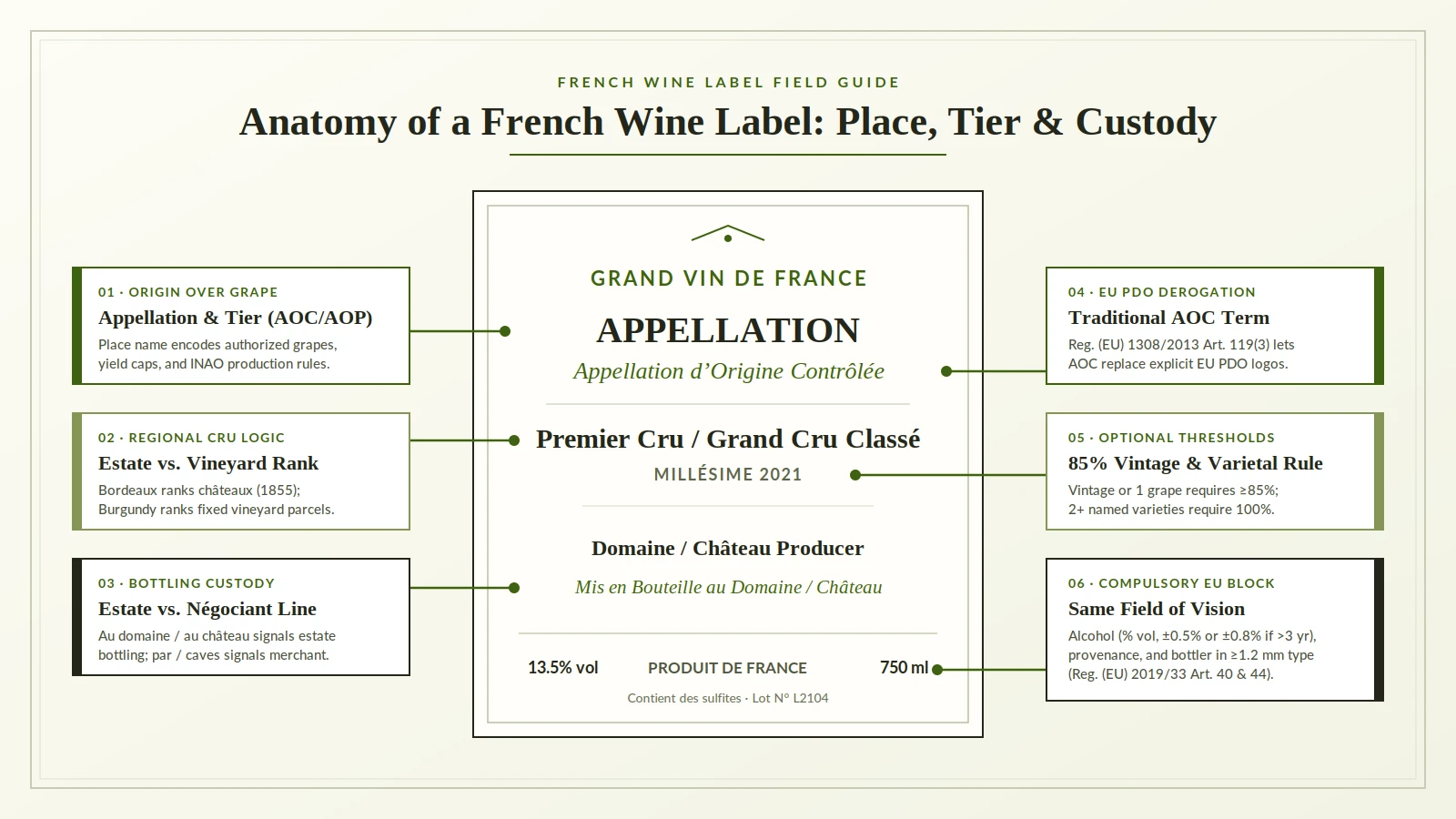
A French wine label identifies wine by geographical origin and quality tier — AOC/AOP, IGP, or Vin de France — rather than grape variety, because French appellation rules encode authorized grapes and production methods into the place name. Regional cru terms, bottling custody phrases, and compulsory EU alcohol and origin fields complete the label.
Because French wine law ties authorized grapes, yield ceilings, and traditional production practices to defined terroirs rather than front-label varietal marketing, an unlabelled grape does not mean a generic table blend. Readers comparing European rules with U.S. bottle formatting can pair this breakdown with our explainers on U.S. TTB mandatory wine label fields and U.S. grape, appellation, and vintage percentage rules.
How are French wine labels structured around place instead of grape variety?
French wine labels center on geographical origin because the Institut national de l’origine et de la qualité (INAO) certifies appellations around defined terroirs and traditional production methods, while EU law treats grape variety names as optional fields that national appellation rules may restrict or omit. With the exception of Alsace, French wine appellations historically omitted front-label grape names.
Under Regulation (EU) No 1308/2013, listing one or more wine grape varieties is classified as an optional particular rather than a compulsory requirement on wine packaging. Even more importantly, Commission Delegated Regulation (EU) 2019/33 authorizes producing Member States to make optional particulars under Articles 49, 50, 52, 53, and 55 compulsory, prohibited, or limited inside the product specifications of protected designations of origin (PDO) and protected geographical indications (PGI).
That legal structure explains why two French bottles sitting side by side look completely different. A regional IGP or national Vin de France bottle frequently displays Chardonnay or Sauvignon blanc on the front label, whereas a classic Bordeaux, Burgundy, or Loire AOC bottle puts the region, village, or vineyard first because INAO’s geographical rules already encode which grapes are allowed.
- Origin encodes the grape rule: Most French grape varieties are tied closely to specific regions, such as Cabernet Sauvignon in Bordeaux, Syrah in the Rhône, and Chardonnay in Burgundy and Champagne.
- Alsace is the long-standing exception: Because Alsace historically followed varietal-labeling practices alongside its AOC framework, front labels from Alsace routinely print the grape name alongside the appellation.
- Geographic precision narrows the wine: Across France, moving from a broad regional name down to a specific village or single vineyard signals tighter geographic boundaries and stricter appellation rules.
How do AOC, AOP, IGP, and Vin de France tiers map to European PDO and PGI rules?
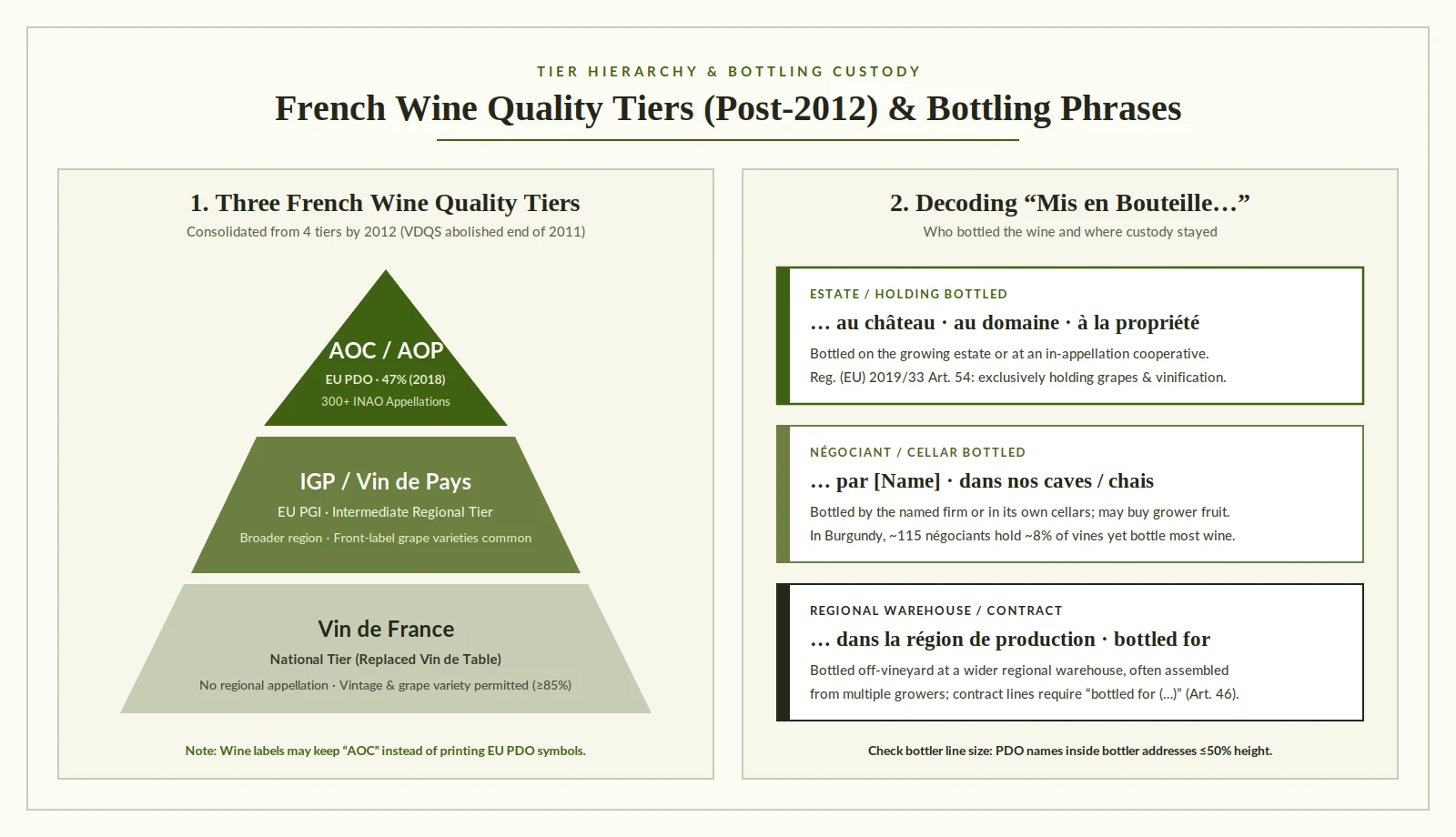
France revised its wine classification in 2006 and fully introduced a three-tier European structure by 2012 — AOP (matching EU PDO), IGP (matching EU PGI), and Vin de France — while abolishing the former VDQS tier. Under EU wine-labeling derogations, producers of qualifying French wines may still display the traditional term AOC without printing EU PDO wording or logos.
Over 300 French wines are entitled to display the AOC seal, and in 2018, 47 percent of the wine produced in France carried a controlled designation of origin. Under EU wine geographical indication and traditional-term rules and European Commission geographical indications guidance, wine labels under Regulation (EU) No 1308/2013 may omit the explicit words protected designation of origin or protected geographical indication in defined derogation cases when a recognized traditional term like AOC appears, largely for aesthetic continuity on traditional bottle labels.
| French Label Tier | Former French Category | EU Equivalent | Geographical Scope | Grape Variety & Vintage Labeling |
|---|---|---|---|---|
| AOC / AOP | Appellation d’origine contrôlée (AOC) | Protected Designation of Origin (PDO) | Strict INAO-delimited region, village, or single vineyard | Grape variety historically omitted outside Alsace; restricted by specification |
| IGP / Vin de Pays | Vin de Pays (plus absorbed former VDQS) | Protected Geographical Indication (PGI) | Intermediate regional geographical area | Broader regional rules; varietal labeling is common |
| Vin de France | Vin de Table | Wine without geographical indication | National French origin (no regional appellation) | Vintage year and grape variety permitted on the label |
Why AOC scale varies from 30,000 hectares to under 4 hectares
Seeing AOC or AOP confirms that a wine passed INAO geographical and production rules, yet the geographic footprint behind that seal spans orders of magnitude. Côtes du Rhône AOC covers roughly 75,000 acres (about 30,000 hectares) across 171 villages, making it one of France’s largest appellations. Inside that same wider area sits one of France’s smallest appellations, Château-Grillet, occupying less than 4 hectares (9.9 acres). Always read the exact place name printed between Appellation and Contrôlée (or Protégée) before judging how narrow the origin actually is.
What does cru, Premier Cru, or Grand Cru mean across Bordeaux, Burgundy, and Saint-Émilion?
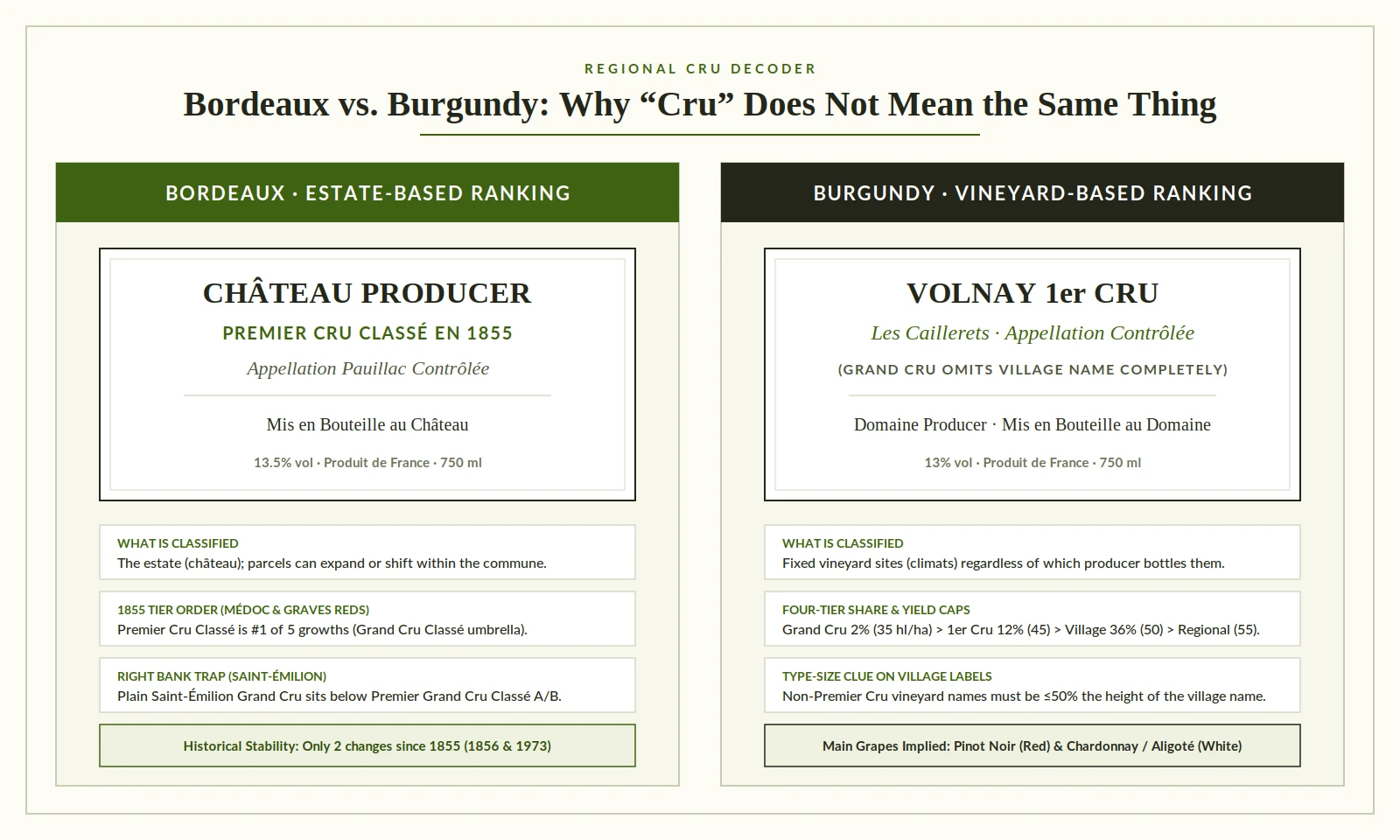
The French term cru does not represent one uniform national ladder: Bordeaux’s 1855 Classification ranks individual estates (châteaux) with Premier Cru Classé at the top of five growths, Burgundy ranks fixed vineyard plots with Grand Cru above Premier Cru, and Saint-Émilion uses plain Saint-Émilion Grand Cru below its Premier Grand Cru Classé A and B tiers.
Applying Burgundy’s vineyard logic to a Bordeaux label — or reading Saint-Émilion Grand Cru as Burgundy’s highest tier — is one of the most frequent label-reading mistakes. Comparing each regional system side by side prevents mixing up producer rankings, vineyard rankings, and appellation tiers.
| Region & System | What Is Classified | Top Tier Wording | Lower Classified or Appellation Tiers | Measured Share, Yield, or Revision Rule |
|---|---|---|---|---|
| Bordeaux 1855 (Médoc & Graves reds) | Estate (château) | Premier Cru Classé (First Growth) | Second through Fifth Growths within Grand Cru Classé; unclassified Médoc may use Cru Bourgeois | All red estates in Médoc except Château Haut-Brion in Graves; only two changes (1856 and 1973) |
| Bordeaux 1855 (Sauternes & Barsac sweet whites) | Estate (château) | Premier Cru Supérieur (Superior First Growth) | Premier Cru (2nd of 3) and Deuxième Cru (3rd of 3) | Three-tier estate hierarchy created alongside the 1855 red list |
| Saint-Émilion (Right Bank Bordeaux) | Estate (château) plus appellation tier | Premier Grand Cru Classé A and B | Grand Cru Classé, followed below by plain Saint-Émilion Grand Cru | Plain Saint-Émilion Grand Cru sits inside appellation rules below Grand Cru Classé |
| Burgundy (Côte d’Or & regional) | Fixed vineyard site (climat) | Grand Cru (vineyard name only; no village name) | Premier Cru (1er Cru), Village (42 villages), Regional AOC Bourgogne | Grand Cru 2% (35 hl/ha); 1er Cru 12% (45 hl/ha); Village 36% (50 hl/ha); Regional 55 hl/ha |
How Bordeaux’s 1855 estate ranking and Cru Bourgeois work
In Bordeaux’s 1855 Official Classification, wine brokers ranked red estates from First to Fifth Growth under the Grand Cru Classé umbrella, with every red estate drawn from the Médoc except Château Haut-Brion in Graves. Sweet white wines from Sauternes and Barsac were ranked across three levels, placing Premier Cru second beneath Premier Cru Supérieur.
Only two substantive revisions have occurred since 1855: Château Cantemerle was added as a Fifth Growth in 1856, and Château Mouton Rothschild was elevated from Second Growth to First Growth in 1973. Because the 1855 rank attaches to the château rather than immutable plot boundaries, estate vineyard holdings have expanded, shrunk, and changed parcels over time without triggering reclassification. Many of the leading Médoc estates not included in the 1855 list are classified as Cru Bourgeois, a separate Médoc system updated since 1932, declared illegal by France’s competition and fraud authority (DGCCRF) in 2007, and reinstated in 2010.
Why Saint-Émilion Grand Cru reads differently from Burgundy Grand Cru
Within France’s regional classifications recognized alongside EU traditional-term protections, Saint-Émilion places Premier Grand Cru Classé A at the top and Premier Grand Cru Classé B directly beneath it. By contrast, plain Saint-Émilion Grand Cru — without the word Classé — sits below the overall Grand Cru Classé tier and operates as an integrated appellation designation rather than the region’s highest classified estate rank. Always check whether the word Classé follows Grand Cru on a Saint-Émilion label.
How to read Burgundy’s four-tier vineyard hierarchy and font-height clue
In Burgundy, classification attaches permanently to the vineyard site rather than the winemaking estate, which puts the appellation name in the largest type and often relegates the producer name to smaller print at the bottom. Four ascending tiers govern both yield caps and label layout:
- Regional AOC Bourgogne (up to 55 hl/ha): Covers wines produced across the broader Burgundy region.
- Village appellations (36 percent of production, 50 hl/ha): Drawn from 42 designated villages; labels display the village name and sometimes an unclassified single vineyard.
- Premier Cru / 1er Cru (12 percent of production, 45 hl/ha): Classified high-quality vineyards sitting below Grand Cru and above basic Village AOCs; labels display the village name, Premier Cru (or 1er Cru), and usually the vineyard name.
- Grand Cru (2 percent of production, 35 hl/ha): Top-tier Côte d’Or vineyard sites typically built for a minimum of five to seven years of cellaring; labels print only the vineyard name as the appellation alongside Grand Cru and omit the village name completely.
Watch the typography on Burgundy village labels closely. Unless a wine comes from a Premier Cru vineyard, an individual vineyard name on a village label must be printed in characters no more than half the height of the village name.
Which French bottling phrases separate estate-grown bottles from négociant bottlings?
French bottling lines distinguish grower-bottled estates from wine merchants: Mis en bouteille au château, au domaine, or à la propriété signals estate bottling at the property or an in-appellation cooperative, whereas Mis en bouteille par, dans nos caves, or dans la région de production signals merchant, cellar, or regional-warehouse bottling.
In French wine commerce, checking who bottled the wine matters just as much as reading the front appellation. Under Commission Delegated Regulation (EU) 2019/33 and its EU protected holding-term rules, protected holding terms may be used only when the wine is made exclusively from grapes harvested in vineyards exploited by that holding and winemaking is carried out entirely on that holding. Readers comparing French holding wording with American federal estate-bottling rules can review our side-by-side breakdown of estate bottled versus single vineyard labels.
| French Bottling Phrase | Literal Meaning | Operational Custody Signaled |
|---|---|---|
| Mis en bouteille au château / au domaine / à la propriété | Bottled at the château, domain, or estate property | Estate bottled on the growing property or at a member cooperative inside the appellation boundary |
| Mis en bouteille dans nos caves / dans nos chais | Bottled in our cellars | Used by négociants or named firms bottling in their own cellars; does not confer grower estate-bottled status |
| Mis en bouteille par [Name] | Bottled by [Name] | Identifies the bottling concern, which may or may not be the producing vineyard |
| Mis en bouteille dans la région de production | Bottled in the production region | Bottled away from the vineyard at a larger firm’s warehouse in the wider winemaking region, not necessarily inside the appellation boundary |
| Bottled for (…) / Bottled for (…) by (…) | Contract bottling statement | Required when a third-party bottler packages wine on behalf of another firm |
Why Burgundy relies heavily on négociant bottling
Burgundy’s fragmented vineyard ownership makes the bottling phrase an especially sharp filter. Roughly 115 négociants produce the majority of Burgundy wine while controlling only around 8 percent of the vineyard area, purchasing grapes or wine from growers across appellations. Individual growers hold around 67 percent of the vineyard area yet produce and market only around 25 percent of the wine directly. Because négociants cannot legally use grower estate-bottled designations like Mis en bouteille au domaine, the bottling line immediately separates merchant bottlings (Mis en bouteille par or Mis en bouteille dans nos caves) from grower-estate bottlings.
Watch the half-height rule on bottler names containing an appellation
EU labeling law also polices deceptive company names on the bottler line. When the name or address of a bottler, producer, importer, or vendor consists of or contains a PDO or PGI name, Regulation (EU) 2019/33 requires that name to appear in characters no more than half the size of the PDO, PGI, or product-category designation (unless replaced by an official Member State code).
What compulsory origin, alcohol, vintage, and size rules govern a French bottle?
Under EU wine regulations, compulsory particulars — actual alcoholic strength by volume, provenance, bottler (or producer/vendor for sparkling wines), and sparkling sugar content — must appear in the same field of vision at least 1.2 mm tall, while optional vintage, single-varietal, and sub-region claims trigger strict 85 percent or 100 percent rules.
Checking these statutory numbers lets you verify compliance and understand exactly how much tolerance or blending flexibility lies behind the printed numbers on any French bottle.
| Label Element | Legal Status | Exact EU Statutory Rule or Threshold |
|---|---|---|
| Same field of vision & type height | Compulsory (Regulation (EU) No 1308/2013 Article 119) | Compulsory particulars readable simultaneously without turning the bottle; minimum character size 1.2 mm (including Article 41(1) allergen terms) |
| Actual alcoholic strength (% vol) | Compulsory (Article 119(1)(c)) | Printed in percentage units or half units; max deviation 0.5% vol from analysis (0.8% vol if PDO/PGI stored in bottle more than three years, sparkling, liqueur, or overripe-grape wine) |
| Indication of provenance | Compulsory | Identifies country of origin (e.g., Produit de France) |
| Bottler / Producer / Vendor | Compulsory | Identifies bottler (or producer/vendor for sparkling categories); contract bottling requires bottled for wording |
| Sparkling sugar content | Compulsory for sparkling | Mandatory sweetness term on sparkling, aerated sparkling, quality sparkling, and quality aromatic sparkling wines |
| Vintage year | Optional (Article 120(1)(a) & Article 49) | At least 85% of grapes must be harvested in the stated vintage year |
| Single grape variety | Optional (Article 50) | At least 85% of the wine must come from the named grape variety |
| Two or more grape varieties | Optional (Article 50) | 100% of the wine must come from the named varieties, printed in descending order and identical character size |
| Smaller geographical unit inside PDO/PGI | Optional (Article 55) | At least 85% of grapes must originate in that smaller geographical unit |
Applying alcohol tolerances and multi-varietal thresholds on real bottles
Two practical checks show how EU statutory thresholds operate when comparing bottles side by side:
- Alcohol tolerance check: On a standard young French still AOC wine, the labeled alcohol figure in whole or half percentage units cannot differ by more than 0.5% vol from laboratory analysis. For PDO or PGI wines stored in bottles for more than three years — as well as sparkling wines, liqueur wines, and wines of overripe grapes — the permitted analytical tolerance widens to 0.8% vol.
- Single vs. dual varietal check: When a French IGP or Vin de France bottle names only one grape variety such as Syrah, at least 85 percent of the wine must come from that variety. Once a bottle names two or more grape varieties — such as Syrah and Cabernet Sauvignon — 100 percent of the wine must come from those named varieties, printed in descending order of proportion and in characters of identical size.
How can you infer the grape varieties from major French regional appellations?
When a French AOC bottle omits grape names from the front label, the regional appellation tells you the authorized grape varieties: Burgundy signals Pinot noir reds and Chardonnay or Aligoté whites, Bordeaux centers on Cabernet Sauvignon and Sauvignon blanc, the Rhône highlights Syrah, and Loire sub-regions separate Sauvignon blanc, Chenin blanc, and Cabernet Franc by village.
Use this regional decoder table whenever a French label displays only a place name and Appellation Contrôlée:
| French Region or Appellation on Label | Primary Implied Grape Varieties | Key Label Clue |
|---|---|---|
| Bordeaux | Cabernet Sauvignon (red); Sauvignon blanc (white) | Château name leads; estate classifications (1855, Cru Bourgeois, Saint-Émilion) indicate rank |
| Burgundy (Bourgogne) & Chablis | Pinot noir (red); Chardonnay and Aligoté (white) | Appellation / vineyard site leads; 4-tier hierarchy from Regional to Grand Cru |
| Beaujolais (12 appellations) | Gamay | Includes Beaujolais AOC, Beaujolais-Villages AOC, and 10 named Crus (Brouilly, Regnié, Chiroubles, Cote de Brouilly, Fleurie, Saint-Amour, Chénas, Juliénas, Morgon, Moulin-a-Vent) |
| Champagne | Chardonnay (among classic regional grapes) | Sparkling sugar content is compulsory under EU law |
| Upper Loire (Sancerre AOC) | Sauvignon blanc | Village AOC name replaces varietal name on front label |
| Touraine (Vouvray AOC) | Chenin blanc | Cold-climate white wines across dry, sweet, or sparkling styles |
| Touraine (Bourgueil AOC & Chinon AOC) | Cabernet Franc | Loire red appellations printed by village name rather than grape |
| Rhône Valley | Syrah (signature regional variety) | Broad regional Côtes du Rhône AOC contrasts with tiny single-site AOCs like Château-Grillet |
| Alsace | Front-label varietal naming tradition | Historical French exception where the grape variety appears directly on the front label |
How can you verify any French wine label in five quick checks?
Moving from geographical tier down to fine-print custody and statutory compliance lets you read any French bottle systematically without hunting for grape words first.
- Locate the quality tier line: Check whether the bottle states Appellation [Place] Contrôlée or Protégée (AOC/AOP), Indication Géographique Protégée / Vin de Pays (IGP), or Vin de France.
- Read the place name between Appellation and Contrôlée: Identify whether the geography is broad (regional), narrower (village or commune), or site-specific (single vineyard), and map that region to its signature grape varieties.
- Decode any cru wording by region — never interchangeably: Confirm whether the bottle is from Bordeaux (estate-ranked 1855 growths, Cru Bourgeois, or Saint-Émilion where Classé separates top tiers from plain Grand Cru) or Burgundy (vineyard-ranked Grand Cru omitting the village name, Premier Cru / 1er Cru, or a Village label where non-Premier Cru vineyard print cannot exceed half the village-name height).
- Check the bottling custody line: Distinguish estate bottling (Mis en bouteille au château, au domaine, or à la propriété) from merchant or regional warehouse bottling (Mis en bouteille par, dans nos caves, or dans la région de production), and spot any contract-bottling bottled for phrasing.
- Scan the compulsory EU field-of-vision block: Verify actual alcoholic strength in whole or half percentage units (% vol), country provenance, bottler or sparkling producer/vendor details, sparkling sugar content if applicable, and any optional vintage year or varietal listing governed by the 85 percent and 100 percent rules.
For related deep dives on bottle packaging, appellation thresholds, and bottling-line disclosures, browse our full Labels and Filling archive.